History
In Loreto stands the Holy House (Santa Casa). This house of the Holy Family once stood in Nazareth. Archaeological excavations, carried out between 1962 and 1965, have uncovered wall paintings of Palestinian (Jewish-Christian) origin, and it is largely due to these findings that it is assumed the Santa Casa comes from Nazareth. Inside the Holy House, remains of Gothic wall paintings have been preserved. In Nazareth, Mary lived in a small house, built from red natural stone. Joseph and Jesus also knew this house as their home.
Towards the end of the 13th century, the house's existence was severely threatened by advancing and destructive Muslims. Legend has it that angels came to the house's aid. This was in 1291. In that year, angels lifted the small building, and after a phased aerial journey, it ended up in Loreto. This occurred on 10th December 1294.
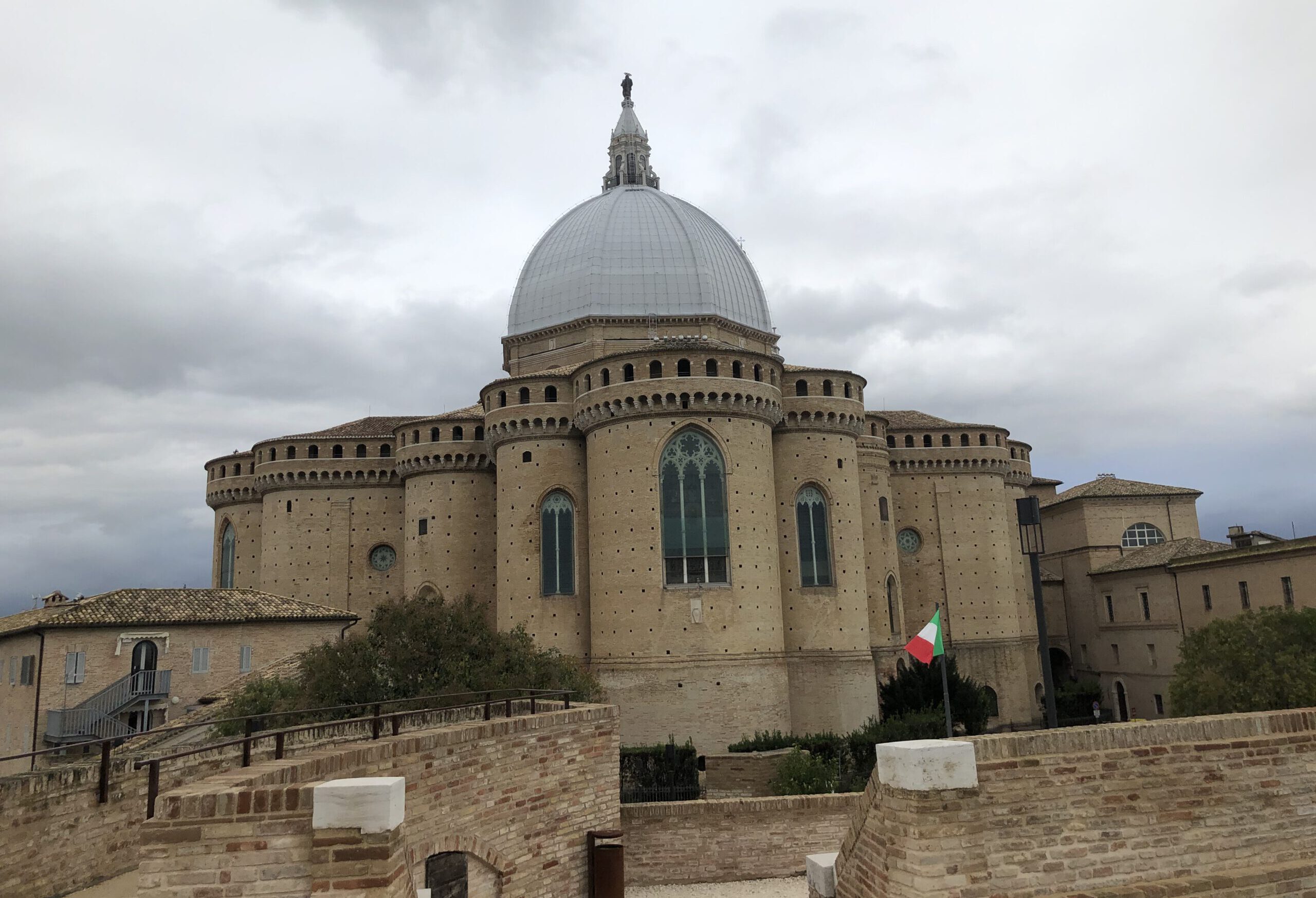
Construction of a church over the Holy House began in 1469 and, over 100 years later in 1587, the place of worship was completed. Architects of the fortified basilica include Giuliano da Maiano (1432-1490), Francesco di Giorgio Martini (1439-1501), Baccio Pontelli (1449-1494) and Antonio di Sangallo the Younger (1484-1546). The basilica's façade displays the Renaissance style with a design from 1571 by Giovanni Boccalini (1520-1580). The sanctuary's portal features bronze doors. The central portal was created in 1590 by Girolamo Lombardo/Lombardi/da Ferrare (c.1506-c.1589).
In 1728, the church was made a basilica: “Basilica della Casa Santa”. From that year, millions of pilgrims have come to the Holy House in the basilica. The Holy House has three stone walls from the house of the Virgin Mary from Nazareth. Here, Mary was born, lived, and the Archangel Gabriel visited her to tell Mary of her future.
The marble walls around the Holy House date from 1509-1578. The marble cladding of the Holy House was commissioned by Julius II, Pope from 1503 to 1513, born Giuliano della Rovere (1443-1513). The design is by Donato Bramante (1444-1514), an architect and painter. Many artists contributed to its creation, including much work by the architect-sculptor Andrea Sansovino (1467-1529), the sculptor Francesco da Sangallo (1484-1576), the architect Antonio da Sangallo the Younger (1484-1546), the architect-sculptor Raffaello da Montelupo (1504-1566), the sculptor Baccio/Bartolomeo Bandinelli (1493-1560), and the architect-sculptor Niccolò Tribolo (c. 1485-c. 1550). The walls display 9 bas-reliefs depicting stages from the life of Mary, prophets, and prophetesses.

The clock tower is a design by architect-painter Luigi Vanvitelli (1700-1773) and was built in 1751-1754.
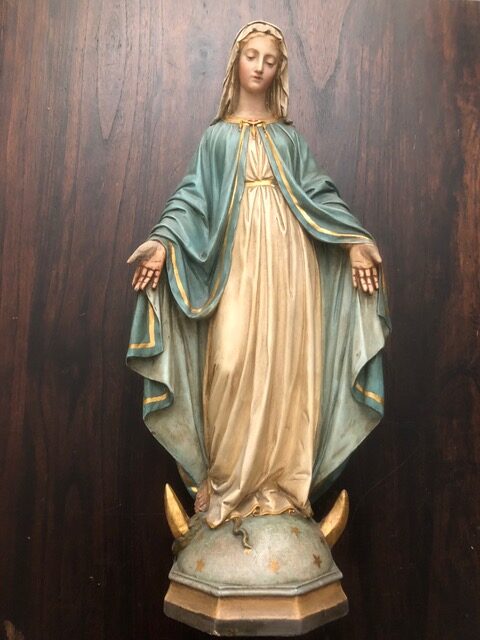
In Loreto, many miracles have occurred, such as miraculous healings. A great miracle was the victory in the naval battle of Lepanto on 7 October 1571. The fame of the Shrine of Loreto increased further with the compilation of the Litany of Loreto. Mary of Loreto is given the title “Virgo Lauretana”; Virgin Mary of Loreto.
The annual feast day of Our Lady of Loreto is 10 December.
Pilgrimage site
Loreto belongs to the province of Ancona, lies around 125 metres above sea level and has a population of over 10,000. The Sanctuary of Loreto shows the need for military defence and the Renaissance style is strongly present.
In the square in front of the basilica is the 17th-century Fountain of Our Lady, a design by architect Carlo Maderno (1556-1629) and his uncle Giovanni Fontana (1540-1614).
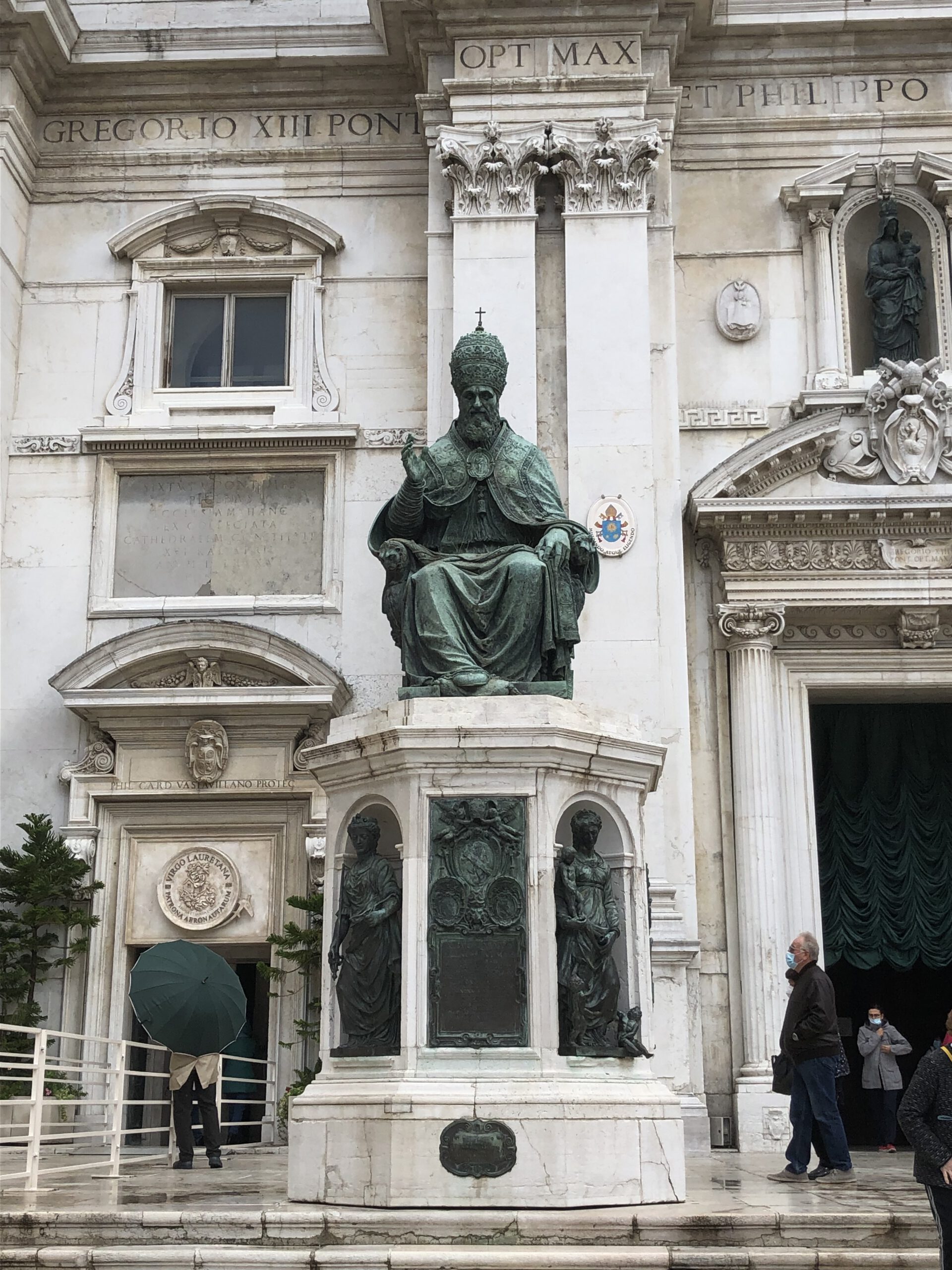
Between the fountain and the basilica stands the bronze statue of Sixtus V, Pope 1585-1590 and born as Felice Peretti da Montalto (1521-1590). This church father is seen as the main patron of the sanctuary. The statue was made in 1587 by Antonio di Bernardino Calcagni/Antonio Calcagni (1536-1593).
The basilica is spacious with dimensions of 93 metres in length and 60 metres in width. There are 12 tall pillars inside the building.
The basilica features a richly decorated facade and an impressive dome with a bell tower. The Holy House stands beneath the basilica's dome and has a marble cladding, which surrounds the entire house. The architect of many of the works is Bramante of Urbino (1444-1514). The white marble blocks come from Carrara in Tuscany, Italy.
The Holy House is made of stone and brick. In this house, the “Word became flesh”, Mary lived and became pregnant. In the Holy House, the Black Madonna is dressed in an impressive ceremonial robe, and both the Mother and the Child are crowned.
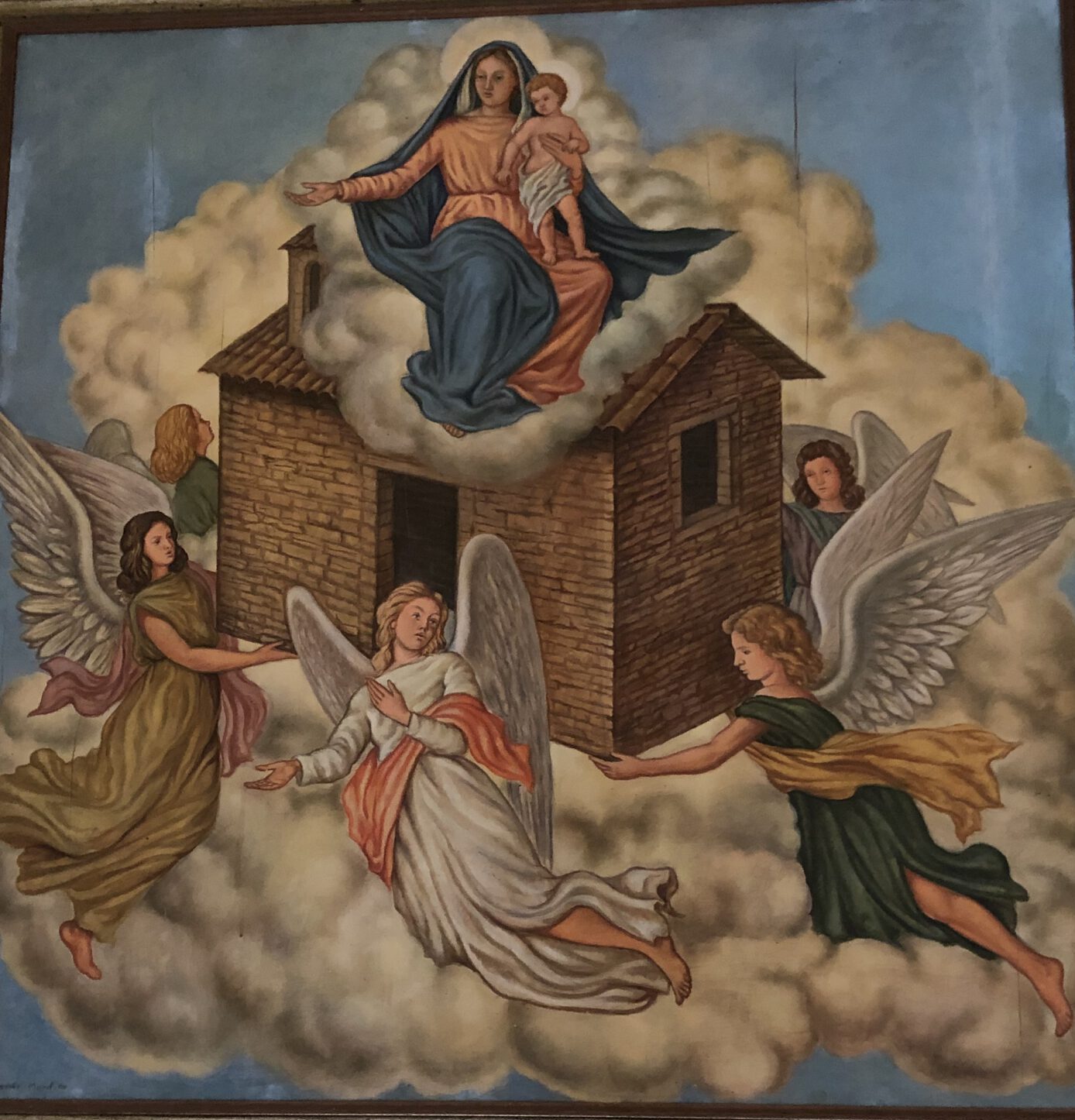
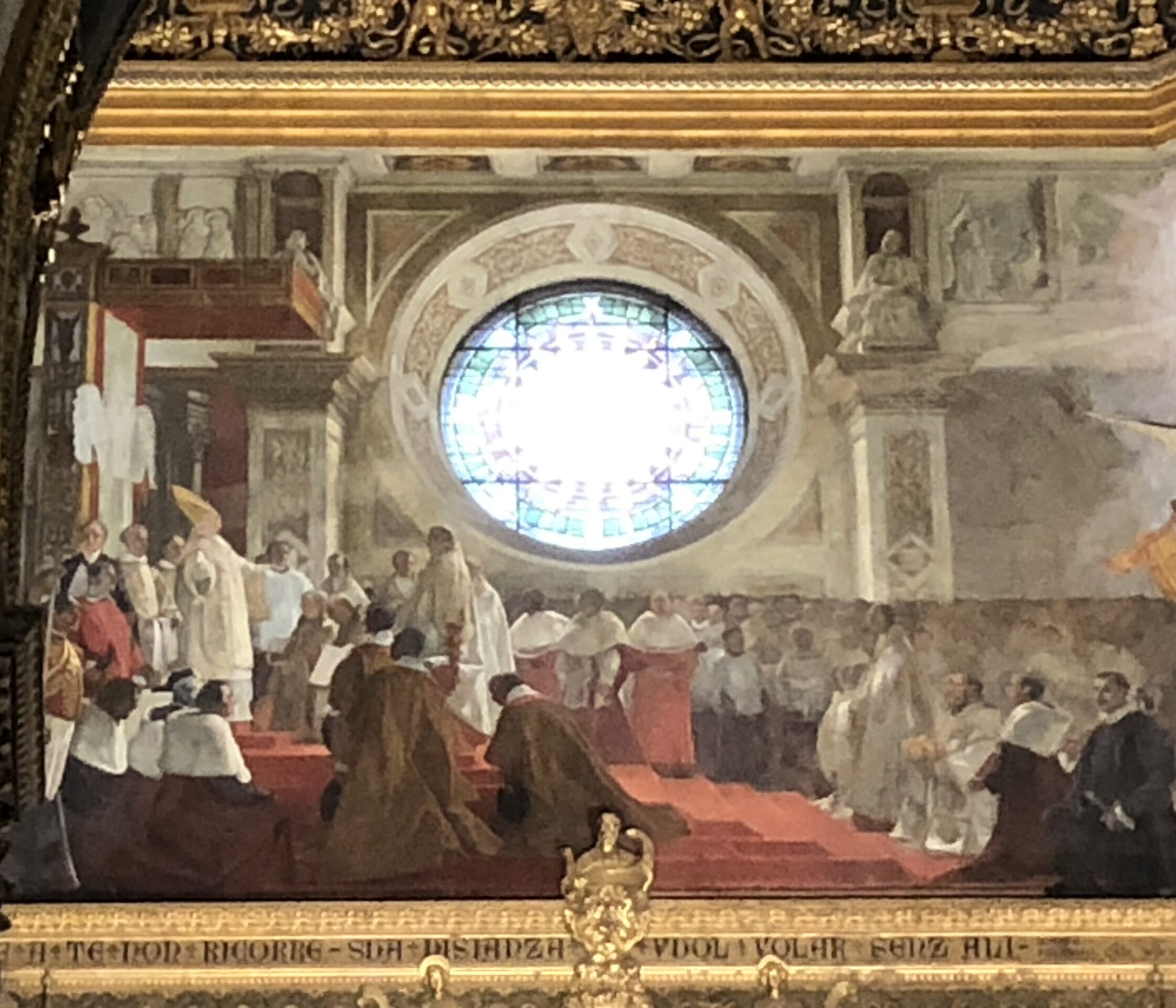
In the basilica, there are many chapels, including the Chapel of the Immaculate Conception of Mary with a mosaic and a mosaic of the Marriage of Mary in the Mexican Chapel. In the Chapel of the Dukes of Urbino, dating from 1584, there is a mosaic altarpiece of the Annunciation by the Archangel to Mary and frescoes from 1585 depicting the Marriage of Mary, the Visitation, the Assumption and the Coronation of Mary, created by Federico Zuccari/Zuccaro/Zucchero (1540-1609). In the German Chapel, frescoes depicting scenes from the life of Mary were added between 1892 and 1908 by Ludwig/Ludovico Seitz (1844-1908). The American Chapel, also called the Chapel of the Assumption, also features frescoes of Mary.
Our Lady of Loreto is the patron saint of aviators, pilots, astronauts, and air travellers. This is due to the legend of the house being moved through the air by angels. An aviation museum can therefore be visited in the centre of Loreto.
Near the basilica stand the buildings of the Apostolic Palace, including a museum with many ancient treasures of the Holy House, the “Museo Pontificio Santa Casa”. Here are paintings by renowned artists, such as Lorenzo Lotto (1480-1556), who died in Loreto, with the Adoration of the Newborn (1549) and the Adoration of the Magi (1554). From Angiolillo Arcuccio (1440-1492) is the artwork "Mother and Child". Also present is "The Annunciation" by Antonio da Faenza (1456-1534). Several paintings depict the transport of the Holy House, such as those by Francesco Foschi (1710-1780), Francesco Menzocchi (1502-1584), and Mariano Fortuny (1871-1949). Furthermore, the museum displays tapestries from Brussels (made between 1620-1624), prestigious vases from a former pharmacy, pottery, jewellery, and more.
ACCESSIBILITY
Loreto is located near the large port city of Ancona, in the east of the country and roughly halfway down the “Boot of Italy”. The sanctuary, situated slightly higher up, can be seen from afar.
Up-to-date information can be found at www.santuarioloreto.va.
Experience

It’s busy on the Piazza della Madonna, the Square of the Mother of God, which lies in front of the basilica. There are so many pilgrims here, wanting to visit the House of Mary. Slowly I approach the basilica.
In the basilica, the Holy House is central. In the middle of the basilica, with a view of the Holy House, I experience the beauty of the marble casing. It seems as though the marble monument has just descended from heaven.
The Holy House bears traces of then and now. I look at this building with awe. I stand before it, look up and feel that above the Holy House, clouds full of prayer hang. I experience that the house is indestructible. It continues to give strength to those who come here for shelter. Then I go into the house... Here Mary lived, Jesus played and Joseph worked, and now I may stand here. I see so much and feel extremely privileged.
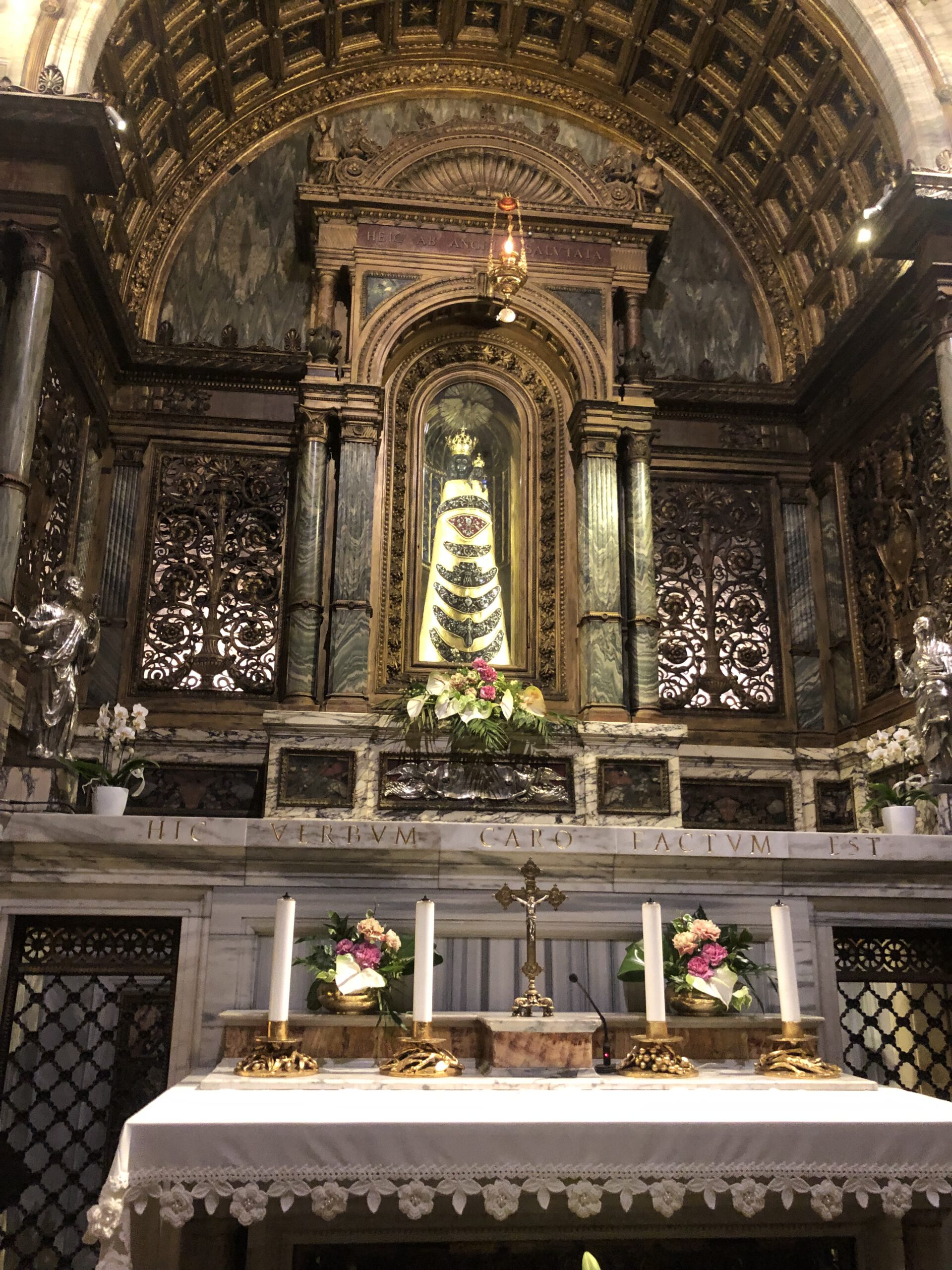
After visiting the Holy House, I take a tour of the basilica. The many chapels are striking, including the German, Spanish, and Polish chapels.
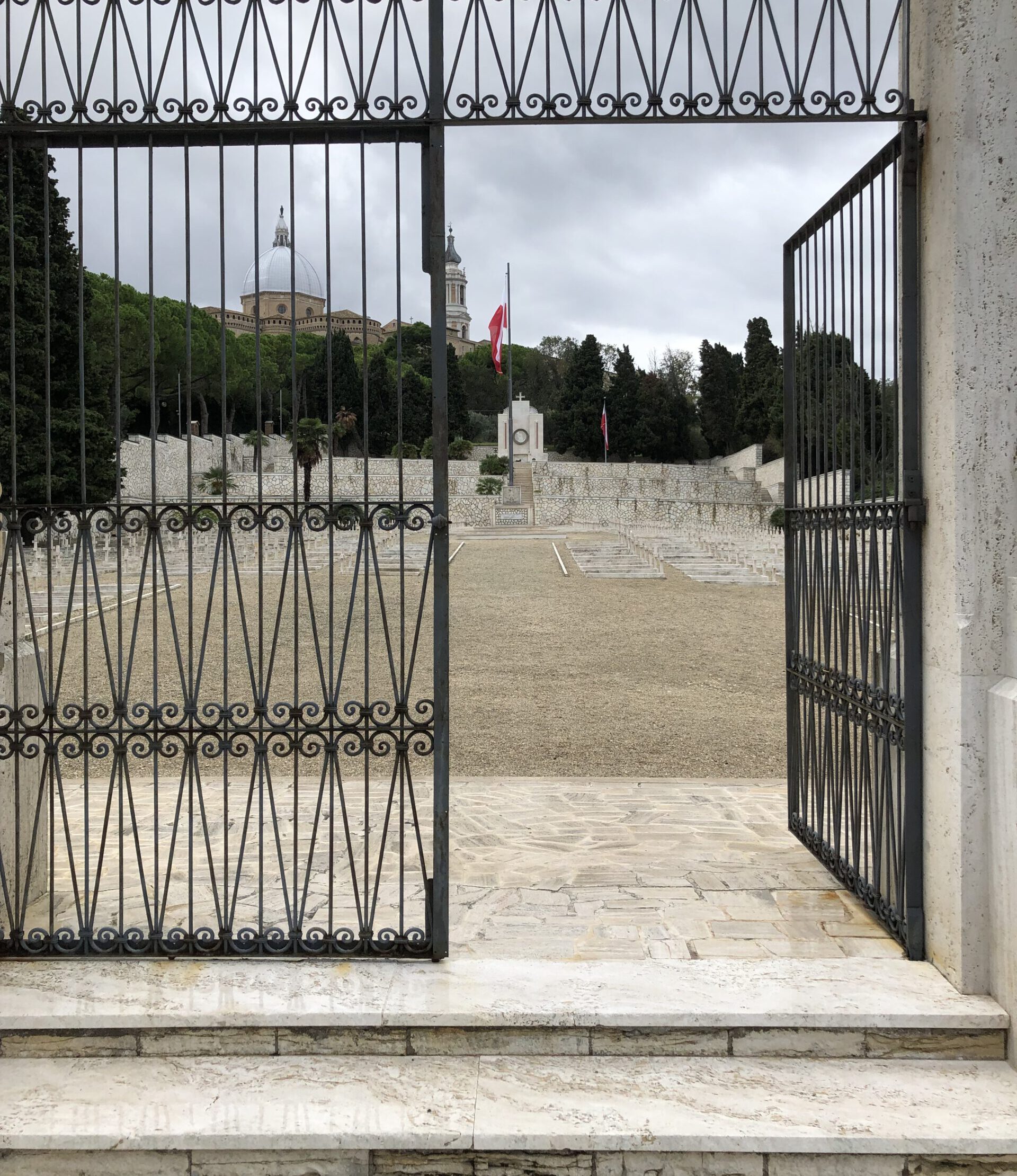
Later in the day, I'll visit the Polish cemetery (Cimitero Polacco), which is located behind the sanctuary.
I have visited Loreto many times and each time I am happy to be able to come here. To see the Holy House of Mary always reminds me of the time when She often stayed within these walls. To be allowed to stand here now is a great gift on Earth. When I am in the Holy House and have Mary in my thoughts, I become quiet and pray to Her. How did She experience being in this house? What went through Her mind here? Now I stand in the house where the Mother of God lived. Is this a foretaste of eternity?
Loreto is the Italian pilgrimage site that I like to visit and revisit.
In autumn 2025, I will be visiting Loreto for the fifth time. I am always deeply impressed by the Holy House of Mary. It feels so special to be in Mary's home.
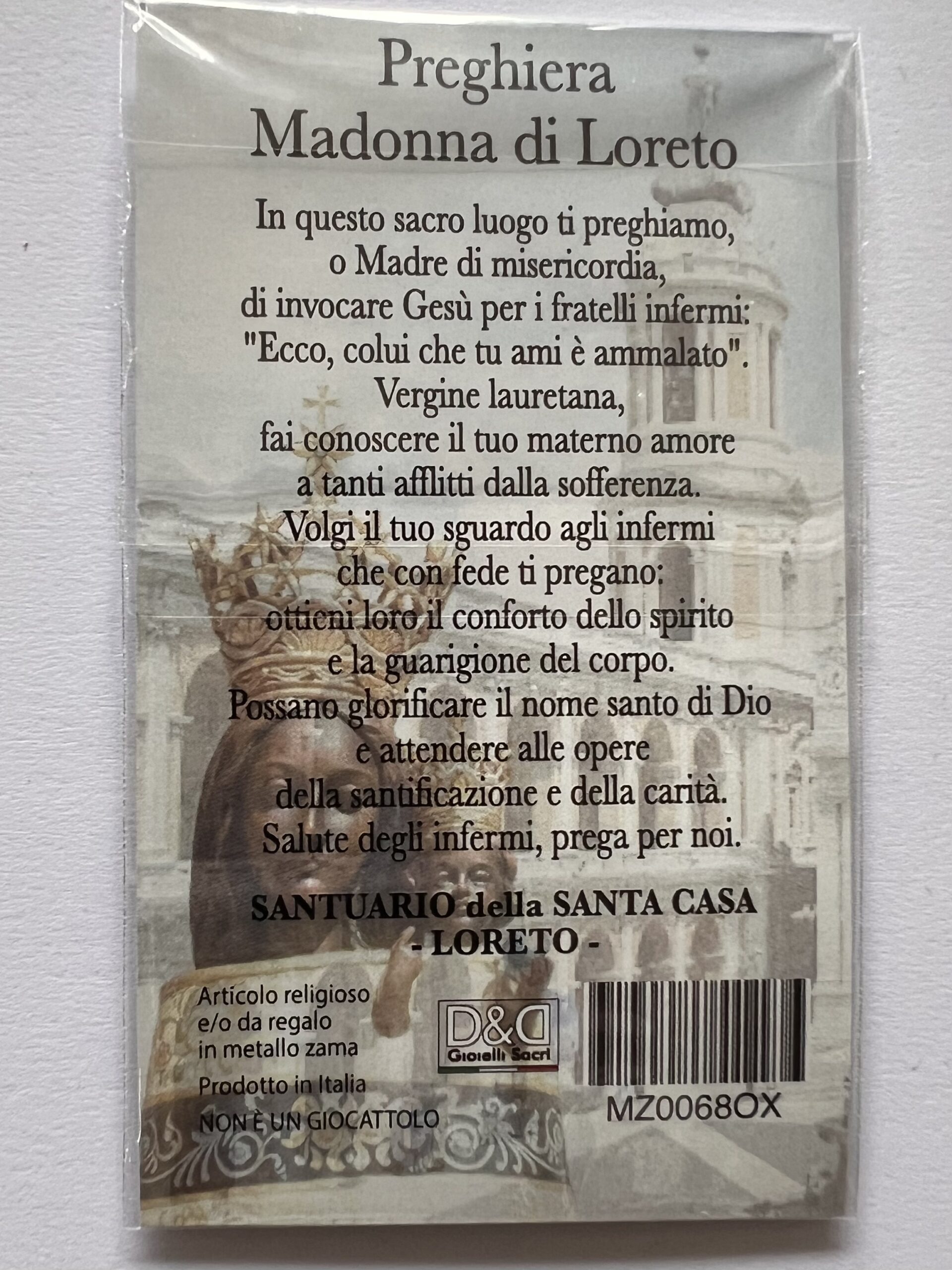
In the religious articles shop I see a medallion with an image of the basilica on one side and on the other side a prayer in Italian with a print of the miraculous image. I translate the prayer into Dutch and get the following text:
“Prayer to Our Lady of Loreto.
On this holy site, we pray to You, O Mother of Mercy, to invoke Jesus for our sick brothers and sisters: “Behold, he whom You love is ill”. Virgin of Loreto, make Your motherly love known to so many who are afflicted by suffering.
Turn your gaze to the sick, who pray to You with faith: obtain for them spiritual comfort and bodily healing.
May they glorify the holy name of God and devote themselves to works of holiness and charity.
Health of the sick, pray for us.
Sanctuary of the Holy House of Loreto.”
Environment
In Loreto, there is also a museum with a great deal of aviation history, the “Museo Storico Aereonautico di Loreto”. Hundreds of donated uniforms are on display. This museum is located in Loreto because the Virgin Mary is the patron saint of pilots. A plane has also been placed near the sanctuary.
Travelling from the port city of Ancona to Loreto is a 34 km journey south.
The distance from Pescara to Loreto is 140 km going north.
Leaving the pilgrimage site in Assisi and arriving in Loreto requires travelling approximately 140 km to the northeast.
Travelling from Corinaldo, the birthplace of Saint Maria Goretti (1890-1902), to Loreto is to go 75 km southeast.
~~~

 Nederlands
  English (UK)
  Deutsch
  Français