~~~
History
The town of Cherasco was founded in 1243 and over the centuries has grown into a place of pilgrimage to Mary.
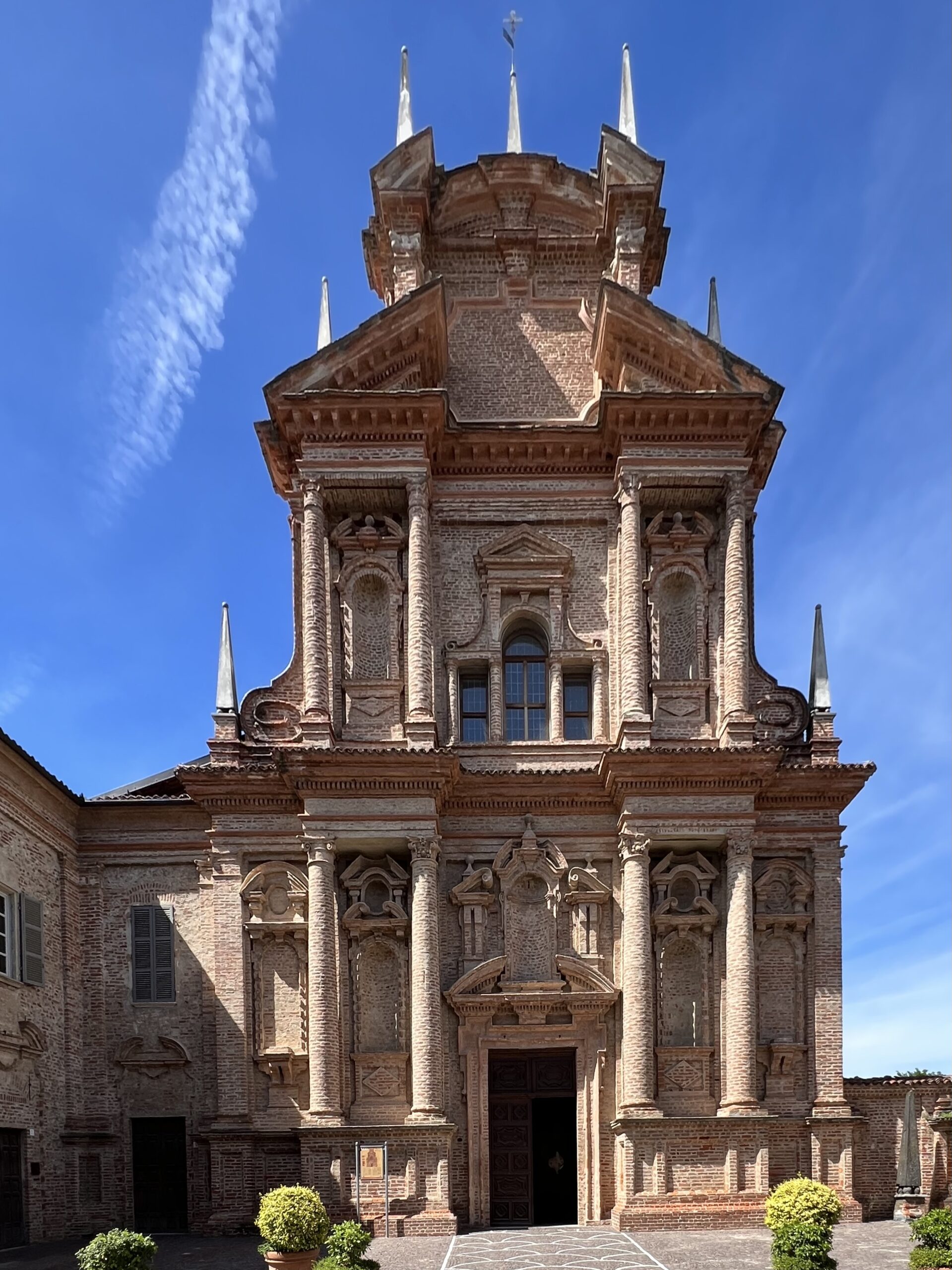
The design of the Church of Our Lady of the People is by architect and painter Sebastiano Taricco (c. 1641-1710). This church was completed in 1702 and is full of artworks. Over the years, many special works have been added to the building, such as in the choir of John the Evangelist and Joseph. Frescoes are found above the entrance and above the high altar, among other places. Sculpted benches are also in the church. Works by painter Pietro Giuseppe Metey (1728-1765) have been placed in the house of worship, as well as canvases by Giovanni Claret (1599-1679) and Pietro Paolo Operti (1704-1793).
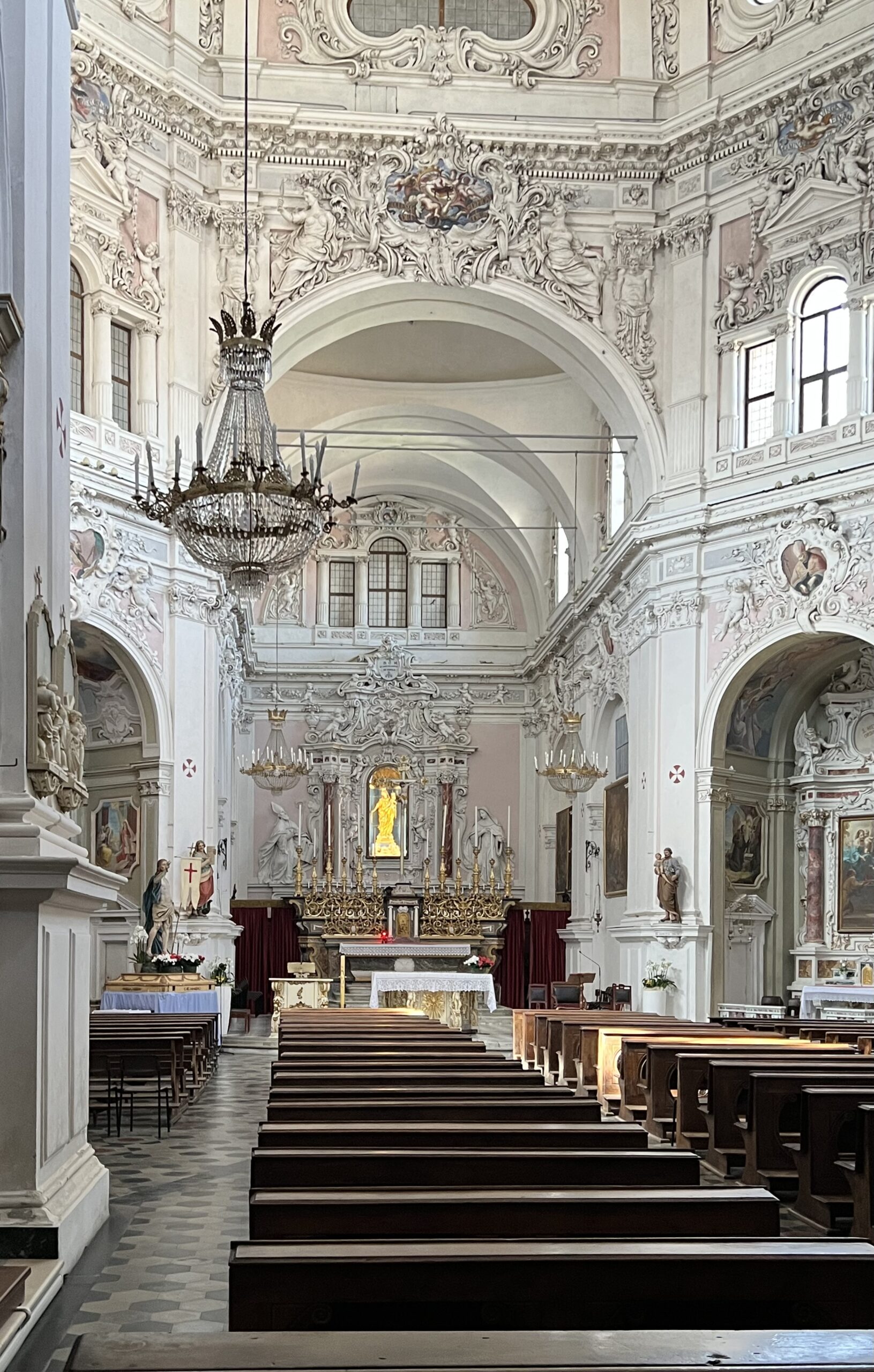
In 1988 the church was consecrated as a shrine to Mary. It is a pilgrimage site for pilgrims from all over Italy and beyond.
Pilgrimage site
The town of Cherasco is known for Barolo wine, Robiola soft cheese, honey, chocolate, and two pilgrimage churches.
The pilgrimage church “Madonna del Popolo” is one of the largest sanctuaries in Piedmont.
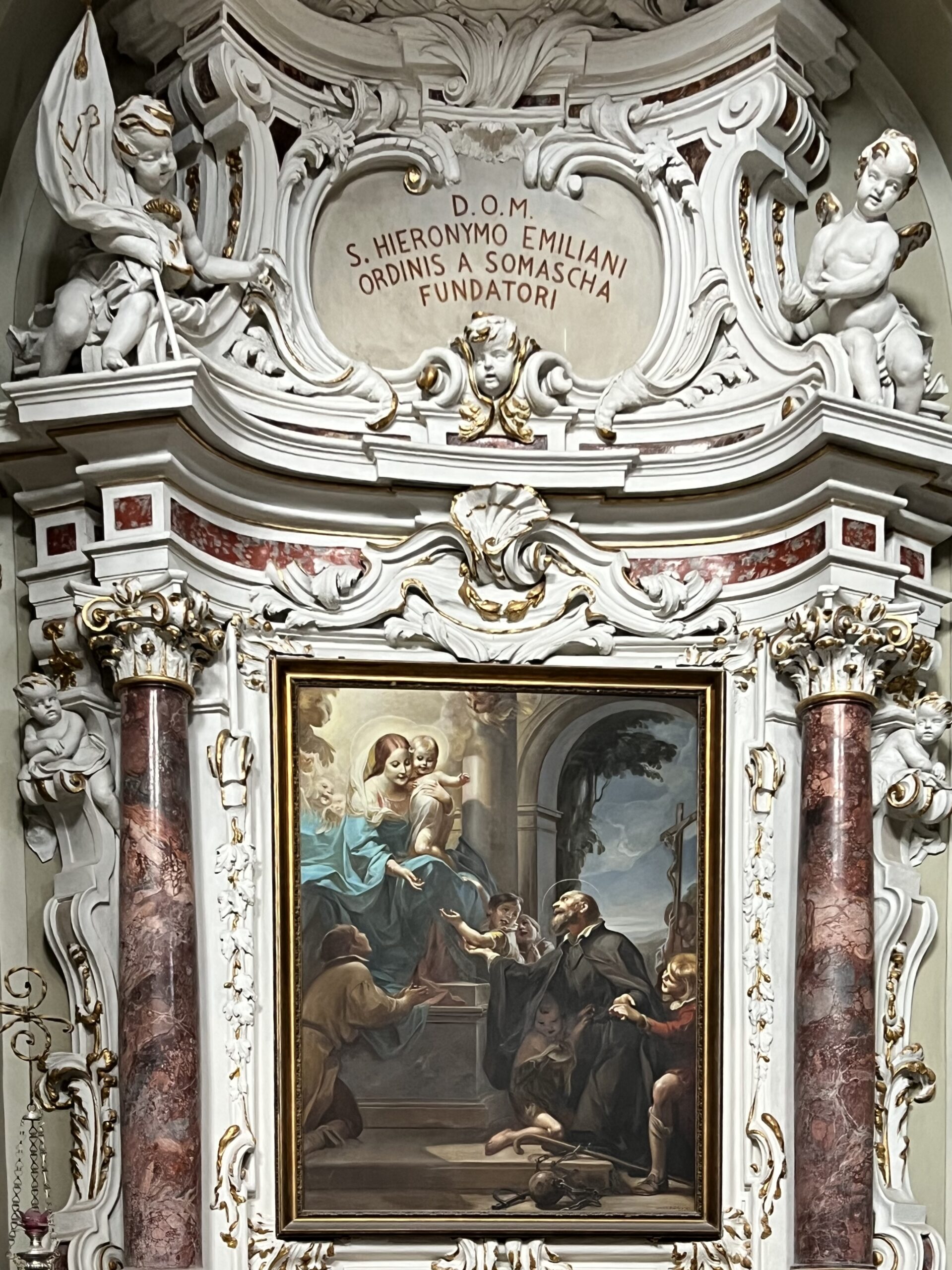
The church displays a rich collection of artworks. Large paintings are hung on the high walls, and Mary is therefore always depicted at a height. In one painting, she is with nuns and small children. Another artwork shows visitors with the newborn Jesus, bringing gifts, including two hens. A painting depicts the Three Wise Men visiting, with Mary holding her Son here as well. Another artwork shows Mary handing the rosary to Saint Jerome Emiliani (1481-1537), the founder of the Somascan Order in 1532. Above it is D.O.M., which stands for Deo Optimo Maximo (“dedicated to God, the best and highest”). The miraculous image is golden and stands in the centre of the chancel.
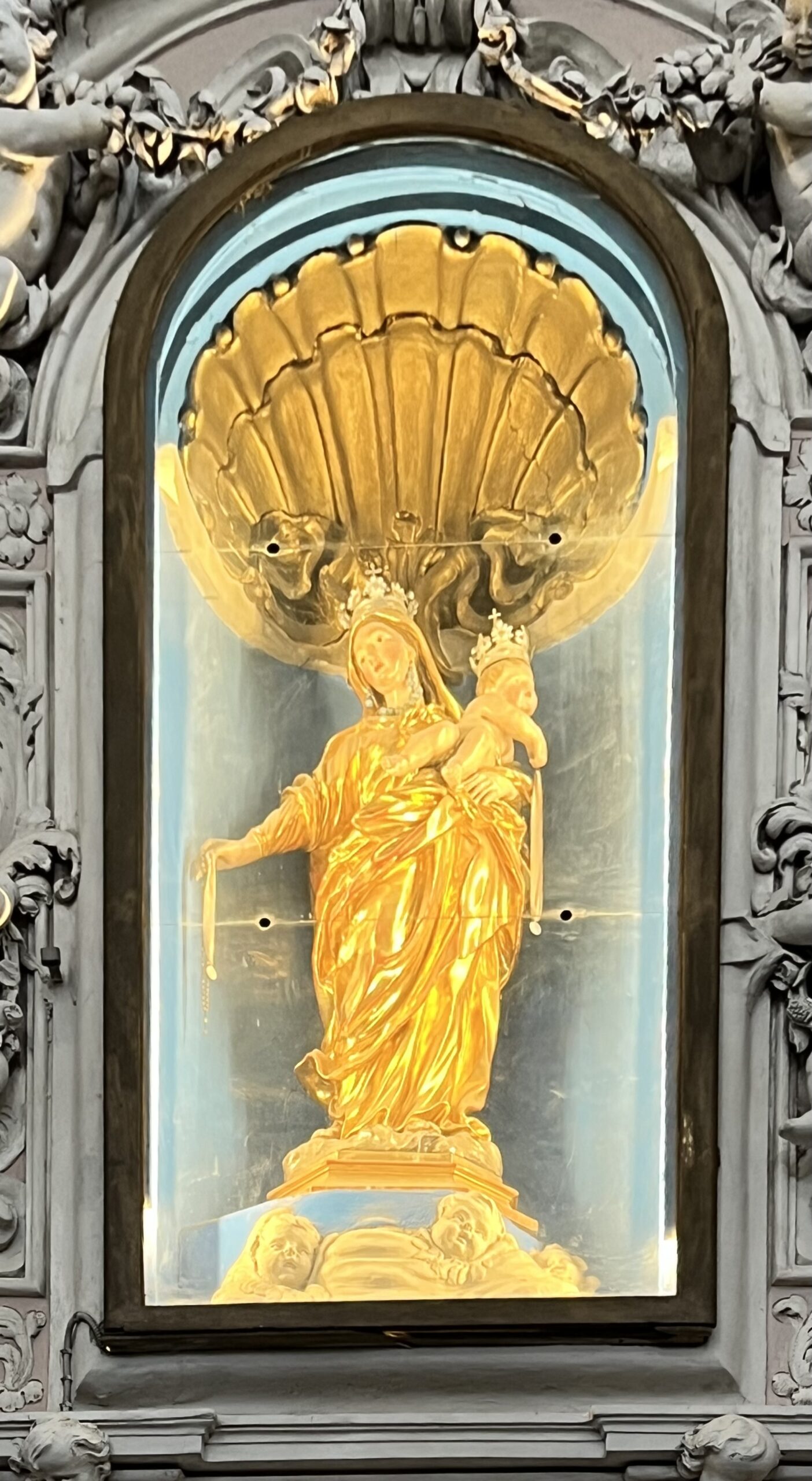
There is also a painting depicting the French, Catholic nun, Saint Jeanne-Antide Thouret (Giovanna Antida Thouret, 1765-1826), the founder of the Institute of the Sisters of Charity, with an old man and two children beside her.
Diagonally behind the Church of Our Lady of the People stands another pilgrimage church, located in Piazza Nicola Vercellone. The square is named after the church's architect. This church was built between 1762 and 1764, next to an old 13th-century pillar. The church is part of the shrine “Santuario Madonna delle Grazie” (Our Lady of Graces). The devotional image is a fresco and depicts Mary with Child and Saint John. Mary is holding a transparent veil wrapped around her Son. Mary has strikingly long, thin fingers and wears a necklace. Mary's cloak is green and she has some rouge on her cheeks. The devotional image is called “Madonnina,” which means a small image of Mary, hence a little Madonna. Within this church, there is another likeness of Mary and two paintings in each corner. The church displays artworks by Sebastiano Taricco (c. 1641-1710) and Pietro Paolo Operti (1704-1793). The church houses 125 ex-votos from two centuries (1726-1927). Above the presbytery with the devotional image is inscribed “IN ME GRATIA OMNIS ECCE XXIV,” which in Latin translates to “All grace is in me.”.
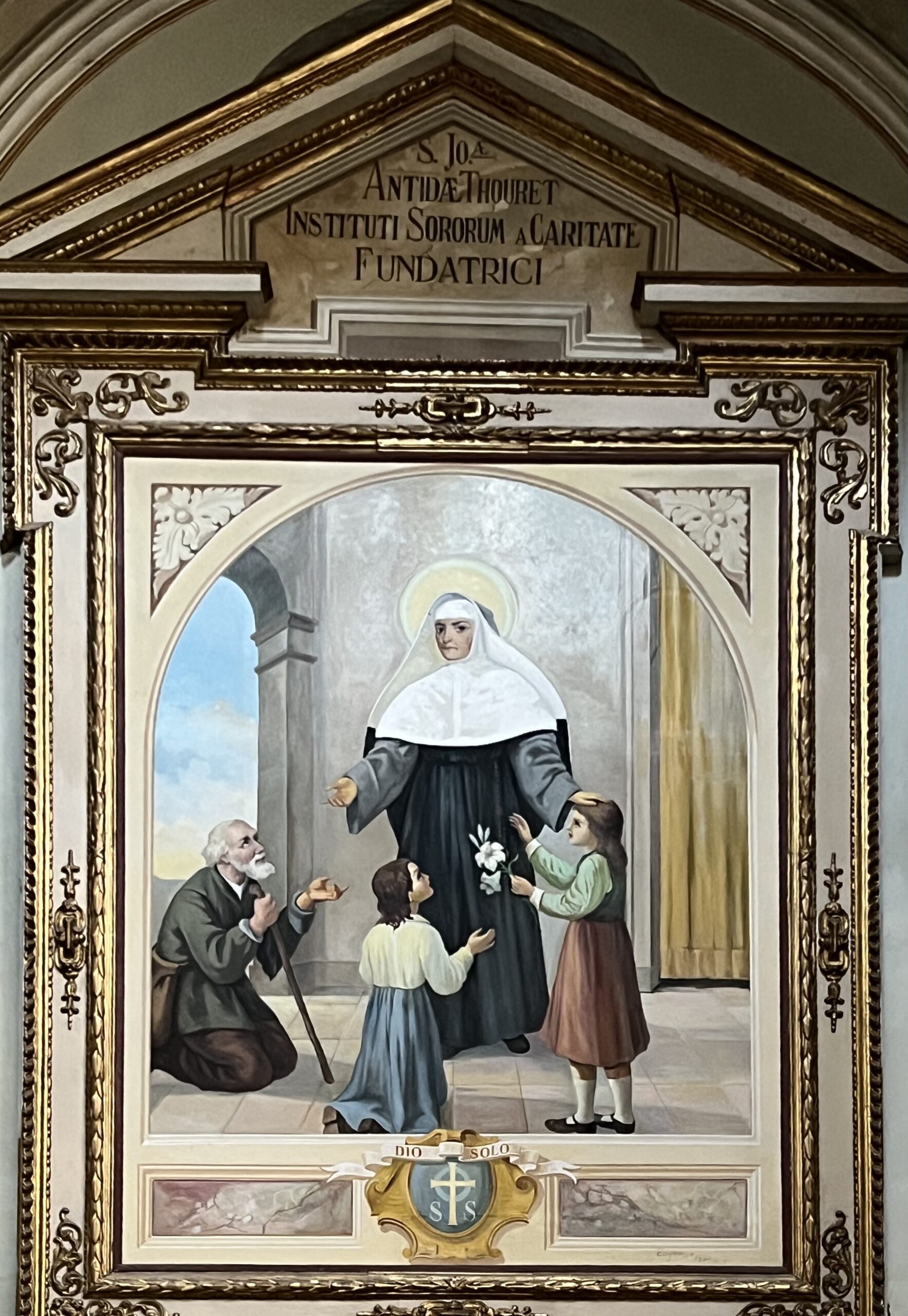
In front of the church stands a tall pillar with the letter “M” at the top. At the bottom, it states that Our Lady of the Rosary is the patron saint of the town. “Per voto del populo fatto il 22-10-1944” (“by a vote of the people made on 22-10-1944”) is written there. This date refers to the end of the Second World War (1939-1945) in this region.
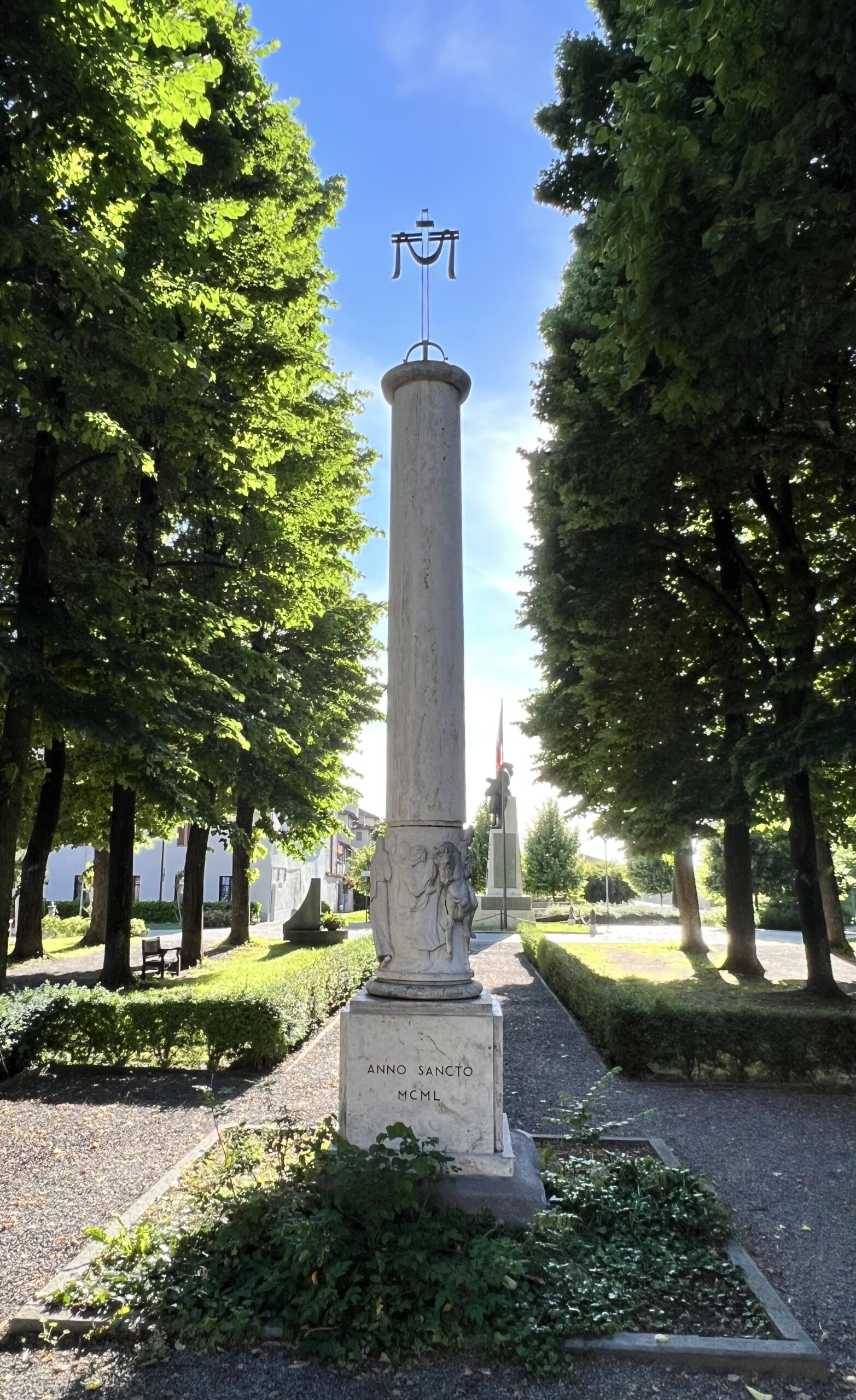
Between the two pilgrimage churches lies a “Giardino della Madonna” (“Garden of Our Lady”) and the ancient garden of the Somanchi fathers. This old garden has been redeveloped and now features edible and ornamental flowers and plants. This space is also suitable for contemplation.
ACCESSIBILITY
Cherasco has a population of around 10,000, belongs to the province of Cuneo and is located in the Piedmont region, in north-western Italy.
The pilgrimage site “Santuario Madonna del Popolo” is located at Via Nostra Signora del Popolo, 12062 Cherasco.
The pilgrimage church “Madonna delle Grazie” is located at Piazza Nicola Vercellone, 12062 Cherasco.
Experience
While looking for a hotel room, I find myself in Cherasco. There I find a place to sleep and take a walk through the town centre. Suddenly, there's an extraordinary encounter as I stand before the church of a sanctuary. I hadn't expected to meet Mary here! The “Santuario Madonna del Popolo” (Sanctuary of Our Lady of the People) is a welcome gift.
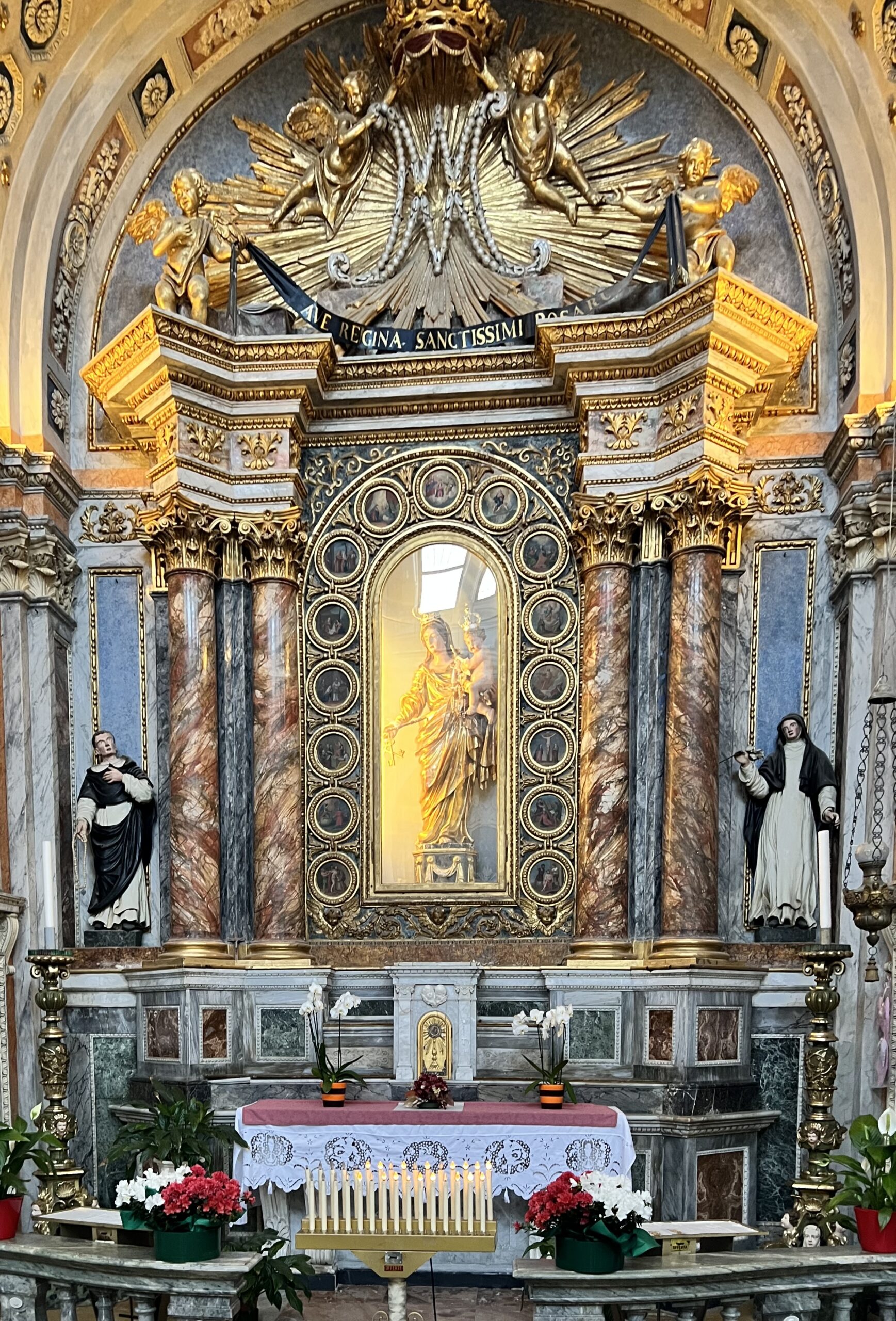
A large facade with some large, empty niches makes me curious. Statues must have stood here once, which have now disappeared. Then it is time to go inside and I am received into a clear beauty! As bare as the facade is, so very different it is in here. All the walls, up to the high dome, are decorated. The devotional image stands in a niche, behind glass, above the altar. Mary and Child are depicted in gold and both wear a crown. Putti hover around this image and beneath the devotional image, two small angel heads can be seen.
In the church hang many large paintings, depicting Mary with children, nuns, the Three Wise Men, and saints, among others. In front of the altar lies a stone with the year 1896.
In the chapel, the icon of grace is on display again, and this time it's behind glass, surrounded by 15 circular images from the life of Mary. It feels so good to see Mary here so often!
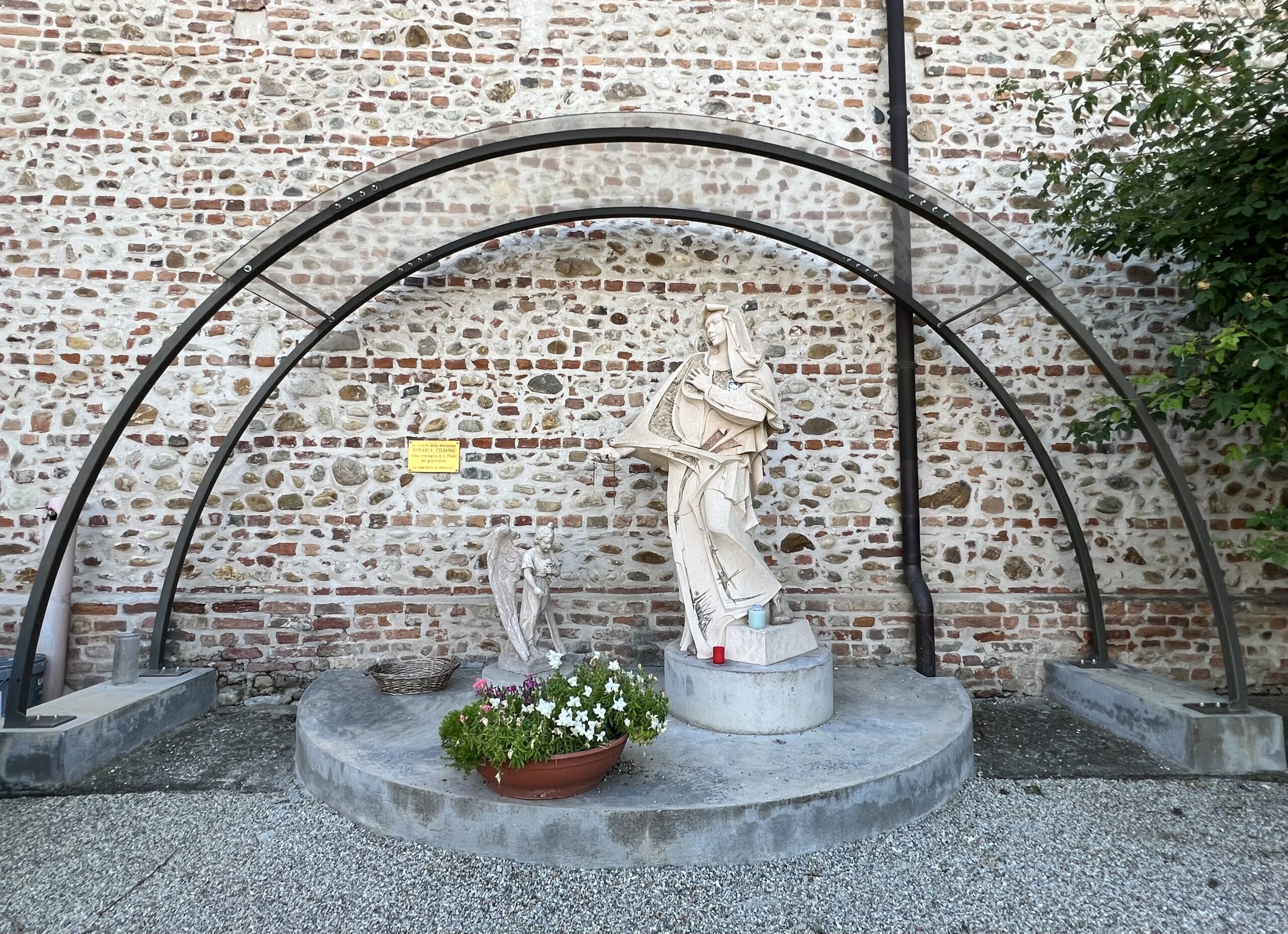
Next to the basilica is a garden, which I'm also visiting. There's a modern statue of Mary with a small angel on the ground, created by sculptor Rosario Ciliano (1947).
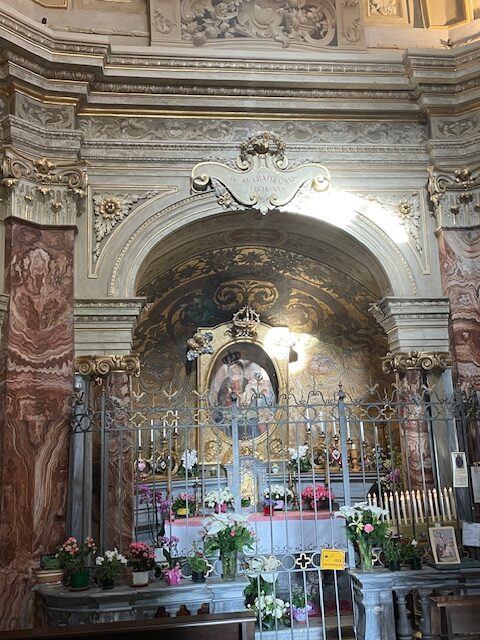
A little over a hundred metres further on is another church, and this too is a sanctuary. I am standing in front of the church of the “Santuario Madonna delle Grazie” (“Our Lady of Graces”). Upon entering, I read on a stone “Viva Maria 1878”. It is a small church and also a pilgrimage site of Mary. In the sanctuary, a painting of Our Lady of Graces hangs. This old image is venerated here. I see that Mary and Child are crowned here as well. Jesus looks at his Mother, who has her gaze fixed on an offered orb. The infant Jesus reaches for this orb. To the right stands an angel.
At the back of the church, I see a prayer card lying there. The image of the miraculous image is on the front and on the back is a prayer by St. Bernard in Italian. When I translate the text into Dutch, it says:
“Prayer to Our Lady of Grace.
Remember, most pious Virgin Mary,
that it has never happened in the world before,
that someone has taken refuge in your protection,
who has begged for your help,
you have requested protection and
If you have been abandoned.
Inspired by this trust,
I turn to you, O Mother,
Maid of Maidens,
I come to You, and, sinful as I am,
I lay myself down at your feet to
to ask for grace.
O Mother of the Divine Word,
do not scorn my prayers,
But listen to it graciously
and question them. Amen.”
This church of the “Madonna delle Grazie” strikes me as one of the most intimate places of worship I have had the privilege to visit. What a space full of feeling and devotion!
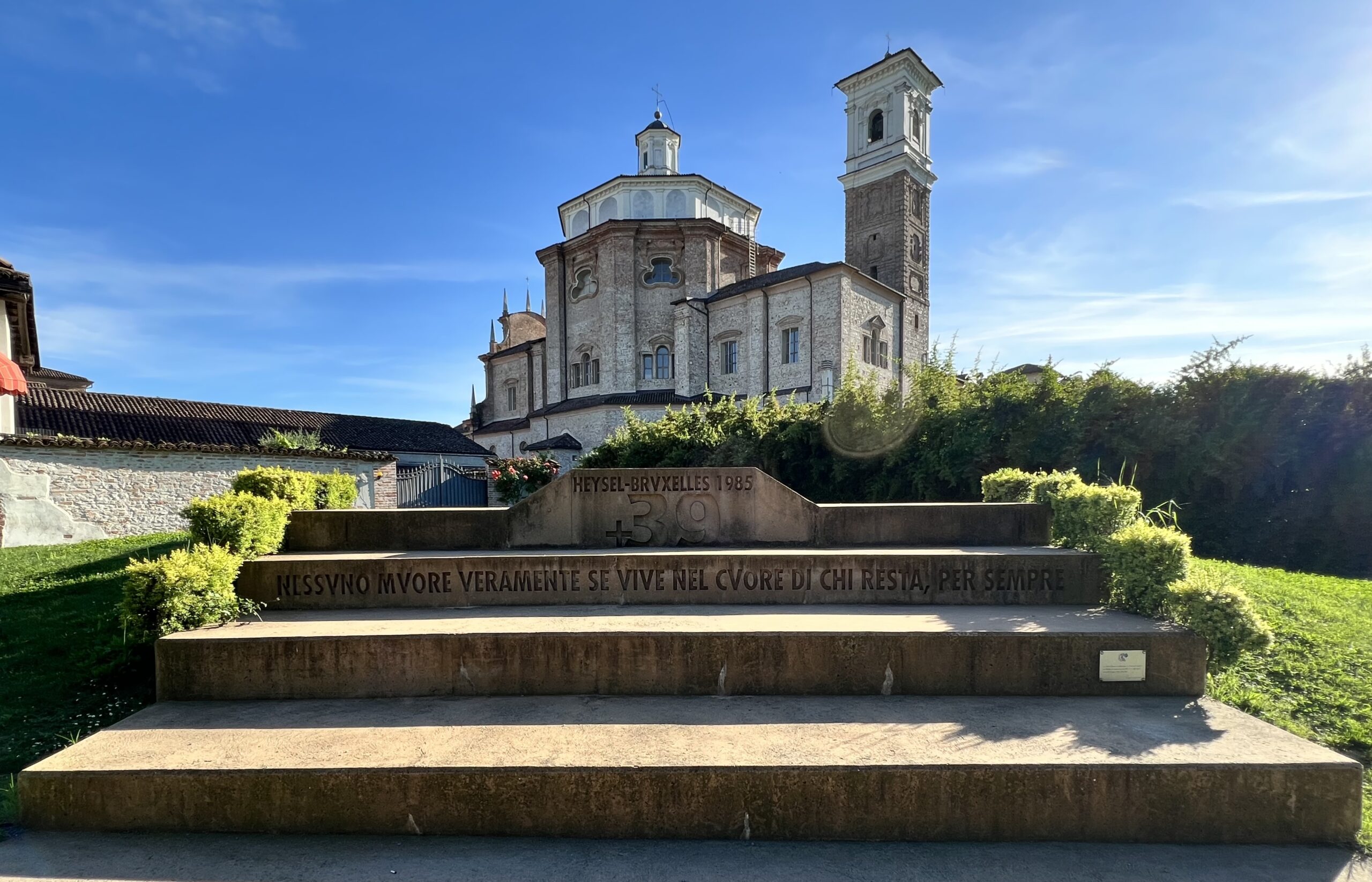
In the garden between the two pilgrimage churches stands a monument to “Heysel – Brussels 1985” with the inscription “nessuno muore veramente se vive nel cuore di chi resta, per sempre. In Dutch, this means “no one truly dies if they live in the hearts of those who remain, forever”. This refers to the Heysel Stadium disaster on 29 May 1985 at the Heysel Stadium in Brussels. This football stadium then became the scene of the greatest disaster in Belgian football history. It was the final of the European Cup 1 between English club Liverpool and Italian club Juventus from Turin. Serious riots occurred, resulting in 39 deaths, 32 of whom were Italians, including several from Cherasco. It strikes me that today, exactly 40 years later, on 29 May 2025, as I am here, there are no flowers laid.
In Cherasco, I arrived looking for a place to spend the night. Many things happen to me in Cherasco. I am again convinced that coincidence does not exist and that my life is directed, through which many things happen to me. Thank you, Maria!
Environment
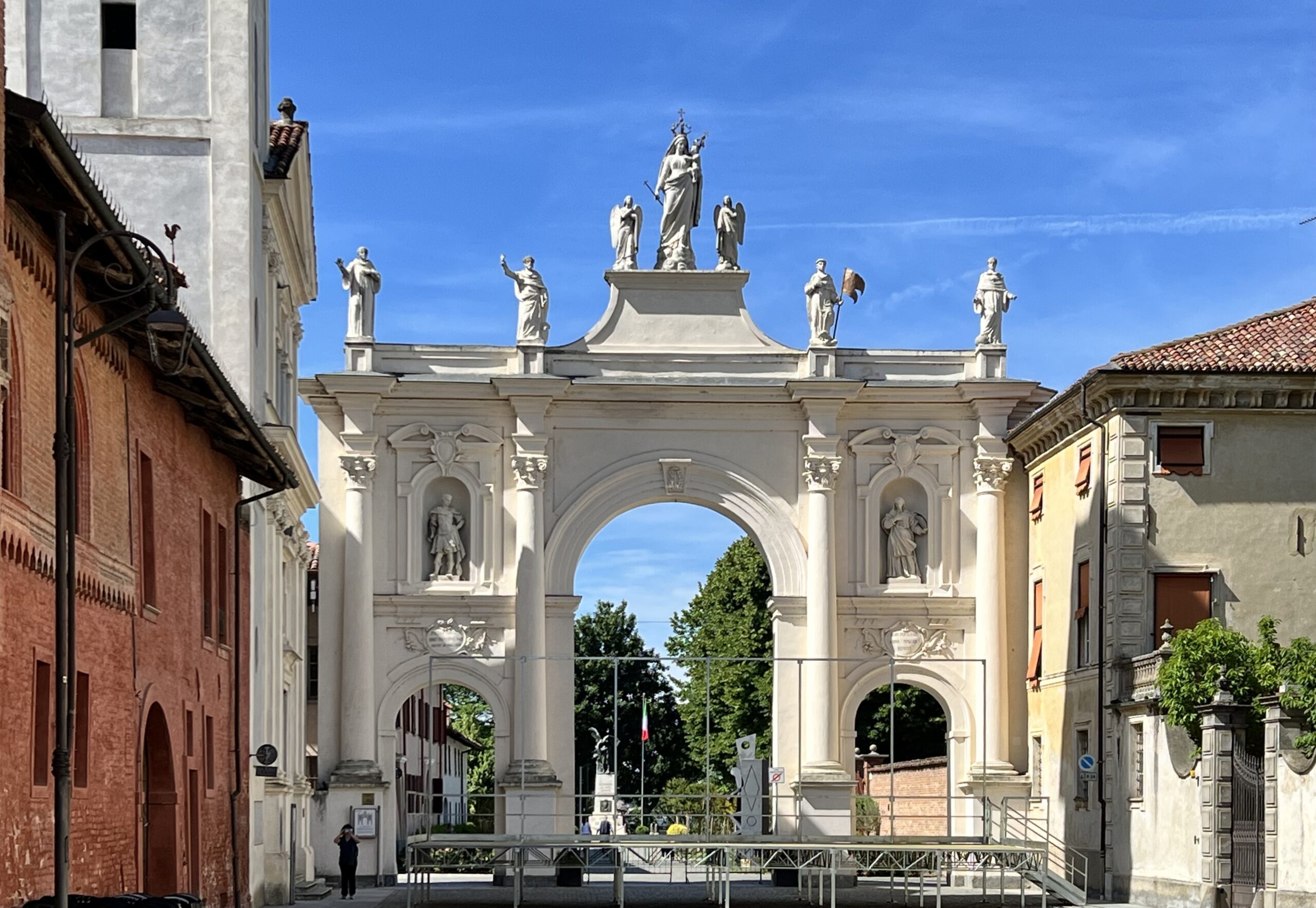
On the street of the sanctuary, Via Nostra Signora del Popolo in Cherasco, stands a tall arch. It is the “Arco de Belvedere” with Our Lady of the Rosary at the top and is a symbol of the town. This arch was built between 1647-1688 as a thanksgiving to Mary for overcoming the plague, which claimed many lives in 1630-1631. The design of the triumphal arch is by the painter Giovenale Boetto (1604-1678) from Fossano. In addition to the effigy of Mary, Saint Iffredo, Alanus de Rupe, and Nicholas of Tolentino have also been placed there. In the niches are the images of the patron saints of Cherasco, namely Saint Verginio and Saint Euphemia.
In Cherasco there is a synagogue, which was built for a small Jewish community.
From the pilgrimage site of Bra to that of Cherasco is 6 km to the south.
Leaving Asti to arrive in Cherasco means travelling 48 km south-west.
Travelling from the big city of Turin to Cherasco involves covering 60 km to the south.
To go from Alba to Cherasco, you need to travel 20 km west.
Leaving Cuneo to arrive in Cherasco means going 61 km north-east.
Leaving the big city of Milan and wanting to go to Cherasco means driving 168 km to the southwest.
~~~

 Nederlands
  English (UK)
  Deutsch
  Français