History
Activities in Tropea date back to the Bronze Age (16th century BC). Tombs from the 4th century AD have been discovered from the Greco-Roman period. According to local literature, the name Tropea may originate from the hero Hercules, who founded the city in honour of his foster mother Juno, also called Tropea, following his recovery from battle with the giants. For a long time, Tropea was under Byzantine rule. This was a difficult period for the city due to numerous raids and occupations by the Saracens. The original city walls were built in 534-536 on the orders of Belisarius (505-565), the greatest Byzantine general of the Eastern Roman Empire. In the 11th century, the Normans arrived and imposed their will, including in religious matters with the Greek rite. After this, French nobles of Anjou and the Spanish nobility of Aragon took possession of the city. The inhabitants of Tropea faced famine and deadly epidemics. There were also severe earthquakes and landslides which caused much destruction, such as in 1783. Subsequently, French troops came to rule the region. After the Second World War (1939-1945), a prosperous period began due to visits from many tourists.
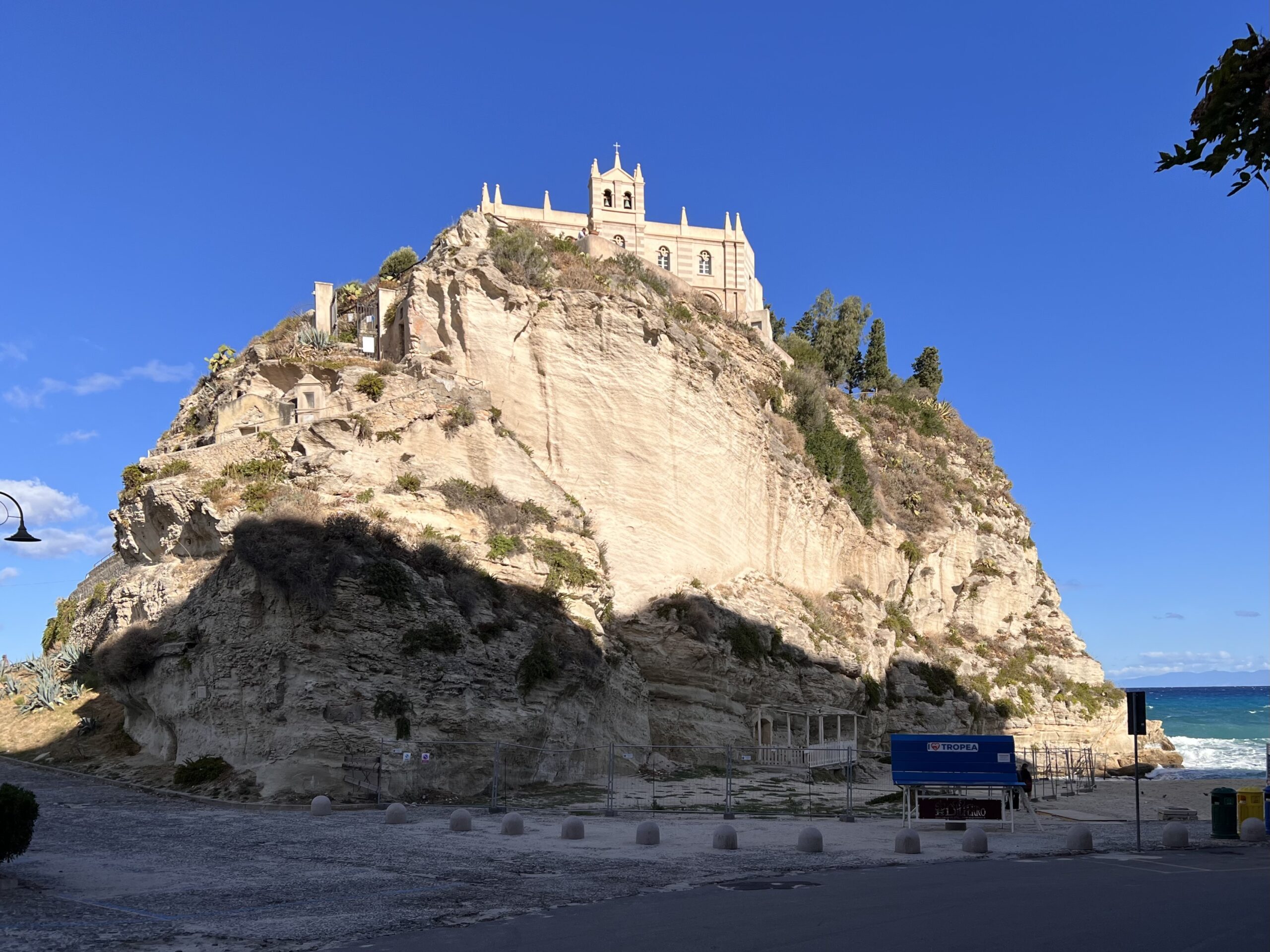
The site of the pilgrimage church on the rock was once an islet, and over time the sand widened, turning it into a small peninsula. The islet was for a long time connected to the mainland by a bridge.
On the religious front, a lot has also happened. In the year 370, Saint Blasius founded more than 400 hermitages for monks in Calabria. He is called Saint Menas or Menna in Tropea, then the Normans arrived with their religious “conversions.” In the 11th century, the island passed to the Benedictines of the monastery of Monte Cassino. The development of the harbour is attributed to the noble Sichegaita/Sikelgaita of Salerno (1040-1090), who donated money for this purpose. In 1397, the church was consecrated.
In 1778, the island of the pilgrimage site is a quarantine location because people are only allowed into the city after a few days in isolation. This is done for reasons of disease prevention, at a time when there are outbreaks.
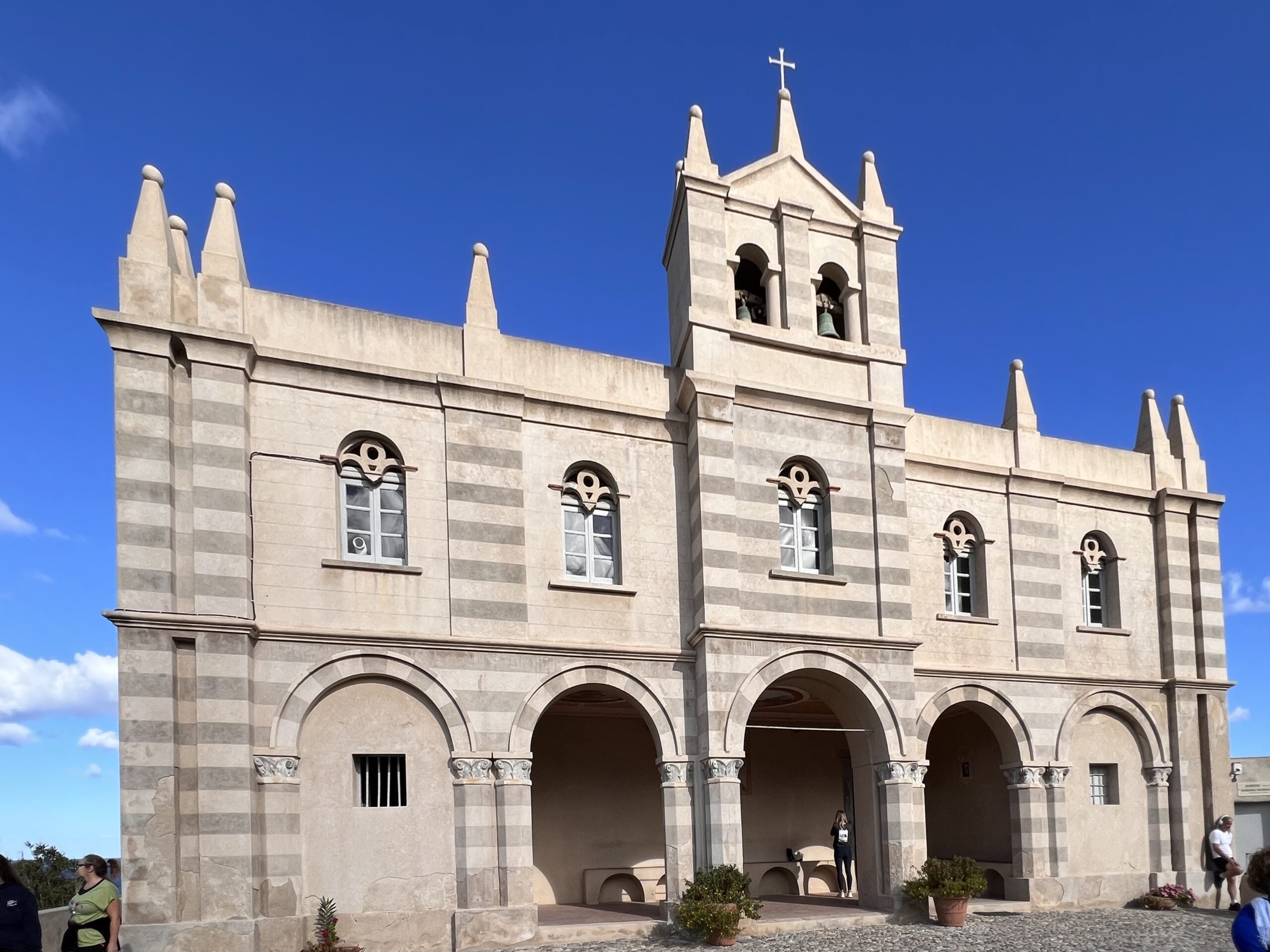
The pilgrimage church has been rebuilt several times due to damage caused by earthquakes and landslides. This applies particularly to the entrance with its arches and the vaults with paintings. Wall remnants indicate former architectural styles.
In 1905, the church's façade was reconstructed after a very large earthquake caused considerable destruction. The idea is to build a narrow staircase to the church's vault leading to a terrace.
In 2010-2011, the facade was renovated and it was given its current appearance.
In 2021, Tropea was named the most beautiful village in Italy (borghi più belli).
Pilgrimage site
The pilgrimage site is officially called “Santuario di Santa Maria dell’Isola di Tropea” or “Sanctuary of Saint Mary of the Island of Tropea”. It is located at a height of 30 metres, is 120 metres long and 80 metres wide. The medieval church dates back to the 11th century and has been rebuilt several times. Brave hermits have worked for years in this Marian site. It involves climbing stairs to reach the Marian site on the rock at a height of over 30 metres. This is a strenuous climb with some high steps, which are not level everywhere. The pilgrimage site is not on an island in open water, as sand washed ashore from the sea has turned it into a peninsula.
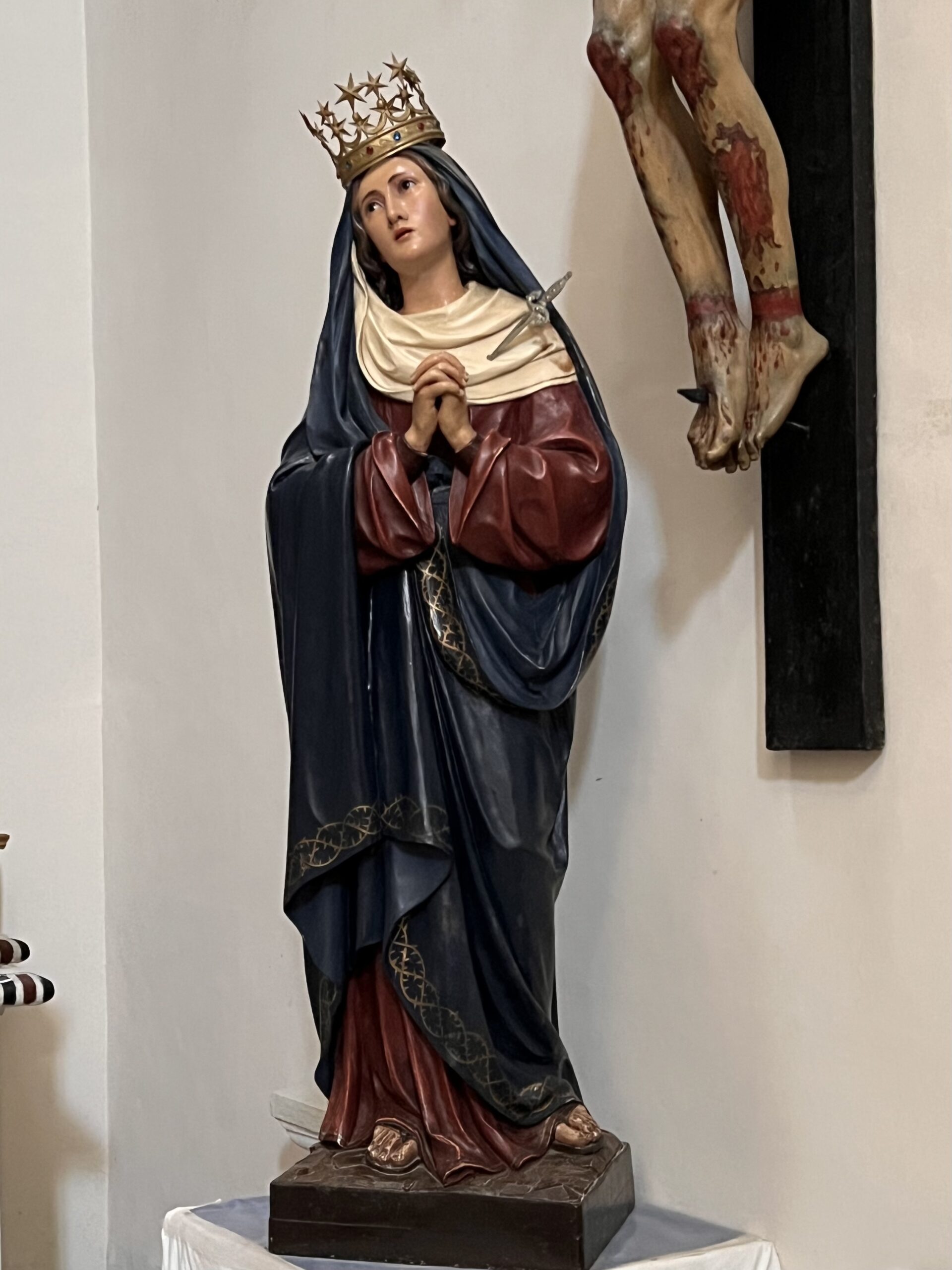
A legend is told, that centuries ago a ship from the east arrived at the island of Tropea and could go no further until an image of the Virgin Mary was taken ashore. This is done in a festive manner with many spectators. The statue of Mary is placed in a small cave in the rock, but the niche proves to be too low. The plan is to make the effigy smaller by sawing off the feet. A carpenter is fetched to perform the task, but the saw breaks and on the second attempt, the man's arms are suddenly paralysed. The cave is then enlarged. When the statue is in the cave, miracles occur, including healings. Later the statue is lost.
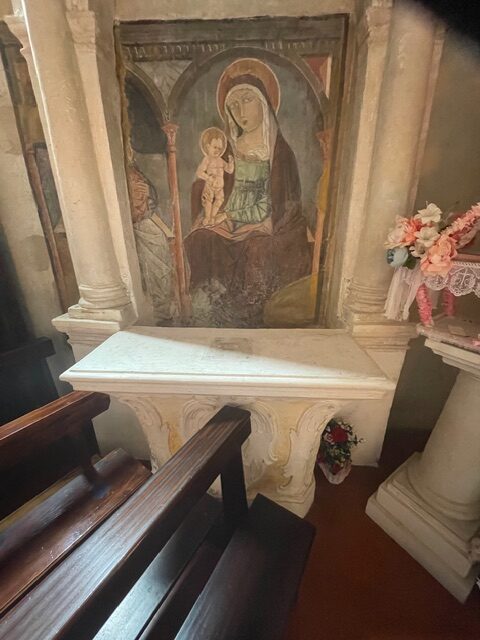
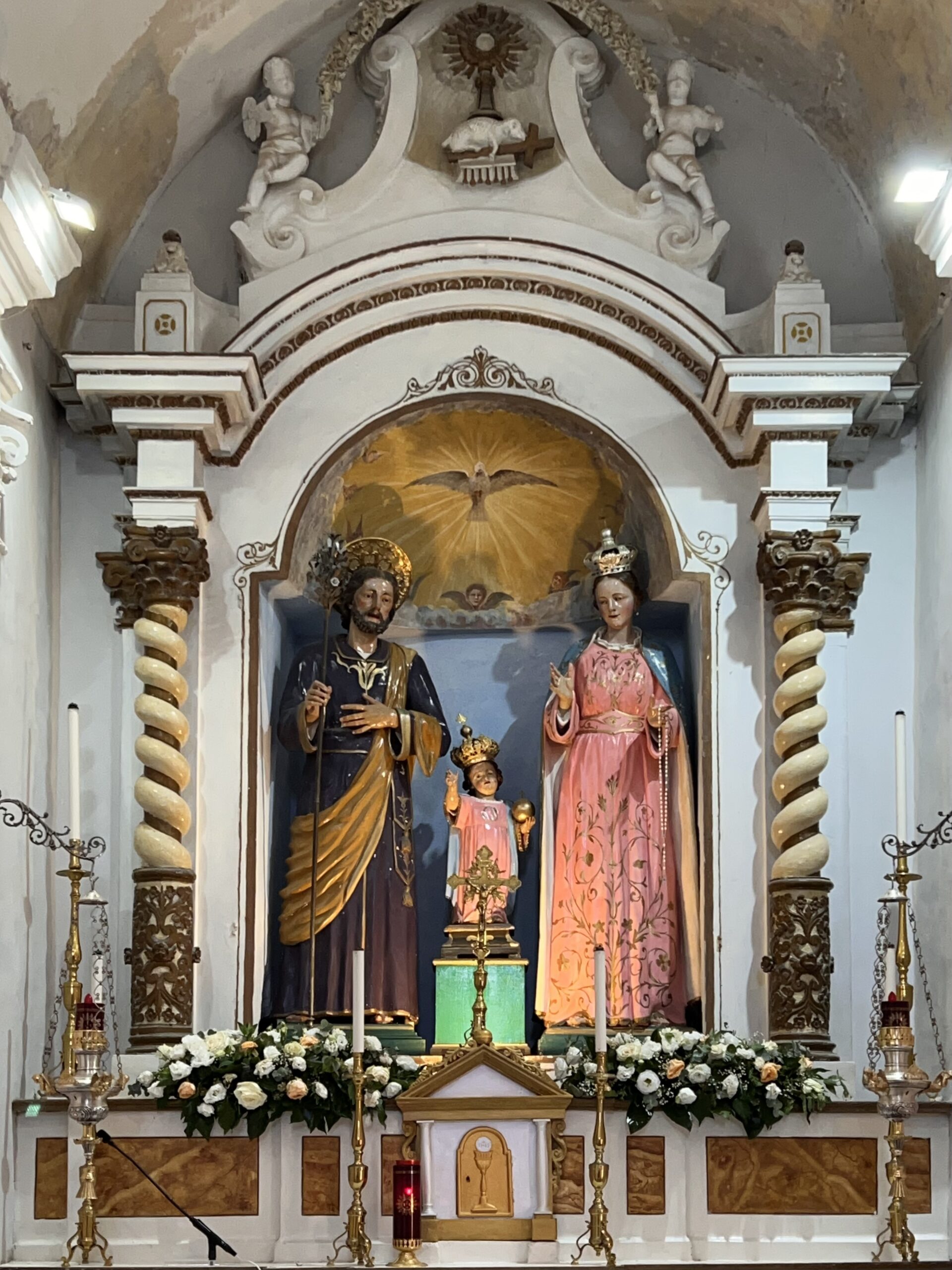
On the altar of the pilgrimage church stand the 16th-century statues of the Holy Family, venerated by visitors. The heads, hands, and feet of the members of the Holy Family are made of wood, and the rest is adjustable. In the second half of the 20th century, the statues were reinforced and retain their original shapes and colours. In the church, there are small alcoves like chapels with a wooden cross, an image of the infant Jesus, and tomb slabs. The tomb slabs may have been used to cover the remains of members of the noble Afflitto family, who also lived in Tropea. There are two more small altars in the church dedicated to Mary: Our Lady of Graces and Our Lady of Portosalvo.
The church is free to visit, but there is a charge to enter the green garden.
At the end of the garden, which lies behind the church, there is a large cross, and also, among other things, cacti, oleanders, and olive trees.
On August 15th (Assumption of Mary), boats sail off the coast to honour the statues of the Holy Family as the patron saints of sailors and fishermen. Afterwards, there is a procession.
Tropea has a population of around 7,000 and is one of Calabria's most beautiful villages, owing to its stunning location, magnificent views, historic centre (centro storico), high cliffs, white beaches and azure sea. It belongs to the “Costa degli Dei” (Coast of the Gods). The town attracts many tourists who come to enjoy the small, narrow streets, pretty squares, special vistas and cosy cafés and restaurants. In Tropea stands a 12th-century cathedral, dedicated to Our Lady of Romania, the town's patron saint, which contains two unexploded bombs from the Second World War (1939-1945). Tropea's speciality is its red peppers.
In the evening, the rock and the pilgrimage church are illuminated with colourful lights. The pilgrimage site is the most visited Marian shrine in Calabria.
In Tropea, you can also visit the Jesuit church and the Cathedral of “Maria Santissima di Romania”, among other places.
ACCESSIBILITY
Tropea lies in the southwest of Italy on the Tyrrhenian Sea and belongs to the province of Vibo Valentia in Calabria.
The pilgrimage site is located at: Via Lungomare, 89861 Tropea, next to a large car park.
The pilgrimage church stands on a rock.
Experience
On the coast of the Tyrrhenian Sea, half in the water, perched on a rock and attracting many onlookers. This is the sanctuary in Tropea! Upon arrival, it's almost 10:00 in the morning and I see quite a few people heading for the renowned rock. Today I am visiting the “Santuario di Santa Maria dell'Isola di Tropea”.
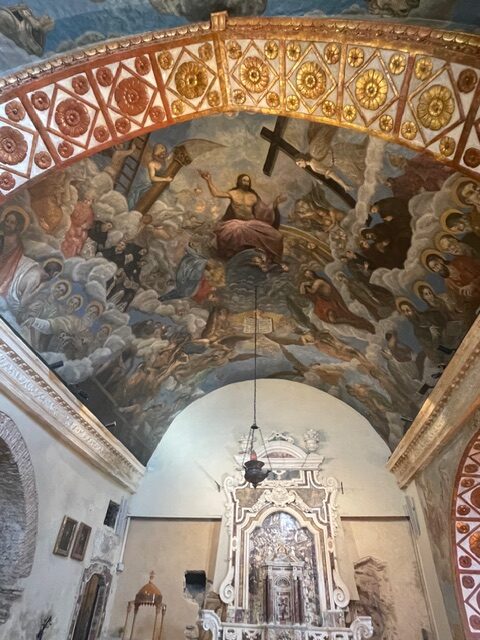
After climbing dozens of steps, I'm at the top, standing in a square in front of the pilgrimage church. The view is spectacular, with rocks, the beach, waves, and the town of Tropea proudly situated on a height. I see the impressive facade of the church and then I go towards the entrance. In the building's vestibule, frescoes have been painted on the ceiling, depicting scenes from, among other times, the 1780s and 1905. To the right, a door is open, and that's where I go.
When I stand in the house of God, the altar catches my eye with three, standing, large and crowned statues of the members of the Holy Family. Mary, Joseph and Jesus are colourfully dressed. Above them are 2 putti and between the large statues, a lamb is placed. Directly above Mary, Joseph and Jesus is a dove with golden rays. Joseph has a decorative staff in his right hand and looks astonished. Jesus, with his left hand, holds an orb with a cross on top, his head is tilted slightly to the right, and with his right hand, he makes a blessing gesture. Mary beams with beauty, her face radiant and her head tilted slightly to the right. She is looking at her Child. Mary is wearing small earrings, which I have not often seen her do before. In her left hand, she holds a rosary and with her other, open hand, she is blessing. Our Lady wears a blue mantle, which is white on the inside, and a pink gown with a belt. This gown is decorated with golden, ornate flowers. It also strikes me that Mary is barefoot. After looking at the effigies for a long time and admiring Mary in particular, it is time to pray to her.
Next, I'll go to the little shop in the church area, where devotional items, jewellery, drinks, cards and books are on offer. I'll buy a booklet about Tropea so that I can re-experience the present impressions at home in a different way. After that, it's time to take a ticket to visit the pilgrimage garden.
I stroll through the garden and also look at the sea, the rocks, the beach and the people. Observing others, I get the impression there are more tourists here than pilgrims. It strikes me that more visitors are staying in the garden than in the little church, and many people hurry past the statues of Mary, Joseph and Jesus. Am I so different then?
Afterwards, I will go back down. As I take the steps for the second time, my head is filled with new events from this sanctuary. What a location! What a special pilgrimage church with statues and old stones. I understand that this is a special place and that many visitors have come here, including certainly architects, poets, filmmakers, photographers, painters, writers, and researchers. A feeling of gratitude wells up within me, and I realise I am a privileged person to be allowed to come here. Thank you, Mary!
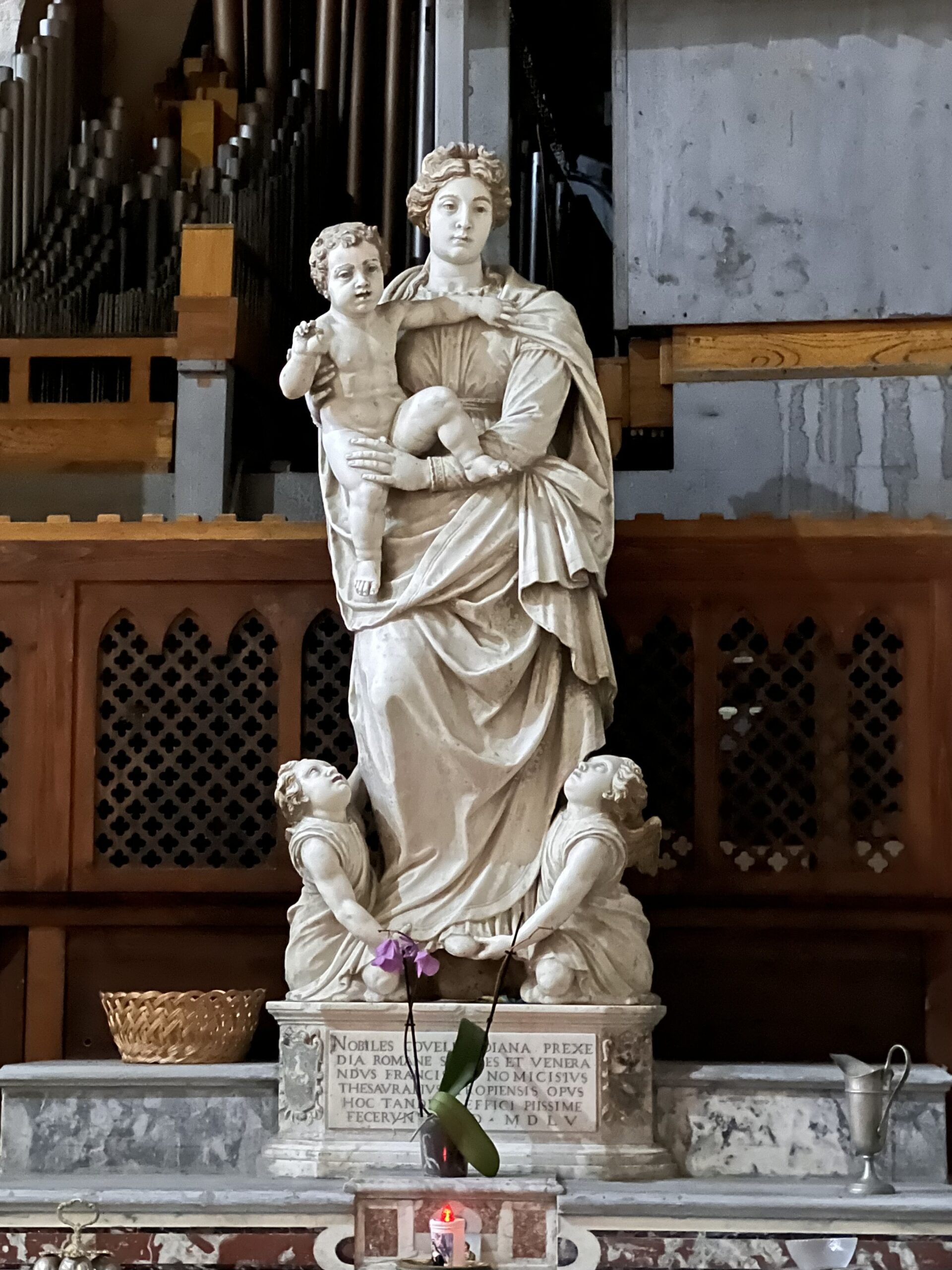
In Tropea, I also visit the Jesuit church and the cathedral, which is dedicated to “Maria Santissima di Romania”. Tropea has so much to offer!
Environment
In the town of Tropea, there's plenty to see with its alleyways, squares, and viewpoints. There is also a large cathedral, “Concattedrale di Maria Santissima di Romania” (Co-cathedral of the Blessed Virgin Mary of Romania), with its first mention dating back to 1163. This church was built in the Norman and later Baroque style. Inside the church, you can see statues of Mary, including “Madonna del Popolo” (Madonna of the People), Madonna dell Libertà (Madonna of Freedom), and the Madonna di Romania (Madonna of Romania).
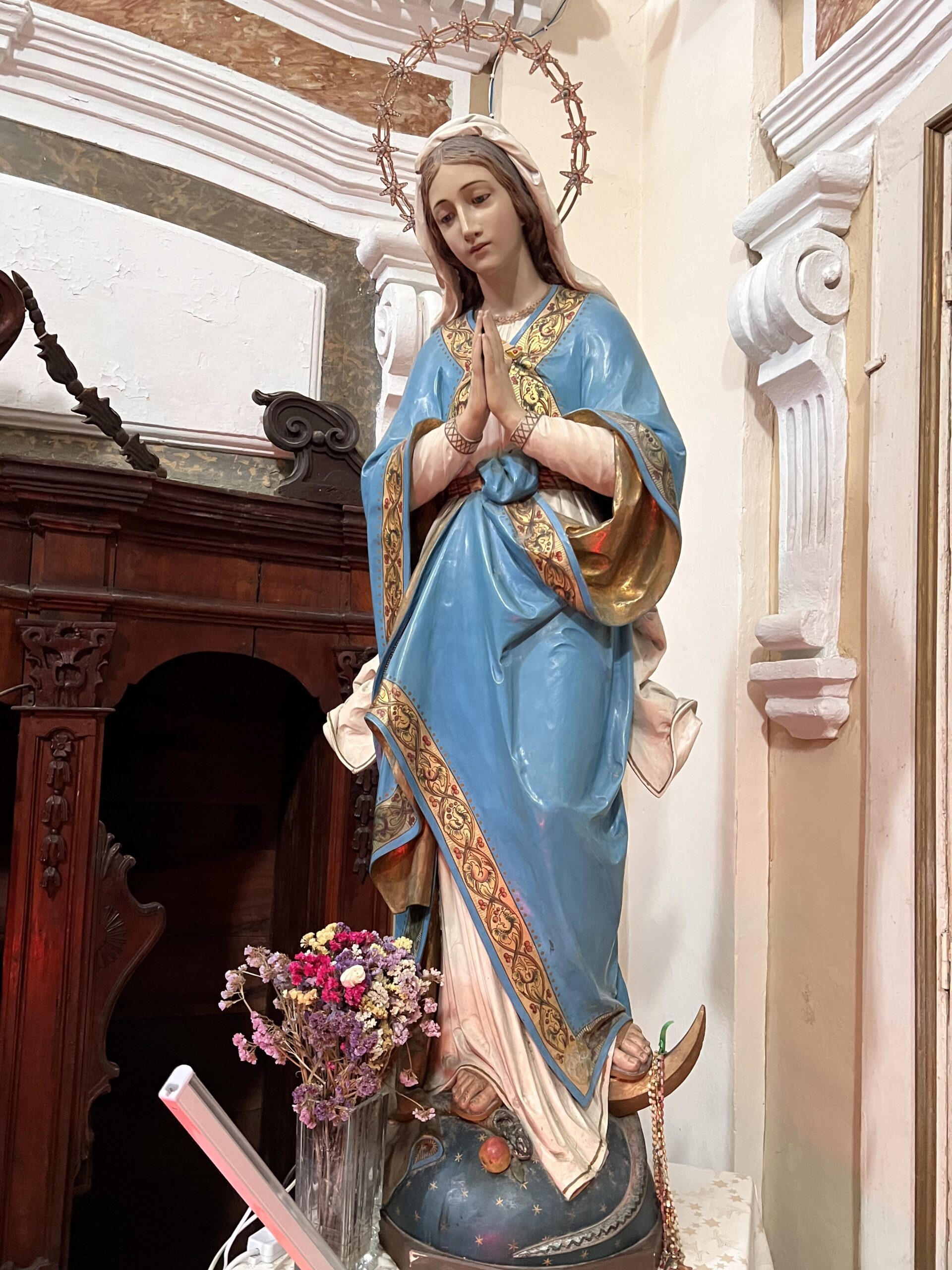
In addition, the Jesuit church in Tropea can be visited, where statues of Our Lady have also been placed.
From the coastal town of Pizzo, with a Marian shrine, to Tropea means travelling 32 km south-west.
The distance from Vibo Valentia to Tropea is 28 km in a westerly direction.
Leaving the larger town of Catanzaro to arrive in Tropea requires covering 93 km to the southwest.
Departing from the city of Cosenza to go to Tropea involves travelling 124 km southwards.
~~~

 Nederlands
  English (UK)
  Deutsch
  Français