History
For many centuries, Zaragoza has been an important hub for trade. The city has also been a place of pilgrimage for a very long time. Furthermore, the city has a turbulent history.
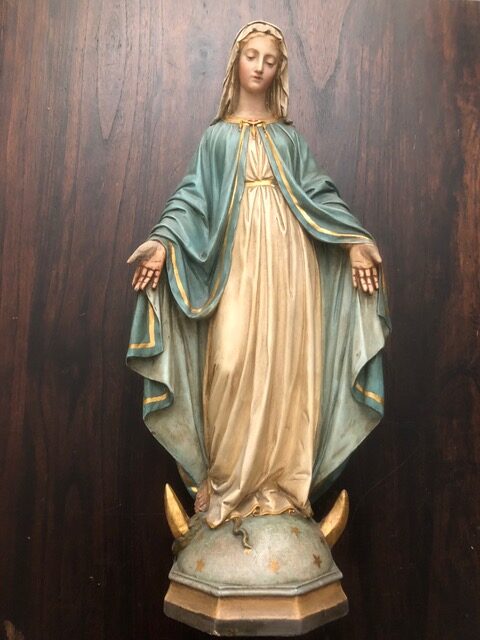
A legend tells... James the Greater is praying on the banks of the River Ebro in the city of Zaragoza. Suddenly, Our Lady appears to him. Mary gives him a statuette of Herself and a pillar. She then tells him to build a church on this site. Mary also gives him the name of the church: “Our Lady of the Pillar”. This happens in the year 40 AD. This church becomes the first to be dedicated to Mary. After the apparition, Mary lives for another 11 years.
The existence of the pillar in the church was documented in the year 254. Over the centuries, the current cathedral and previous churches have been ravaged by fires.
In 711, the Moors invaded Spain and conquered the entire country. In 716, the Muslims changed the name of Zaragoza to Saragusta. The Church of the Pillar remained for celebrations and visits.
In the church with the pillar, miraculous events also happen. In 1640, a particularly remarkable miracle occurred. Miguel-Juan Pellicer (1617-1647) had lost his right leg in an accident. During a visit to the statue of the Virgin Mary on the pillar, he showed that Our Lady had healed his leg.
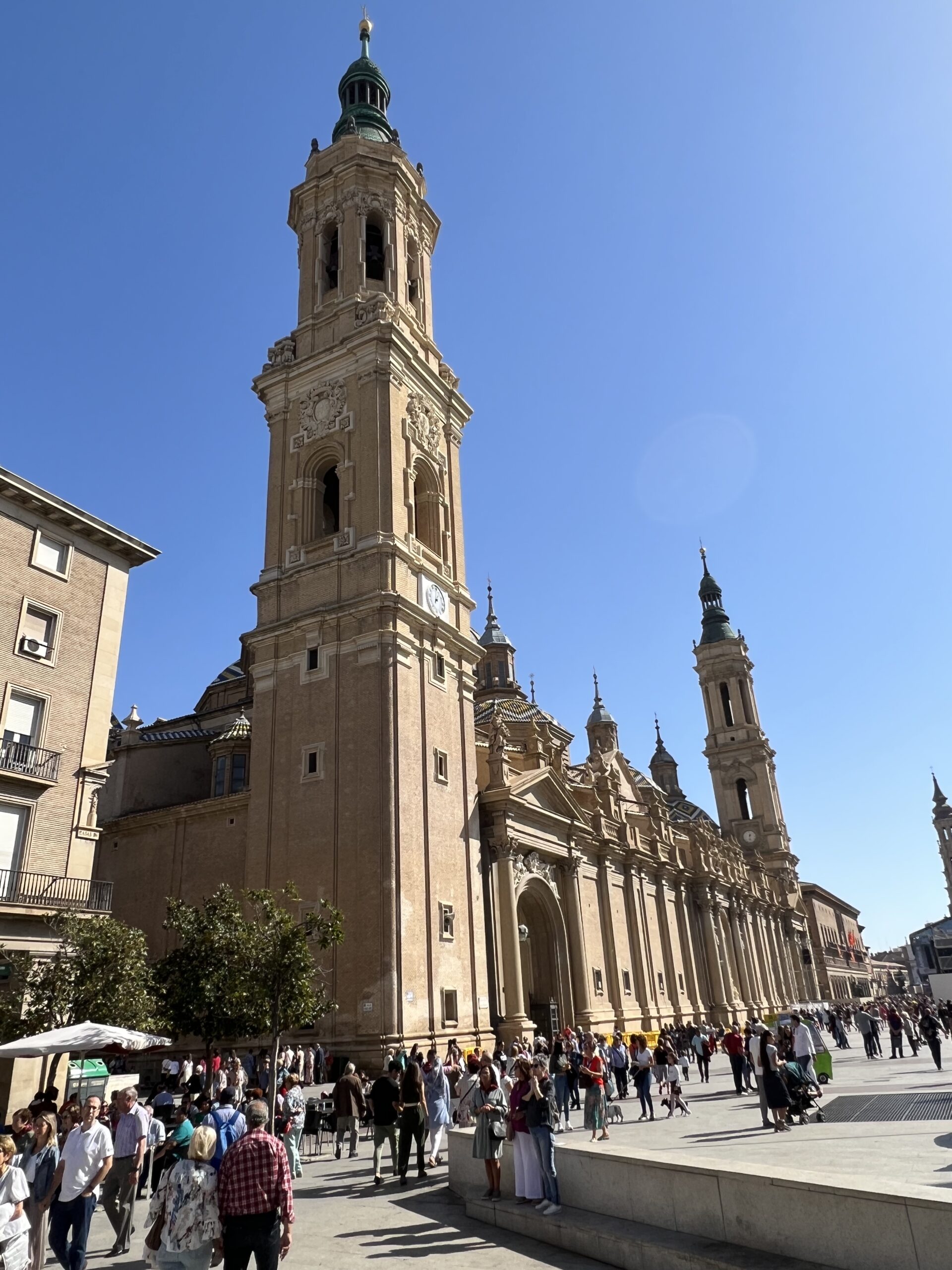
The current church was built between 1681 and 1872, in the Baroque and Rococo styles. The four tall bell towers are built in the Baroque style. Given the long construction period of almost 200 years, several architects contributed, including José Felipe de Busiñac (+1680), Felipe Sánchez (+1712), Francisco da Herrera (1627-1685), and Ventura Rodríguez (1717-1785).
On 11 October 1718, the church was consecrated, even though the construction was not yet complete. The church was named Nuestra Señora del Pilar.
In 1766, a great famine plagued Spain. Discontent grew among the population, and this was also violently expressed in Zaragoza. Many angry farmers from the far-off region had come to the city. An uprising was brewing, and malevolent individuals blamed the Jesuits for the misery. However, on a day of unprecedented tension, Father Giuseppe Maria (Joseph) Pignatelli (1737-1811) addressed the enraged crowd and managed to restore calm among a large part of the populace. Pignatelli was canonised in 1954. The aggression against the Jesuits did not disappear, and in 1767 they were expelled from Spain. This was done on the initiative of Carlos Sebastian (1716-1788), King Carlos III (1759-1788) of Spain.
The image of Our Lady of the Pillar was crowned on 20 May 1905. To commemorate this, the image's cloak is removed for one day on the 20th of each month.
Miraculously, the church has endured a great deal. For instance, during the Spanish Civil War (1936-1939), three bombs fell on the church. However, not a single bomb detonated. The cathedral has also suffered damage from fire.
On 24 June 1948, the Church of Our Lady of the Pillar was granted the honorary title of basilica. It was Pope Pius XII, Pope from 1939 to 1958, who bestowed the title. Since that day, the church has been called a cathedral.
Pilgrimage site
The city of Zaragoza is known for an apparition of Mary to James the Greater in the year 44. This James is one of Jesus's 12 apostles. In Spanish and Portuguese, he is called Santo Lago and San Yago, and these names lead to the name Santiago, patron saint of countries including Spain, Guatemala and Chile. He is also the patron saint of places such as The Hague, Enschede and Kemzeke.

In the cathedral in Zaragoza, Mary is venerated under the name “Nuestra Señora del Pilar”, or Our Lady of the Pillar. In front of the cathedral lies a very large square, where festivals are held.
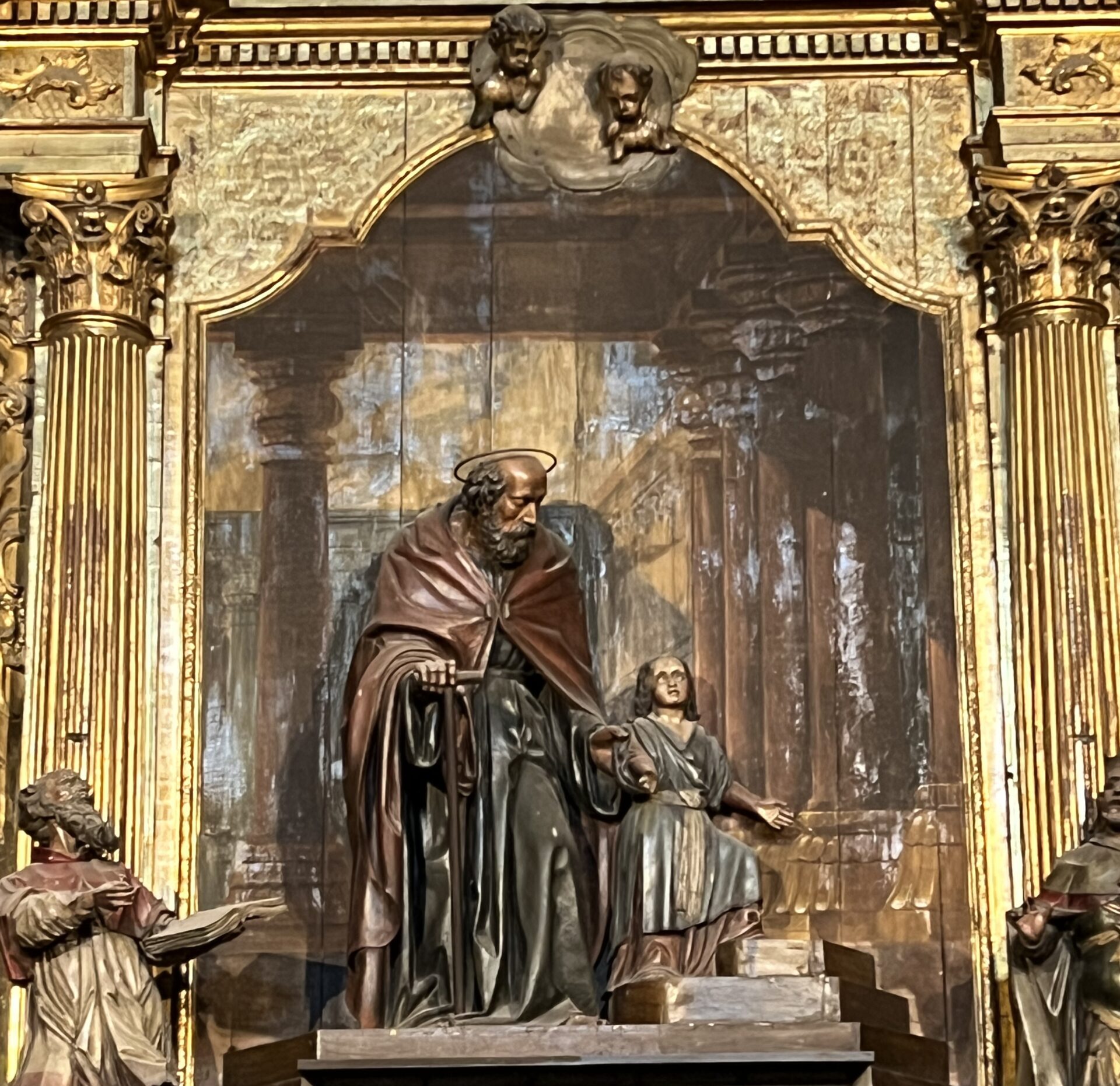
In the cathedral stands a large Gothic high altar dedicated to the Assumption of Mary. Many artworks can be admired in the large space, including works by the Spanish painter Francisco Goya (1746-1828). The cathedral also has chapels.
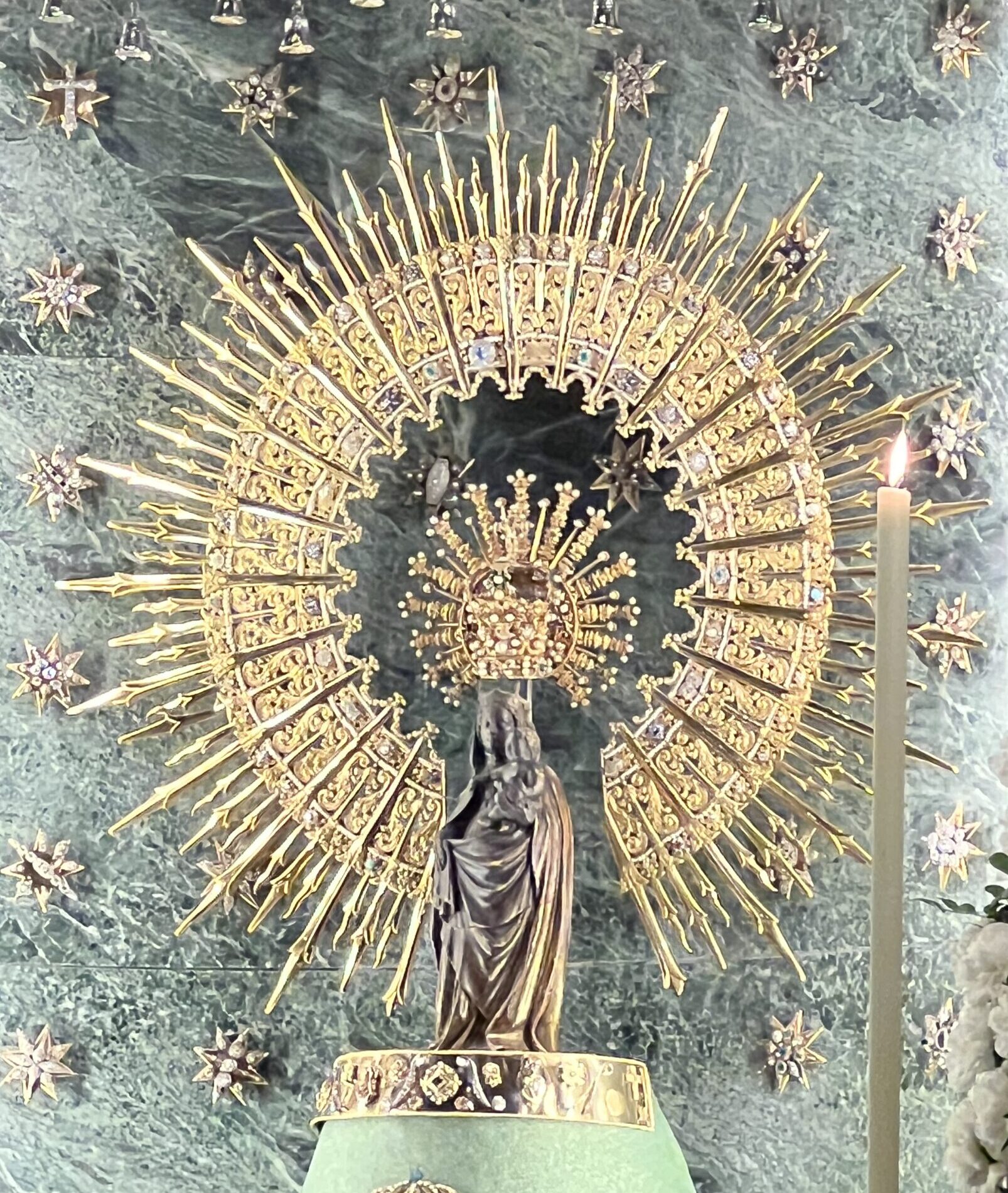
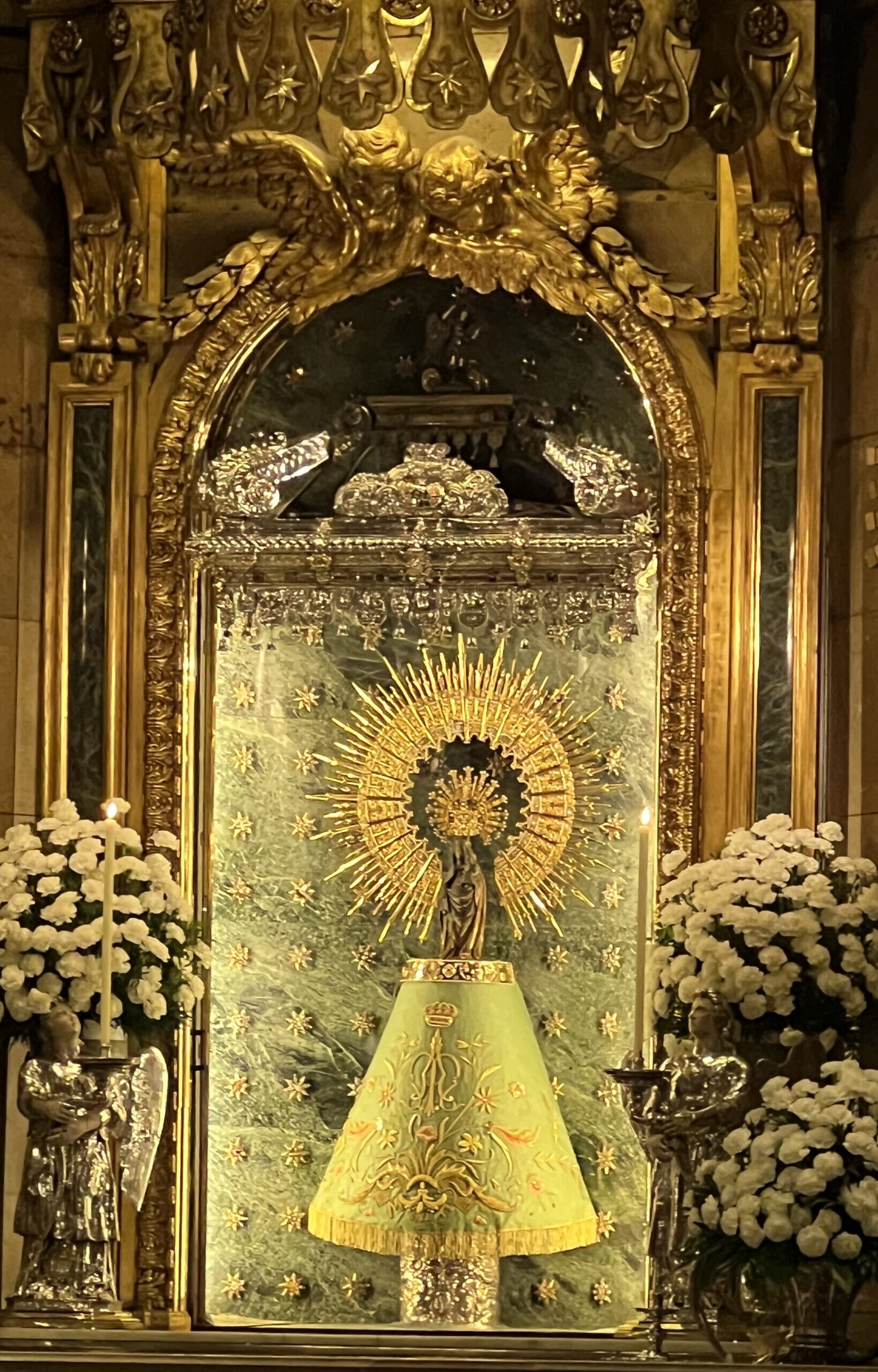
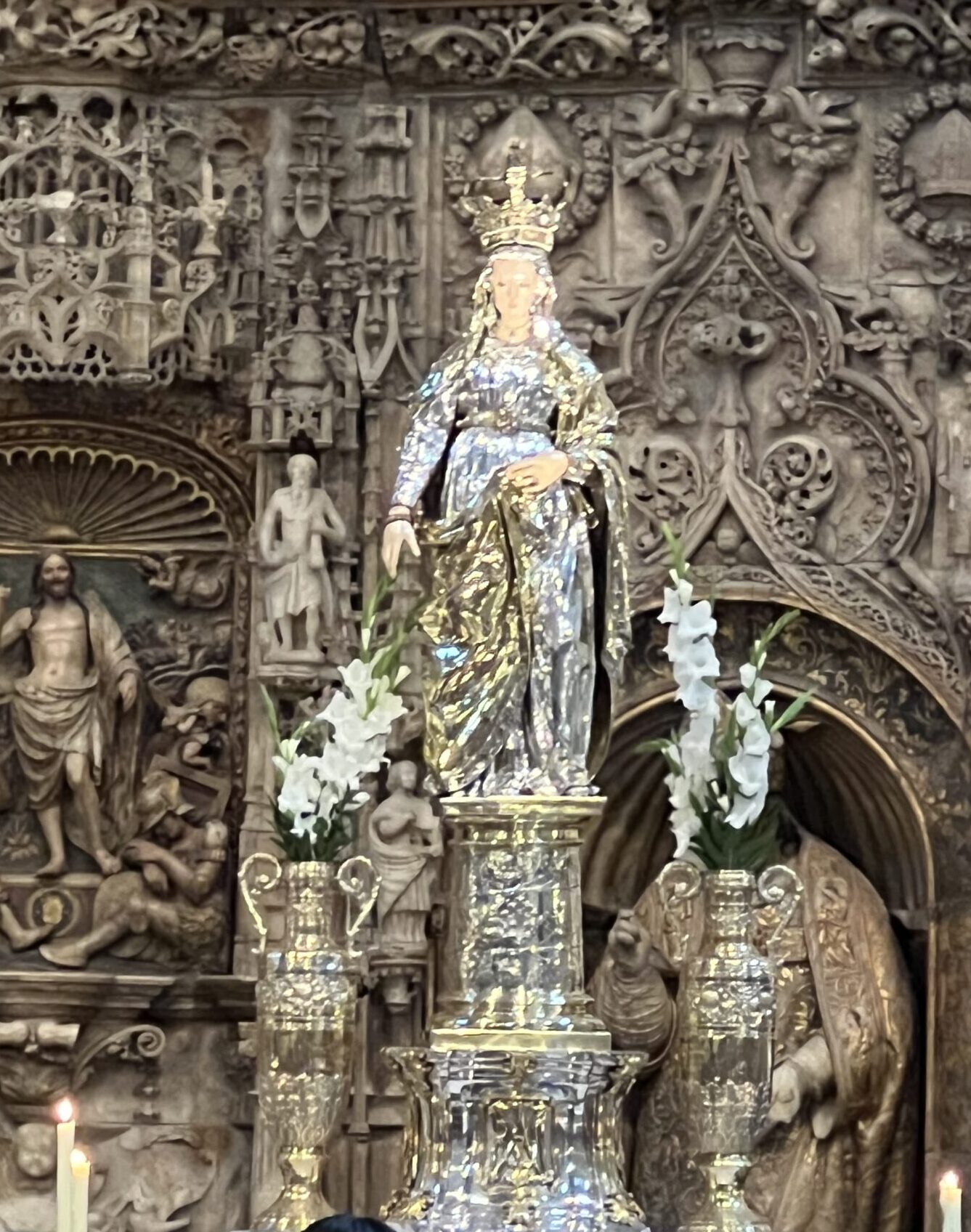
Our Lady of the Pillar statue is made of gilded wood carving and stands 36 centimetres high. It is on a column, which is clad in bronze and silver. This column is 177 centimetres high and has a diameter of 24 centimetres. The effigy wears a mantle. However, on the 2nd, 12th and 20th of the month, which are the feast days of the statue of Mary, the statue does not wear a mantle. Our Lady's dress is buttoned up in gothic style, belted with a buckle, and reaches to her feet. A cloth covers Mary's head and her hair is wavy. She carries her Child on her left arm. The effigy is made in the late Gothic style and dates from 1435. The presumed creator is the Spanish sculptor Juan de la Huerta (1413-1462). The sculptor has Mary looking towards her Child, who is holding his Mother's mantle with his right hand. In his left hand, He holds a little bird. The effigy was donated by Dalmacio de Mur y de Cervelló (+1456), bishop of Zaragoza (1431-1456). The statue was restored in 1990.
A great tradition is that children are introduced to Our Lady of the Pillar at least once in their lives. This visit takes place before their First Communion.
Next to the Cathedral of the Pillar stands a second cathedral and its name is “Catedral del Salvator”.
The pilgrimage site is not only popular with Spaniards, but also with many foreign visitors. Millions visit the cathedral annually. Zaragoza is, after Santiago de Compostela, the most important pilgrimage site in Spain.
The Cathedral of Our Lady of the Pillar can be visited daily.
ACCESSIBILITY
Zaragoza is located in the north of Spain, south of the Pyrenees. The Roman Catholic cathedral of “El Pilar” is in the centre of the city.
Address: Plaza del Pilar, 50003 Zaragoza.
Current information can be found on www.catedraldezaragoza.es.
Experience
I find the old city centre not only atmospheric but also rich in culture, and furthermore, it is a popular pilgrimage site. The imposing, monumental cathedral is therefore a major attraction. This church is called “Catedral-Basílica de Nuestra Señora del Pilar”, or “Cathedral-Basilica of Our Lady of the Pillar”. The cathedral is often referred to as “Basílica del Pilar” (Basilica of the Pillar).
The cathedral makes a great impression on me. What a building! I understand that the dimensions are 120m long, 59m wide, and the tower measures 90m.
Mid-October I'll be in Zaragoza and there are big celebrations called “Fiestas del Pilar”. Many flowers are offered to Maria on the Pillar. This is a nine-day festival, which culminates on 12 October. The feast day of Our Lady of the Pillar is therefore 12 October. On the immense square in front of the cathedral, “Plaza de las Catedrales”, many activities take place, including dance, singing and instrumental music.
I understand there are three annual festivities. On 2 January, the arrival of Our Lady of the Pillar is celebrated. The canonical coronation of the statue of Mary is commemorated on 20 May, and on 12 October, the Our Lady of the Pillar festival is held.
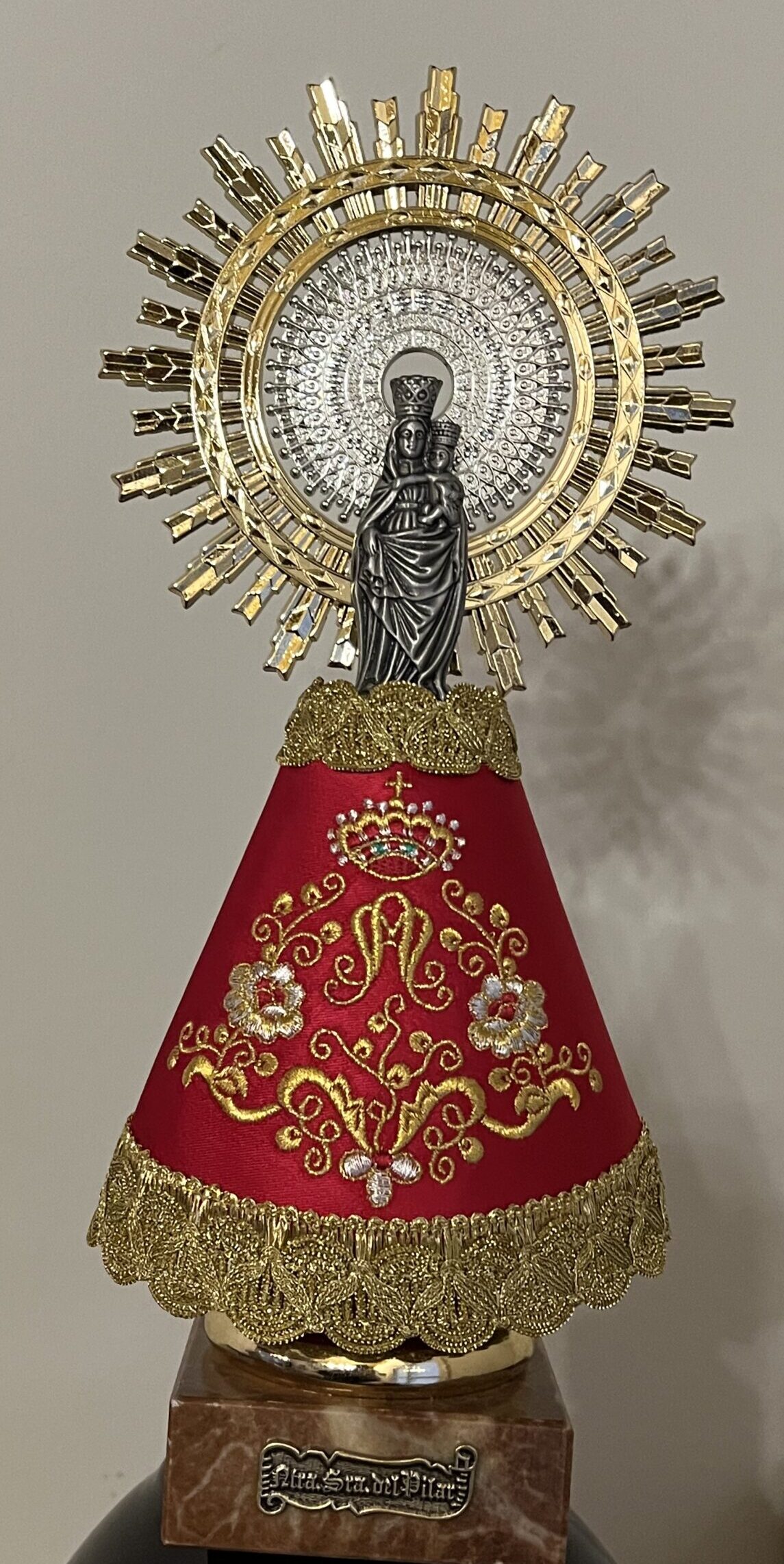
As a souvenir of the impressive visit to the pilgrimage site in Zaragoza, buying a small statue to look at often back home will certainly bring back memories of...
Posted: 17 December 2022
Last modified: 25 January 2023
~~~

 Nederlands
  English (UK)
  Deutsch
  Français