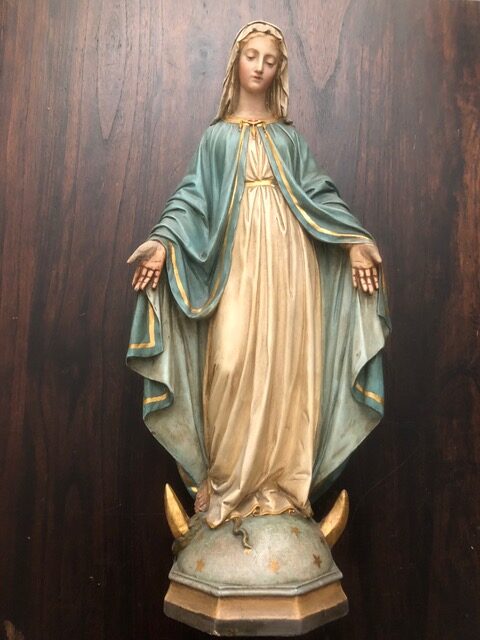
History
The name Medjugorje is of Slavic origin and means “area between the mountains”. The parish of Medjugorje was founded in 1892. The patron saint of the place is St James the Greater. In 1897, a church was built, dedicated to James, apostle of Jesus and patron saint of pilgrims. Due to the decay of this church, a new house of worship was built, and this new building was consecrated in 1969. This is the current church.
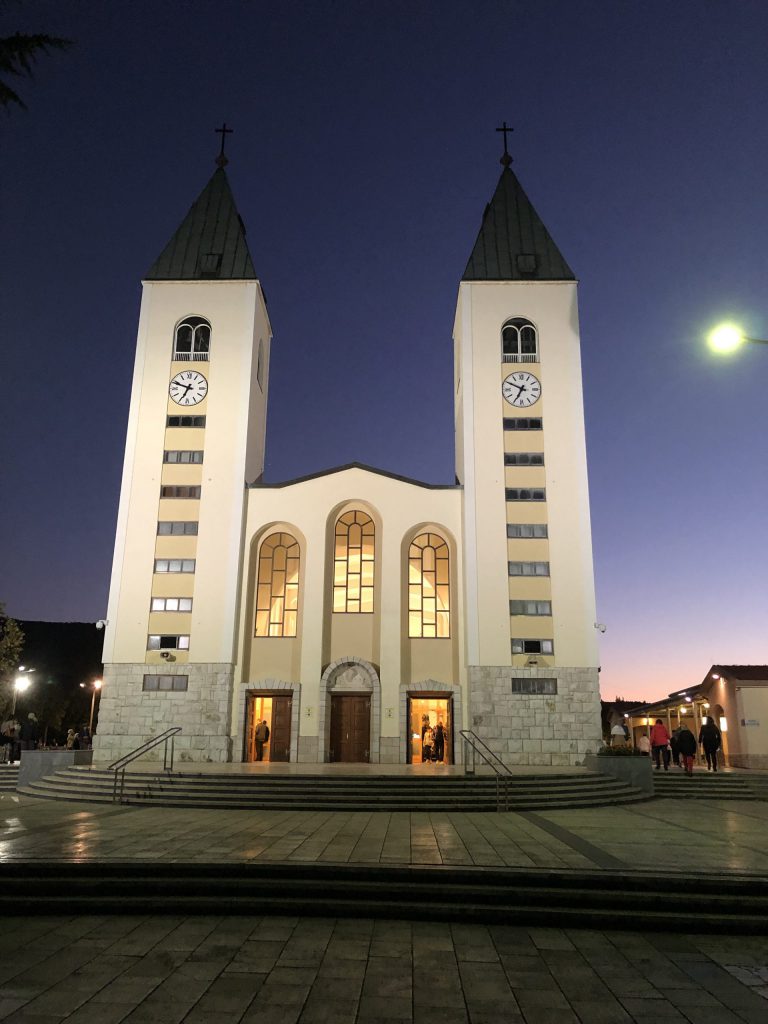
A large, concrete cross stands at the summit of the 540-metre-high Krizevac mountain. This name stands for Cross Mountain. The cross was erected in 1933 to mark the 1900th anniversary of Christ's death. The cross indicates the years 33-1933.
The apparitions of Mary in Medjugorje began on 24 June 1981, the feast day of John the Baptist. The Mother of God is called “Gospa” in Medjugorje, and the “Gospa” is seen by six teenagers, namely Ivanka Ivankovic, Ivan Ivankovic, Vicka Ivankovic, Mirjana Dragicevic, Ivan Dragicevic and Milka Pavlovic. These six young people see a beautiful, young woman with a baby in her arms on the hill of Podbrdo. The woman floats about 30 centimetres above the ground.
On 25 June 1981, the children agreed to meet again where the apparition had taken place the day before. A flash of light appeared and once again the “Gospa” (Lady) appeared. However, this time She was alone. The group of six had changed. Instead of Ivan Ivankovic (1960) and Milka Pavlovic (1968), two others were present. The six visionaries on that day and subsequent occasions were: Vicka Ivankovic (1964), Mirjana Dragicevic (1965), Maria Pavlovic (1965), Ivan Dragicevic (1965), Ivanka Ivankovic (1966) and Jakov Colo (1971). Their birthplace is Bijakovici, a hamlet next to Medjugorje.
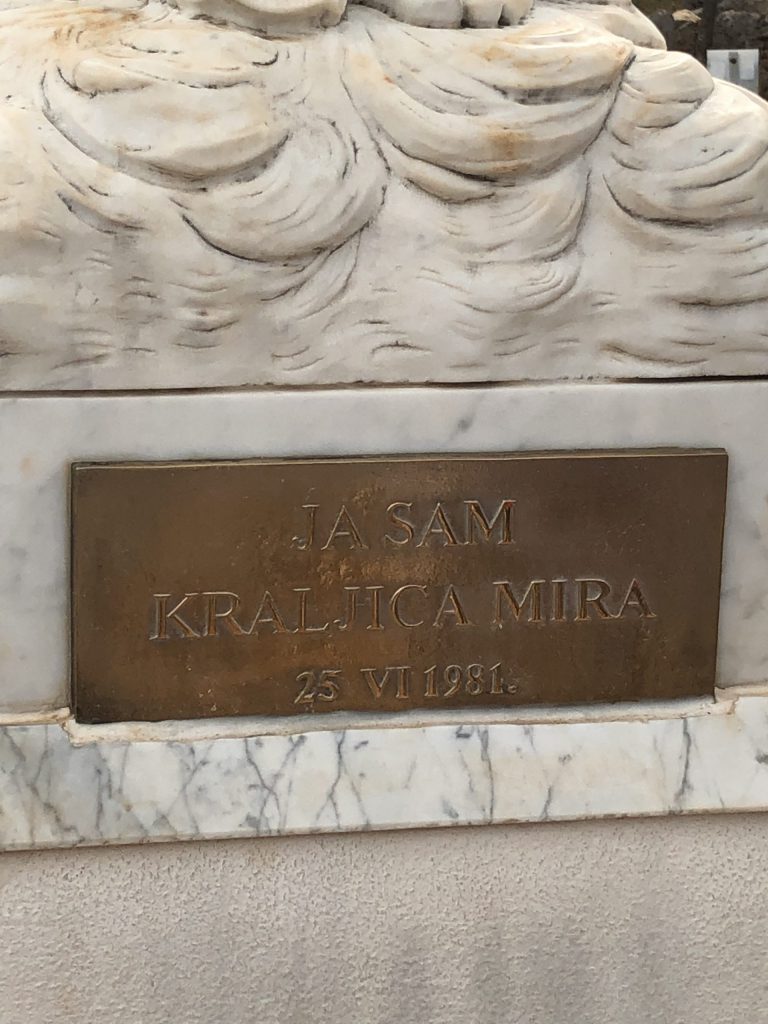
On 26 June 1981, the third apparition took place. The young woman said: “I am the Blessed Virgin Mary”, “Peace, peace, peace! Reconcile yourselves! Go in peace from God,” and “I am the Queen of Peace”. During this apparition, Vicka Ivankovic sprinkled Our Lady with holy water. Mary smiled and encouraged them.
The apparitions begin in Bijakovici, on Crnica, at its foot, called Podbrdo, the Apparition Hill.
After three apparitions, the visionaries are interrogated by the police. Immense pressure is placed on the visionaries during a period of great unrest in the former Yugoslavia. However, the visionaries show courage, sincerity and determination. They prove to be very convincing about the apparitions. The apparitions begin during a period when Marxism is dominant and atheism displays great power. Atheistic media have nothing to do with the apparitions and highlight them as unbelievable. Faith and religion have been tarnished with contempt and ridicule for years. The children are accused of manipulation by the media. The visionaries were not incited by clergy or family members to make false statements. The communist authorities react negatively to the apparitions. Arrests, more interrogations and a short stay in prison follow. Even with a gun to their heads, attempts are made to make the visionaries stop claiming to have seen the Blessed Virgin. The Bishop of Mostar, under whom Bijakovici and Medjugorje fall, adopts a wait-and-see attitude.
Maria promises to entrust the visionaries with 10 secrets each. If the 10th secret is given to an individual seer, the apparition will stop for that witness.
Compared to the sun miracle in Fatima, a special solar phenomenon is also observed in Medjugorje. On one occasion, the sun can be looked at with the naked eye, while it is white and bright. The sun spins rapidly to the right and left. Then the sun emits waves of light which become white rays. Subsequently, a red mist forms around the cross on Krizevac mountain and this takes the shape of a heart. This heart goes to the foot of the mountain and then back up to envelop the cross. A little later, the heart has transformed into a large statue of Mary. This phenomenon has been witnessed by hundreds of pilgrims.
Another peculiar and inexplicable event occurred with the large cross on Križevac (Cross Mountain). Many pilgrims have witnessed the cross disappear and then reappear in its familiar place after fifteen minutes. The cross has also twisted on its axis and taken on the shape of the Virgin Mary.
In late October 1981, a large flame suddenly shot up from the location where the first apparitions had taken place. This flame was visible for thousands for over 10 minutes. This, too, was an unexplained event.
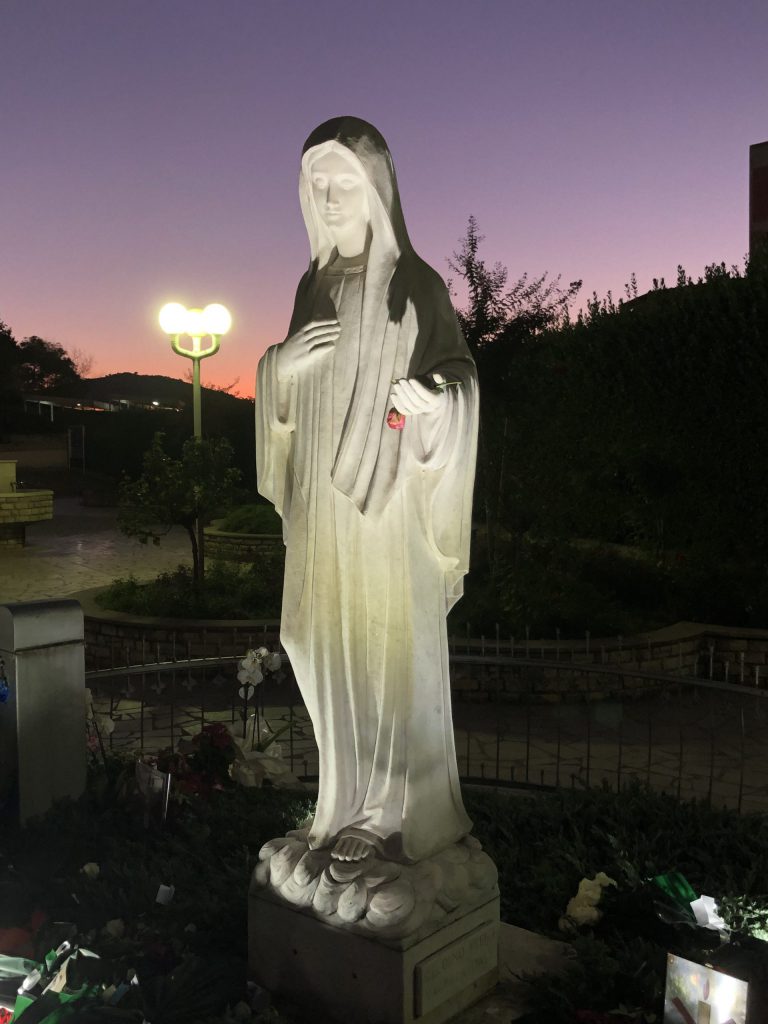
From 14 January 1982, the apparitions take place in the church, in a room behind the current statue of Mary, the current sacristy. This happens after the recitation of the Rosary, but before the Mass.
After daily apparitions with messages, the rhythm becomes once a week. On 8 January 1987, Mary says that instead of every Thursday, She will give messages on the 25th of each month. In addition, there are apparitions with a conversation.
There is a relationship between the apparitions in Medjugorje and those in Fatima, Portugal. This involves Mary's repeated calls for penance for sinners in both locations. On 25th August 1991, Mary says: “I call all of you, dear children, to pray and fast even more strongly, so that with your help everything may happen which I have begun through the secrets in Fatima.” During her apparitions, Mary also tells the visionaries to pray the rosary and to pray a lot. She also says that peace must return between God and humankind. Furthermore, the sun in Fatima and Medjugorje has exhibited peculiar behaviour.
The Franciscan padres have accepted and disseminated the messages from Mary with the visionaries. The visionaries are spiritually guided, particularly by priest Tomislav Vlasic.
During the apparitions, there are reactions from the local Bishop of Mostar. Initially, he is positive towards the apparitions, but later this changes completely. This high-ranking clergyman is under pressure from the communist authorities. He does not want a conflict with the communist regime, which is opposed to the Catholic faith. The bishop issues a negative judgment on the authenticity of the apparitions. He also wants nothing to do with the ecstasies of the visionaries. Due to the communist rulers, the media is also negative about the apparitions. The apparitions are threatened by the church and the communist government. This especially occurs during the war, which leads to the partitioning of Yugoslavia and the emergence of countries like Bosnia-Herzegovina, where Medjugorje is located. It is noteworthy that the church of Medjugorje has been spared from the violence of war. During the war years, Medjugorje becomes a centre of peace. Aid is provided to people during wartime through Medjugorje. Foreign goods meant for people in war-torn Yugoslavia are also distributed via Medjugorje. During this wartime, meetings between politicians and military personnel take place in Medjugorje. In this place, not a shot was fired and no bomb fell. When Serbian pilots fly over Medjugorje to drop bombs, they are blinded by a strange light. This prevents them from dropping the bombs. This is to the relief of the local population and the thousands of refugees who have found refuge in Medjugorje.
In the early years of the apparitions, the ecclesiastical, Roman Catholic authorities prohibited clergy from visiting the pilgrimage site. This situation has since changed. In addition to priests, higher-ranking clergy are also coming to Medjugorje.
Over the years, the pressure on the visionaries increases, as what is happening in Medjugorje is truly remarkable. Many have faith in the apparitions, but there are also critics who make themselves heard. Later, visionary Vicka Ivanovic says that people are free to believe in the events in Medjugorje. It is not an obligation.
In 1999, Franciscans who had allied themselves with the visionaries were expelled by the bishop.
In 2008, Tomislav Vlasic (born 1942), the spiritual advisor to the seers, was suspended by the bishop for spreading dubious doctrines, manipulation and mysticism. He also exhibited an insubordinate attitude. In 2020, he was excommunicated for continuing to present himself as a priest without permission.
In 2017, it was reported that the investigative commission, led by Cardinal Ruini, had spoken positively about the recognition of the first seven supernatural apparitions in Medjugorje. However, after the aforementioned seven apparitions, countless others occurred. The commission did not comment on the apparitions that followed.
The most important messages from the Holy Virgin in Medjugorje are about conversion, penance, prayer, faith, fasting, and peace. During Mary's meetings with the visionaries and later during celebrations, these core concepts are clearly expressed. However, Mary believes more is needed to achieve a world with more love for Her Son. The apparitions continue...
In 2017, Pope Francis appointed Polish bishop Henryk Hoser (1942-2021) as his special envoy to Medjugorje.
Documents from doctors and theologians demonstrate that the events in Medjugorje are significant. In May 2019, it was announced that Pope Francis had decided it is permissible to organise pilgrimages to Medjugorje. This is not yet Vatican recognition of the well-known events, which still require investigation by the Church. The development is that dioceses and parishes no longer need to organise private trips to the well-known and particularly beloved Marian shrine. Now, dioceses and parishes can organise trips to Medjugorje.
It is expected that the Church will show patience until the apparitions are over and will only then make further statements. However, the reality is that hundreds of thousands go to Medjugorje annually and that “Rome” no longer wishes to hinder them.
For a long time, the apparitions were seen by the Vatican as false private experiences. However, from 2020 onwards, there have been signs that the first apparitions of Mary in June 1981 may be considered authentic. The reason for this is that Medjugorje attracts hundreds of thousands of believers annually. Medjugorje's appeal is seen as a substantial, unstoppable, international movement that is becoming more important with each passing year. It is strange, however, that the Vatican makes a distinction between the first seven apparitions and the thousands that followed. This seems like a separation between good and evil. Undoubtedly, the Vatican sees a great deal of positivity in Medjugorje for the Church in Rome. Will the Vatican leave this “low-hanging fruit” to hang for a long time to come?
According to Mirjana Dragicevic, Mary announced on 18 March 2020 that She will no longer appear monthly to give a message. Mary told Mirjana to come once a year on 18 March, the visionary's birthday.
The former spiritual counsellor of the seers, Tomislav Vlasic, was excommunicated on 15 July 2020, banned from the church, because he continued to present himself as a priest.
In 2021, Mgr Henryk Hoser, Rome’s special envoy, passed away. He is succeeded by the Italian Mgr Aldo Cavalli (born 1946), who was previously the apostolic nuncio in the Netherlands. Cavalli becomes the apostolic visitor for the Diocese of Mostar-Duvno and specifically for Medjugorje. The experienced diplomat is tasked with managing the pastoral organisation and addressing political sensitivities. Questions arise such as: What is authentic faith? What nationalist feelings of revenge are present? Is there financial gain involved in the apparitions? Is there a craving for sensationalism? How can the millions of annual visitors to Medjugorje be prevented from being disappointed? These are questions awaiting answers for the Vatican.
In September 2024, the Vatican will issue a document recognising the positive fruits of Medjugorje. These include many conversions of people who have discovered the faith, numerous vocations, many confessions, and countless communions being distributed. Supernatural events are not mentioned. Consequently, the Vatican is not making a pronouncement on the apparitions themselves. Furthermore, there is no hindrance to calling Mary Queen of Peace in Medjugorje. The pilgrimage site will then have the “nihil obstat” prefix, which is Latin for “no objection”. This means the Vatican is permitting the devotion in Medjugorje but is not commenting on the authenticity of the apparitions. In effect, nothing will change. For more conservative Catholics, this statement may be an incentive to visit Medjugorje as well.
Since 1988, a multi-day international youth festival has taken place every year, usually at the beginning of August, with tens of thousands of young people from dozens of countries participating. Medjugorje is building for the present and the future.
In July 2026, vandalism was committed in the pilgrimage site. The statue of Mary in the square in front of the church was defaced and the outdoor altar was set on fire. According to an inscription, the apparitions in Medjugorje are false.
In recent years, Medjugorje has grown into one of the most well-known and most visited pilgrimage sites within the Catholic world.
Pilgrimage site
In Medjugorje, there is a large statue of Mary in the church for veneration. This is done daily by many believers. Church services are held daily and attract many visitors, with the prayer space usually being overcrowded. In this church, apparitions have occurred. Every day, there is a full programme of Masses in Croatian and in other languages. Late in the afternoon, there is a three-hour programme. This includes time for silent prayer, adoration of the Blessed Sacrament, veneration of the cross, communal prayer and singing. Afterwards, there is a Eucharistic celebration, followed by praying the Rosary for the intention of peace.
In front of the church stands a large, white statue of Mary, and there are always flowers present. This is the statue of the Queen of Peace. It was carved from Carrara marble by the Italian artist Dino Felici. Next to the church are many small rooms for confession. This can be done in Croatian and in other languages.
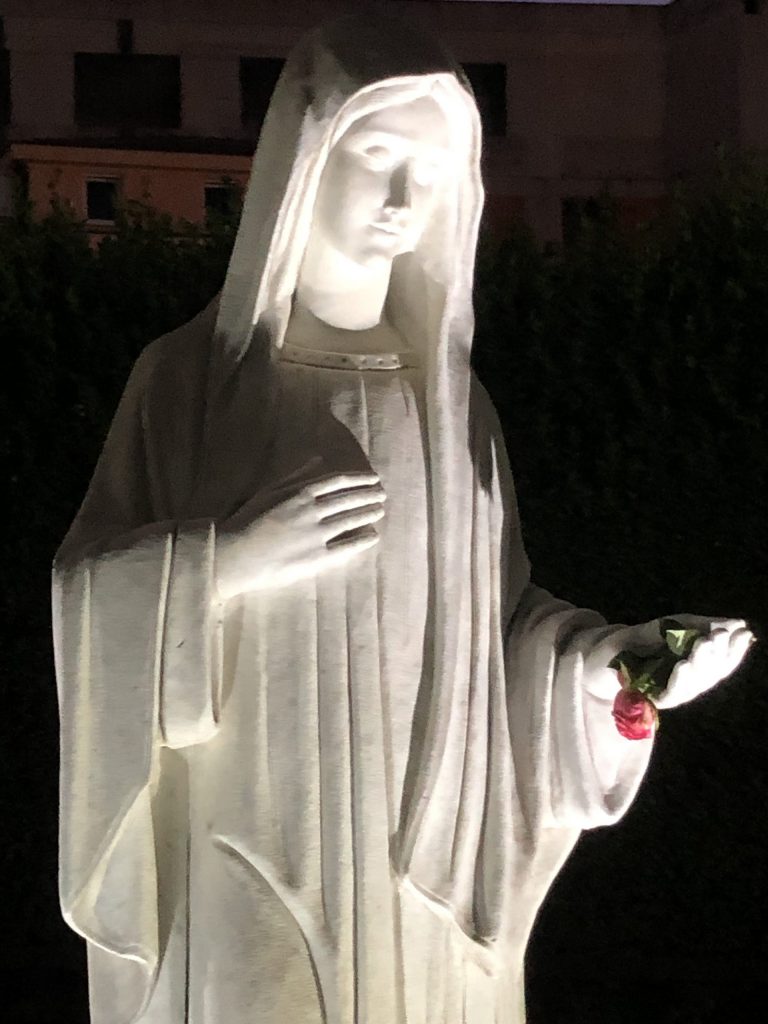
Behind the church is a large open-air space, where services for thousands of believers are held. The hundreds of benches can seat 5,000 visitors.
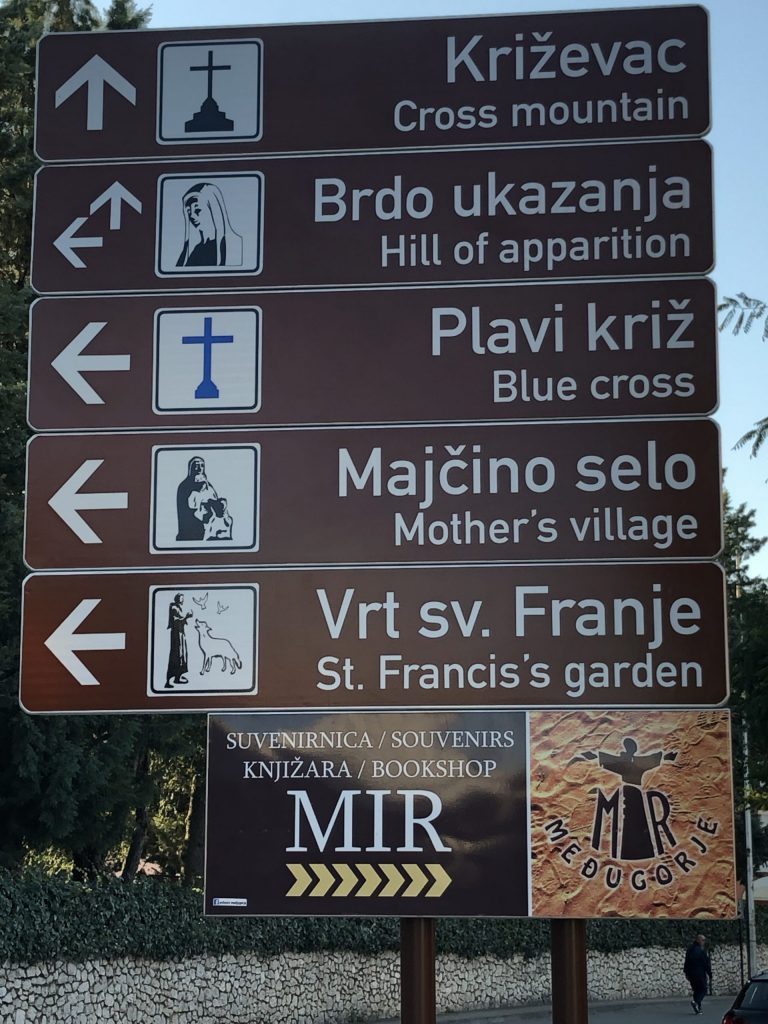
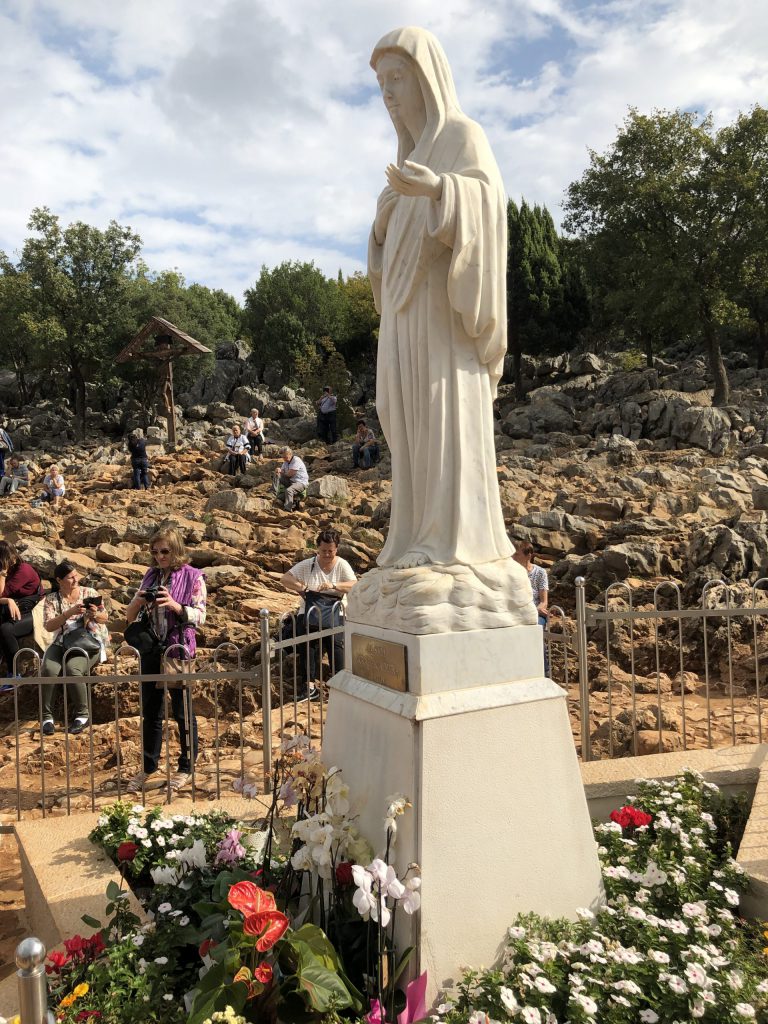
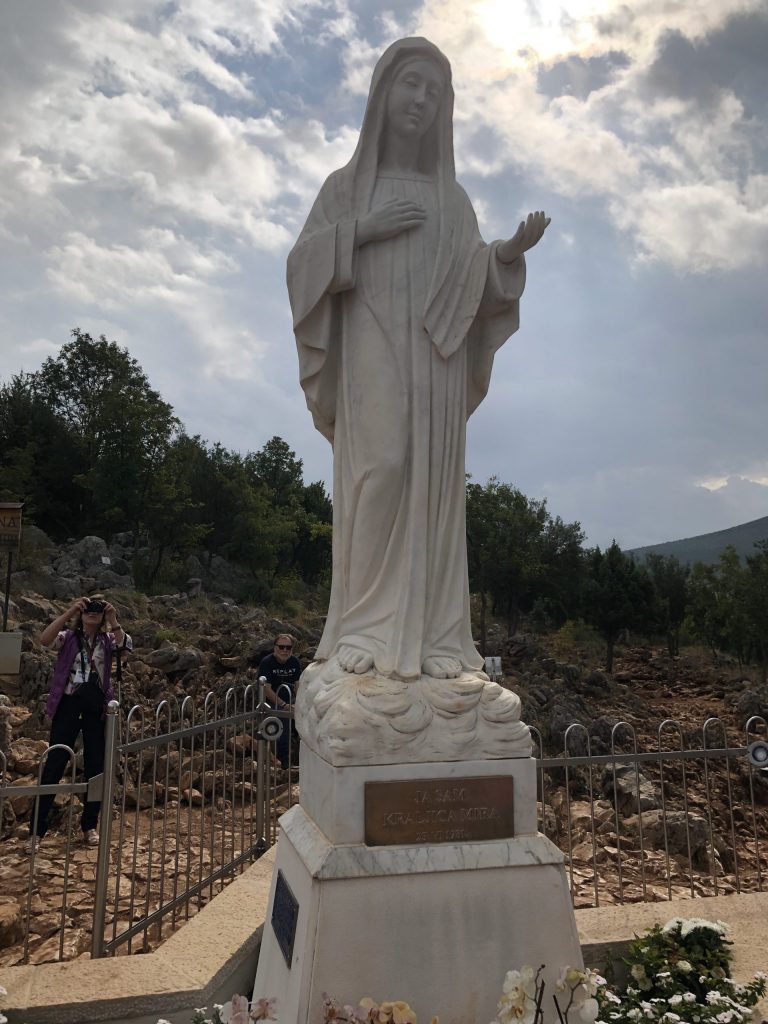
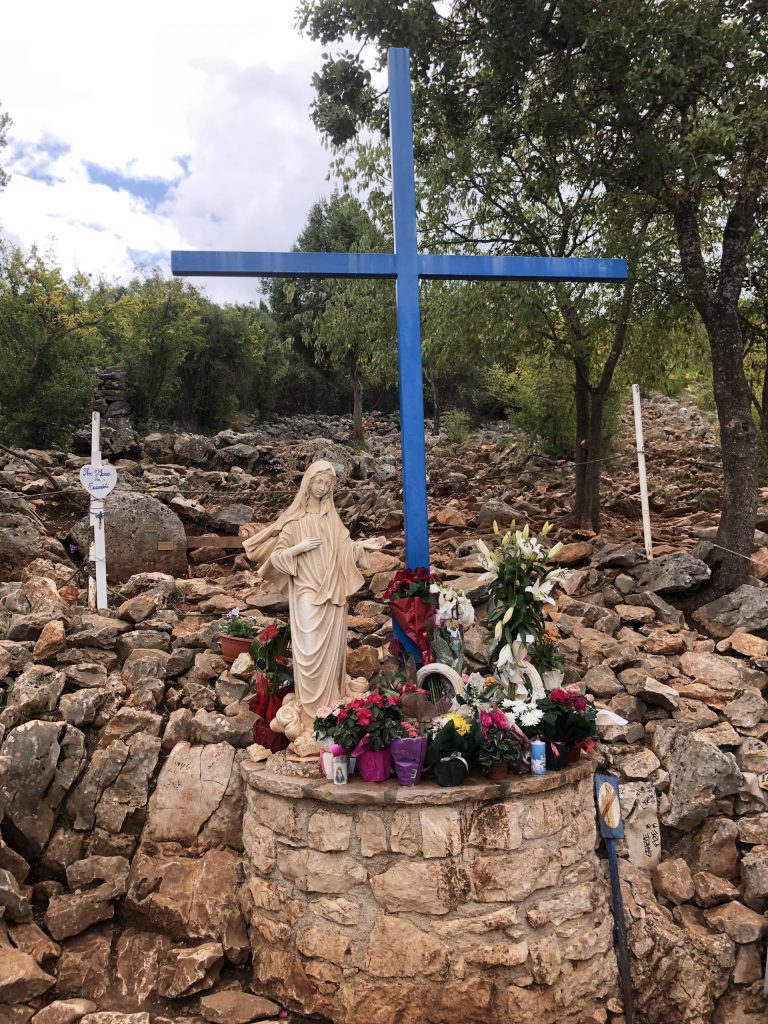
On the Apparition Hill, Podbrdo, there is a blue cross at the start of the climb, and a large statue of Mary further up. Mary frequently appeared in this place.
The parish is served by Franciscans and belongs to the Diocese of Mostar. The apparition site is located in the Catholic, Croatian-speaking region of Herzegovina.
Through the apparitions, visitors return to praying and to love for one another. This arises spontaneously and continues to motivate people to pray and to care for each other in a peaceful manner.
In Medjugorje, the word “MIR” is often seen, meaning peace. There are many shops selling devotional items. The place also offers numerous hotels and restaurants. All these establishments have come about due to the fame of the apparitions. Pilgrims primarily come to Medjugorje to pray and experience peace. Visiting hotels, restaurants, and cafes holds secondary importance.
ACCESSIBILITY
Medjugorje lies in the south of Bosnia-Herzegovina and is part of the municipality of Citluk. The pilgrimage site is located about 25 kilometres from the old, tourist town of Mostar, between this place and Ljubuški. This is close to the border between Croatia and Bosnia-Herzegovina. The A1 motorway from Split to Dubrovnik is exited at the Ljubuški or Mostar junction.
Address: Gospin Trg 1, 88266 Medjugorje (BIH).
Websites: www.medjugorje.nl and www.medjugorje.hr.
Experience
The first time I am in Medjugorje is for the youth prayer days in 2011. With my age, I am certainly no longer a young person, but in my head, it's different. Thousands of young people are noticeably engaged with their faith in Medjugorje. I see many praying and others singing. There are also those who give speeches or talk with others. This happens in about 100 languages. There is no shortage of diversity here. Young people wave flags and banners and applaud each other. I hear that some groups are going to Madrid in a few days, where World Youth Day is being organised this year.
I see more variety here compared to, for instance, Lourdes. Not only are there significantly many young people here, but also lots of parents with small children and countless seniors, right up to very old people. Sick people, such as those in wheelchairs and on stretchers, are hardly to be seen here.
During the open-air evening mass, which is unfortunately only in Croatian, I am estimating the number of attendees. With more than 10,000, I am being a bit too modest. I see many priests, in white robes, standing at the front. There are numerous nuns too, dressed in white or blue. Furthermore, I notice friars in brown habits. There are also many dressed entirely in black. The number of flags is impossible to count.
After the celebration, there is a procession to the cross at the summit of Kruisberg. Along the way, I pass the stations and so I notice that progress is being made. I see and hear that I am not the only one who is not very practiced at climbing and walking uphill. A steeply rising mountain path has to be conquered, which is strewn with large boulders. There are participants in this Way of the Cross who go barefoot to the top. A brave attempt. The stones are well-worn up to the fifth station, and after that, the wear on the stones decreases and the wear on the people increases. Not everyone is able to turn willpower into action. The summit is not reached by itself. It is good that I am not suffering from asthma now, otherwise I would have given up or not started this Way of the Cross. At the top of the mountain, it is a special sight, and I see a small Medjugorje lying below.
The next day I visit the place on the hill where Mary appeared, and it is less strenuous to reach. It is busy with people and pebbles. What great devotion to Mary prevails here. It is time to pray.
From 24 June 1981 onwards, apparitions have been taking place in Medjugorje. Mary frequently visits the visionaries. Initially daily, then weekly, and subsequently monthly or annually. She speaks, among other things, about purgatory, stating that many souls are there, including those of priests and religious. She also says that the best way to fast is on water and bread. The Blessed Virgin concludes every message with the words: “Thank you for answering my call.”
Miracles also happen in Medjugorje or through thoughts of the shrine. For example, inexplicable events of a supernatural nature have occurred. For instance, cancer patients who were given up for dead have suddenly been freed from their tumours, and those suffering from multiple sclerosis have been instantly healed.
Rome does not recognise Medjugorje as a place of apparitions. Is there anything left to prove? In any case, millions of people show their love for Mary here every year. A visit to Medjugorje gives me a particularly good feeling. For me, it is a spiritual and inspiring enrichment.
In 2019, during my second visit to Medjugorje, the church is central. At the back of the church, there is a life-sized statue of Francis of Assisi on one side and, on the other, Anthony of Padua welcomes visitors. Both men are wearing brown robes. I move further forward and reach the altar. Here, it is clear that this house of God is dedicated to James the Great. This apostle and martyr, who has his holy site in Santiago de Compostela in northern Spain, is depicted at the altar. This image shows a somewhat balding, reading, bearded man, with shells on his clothing.
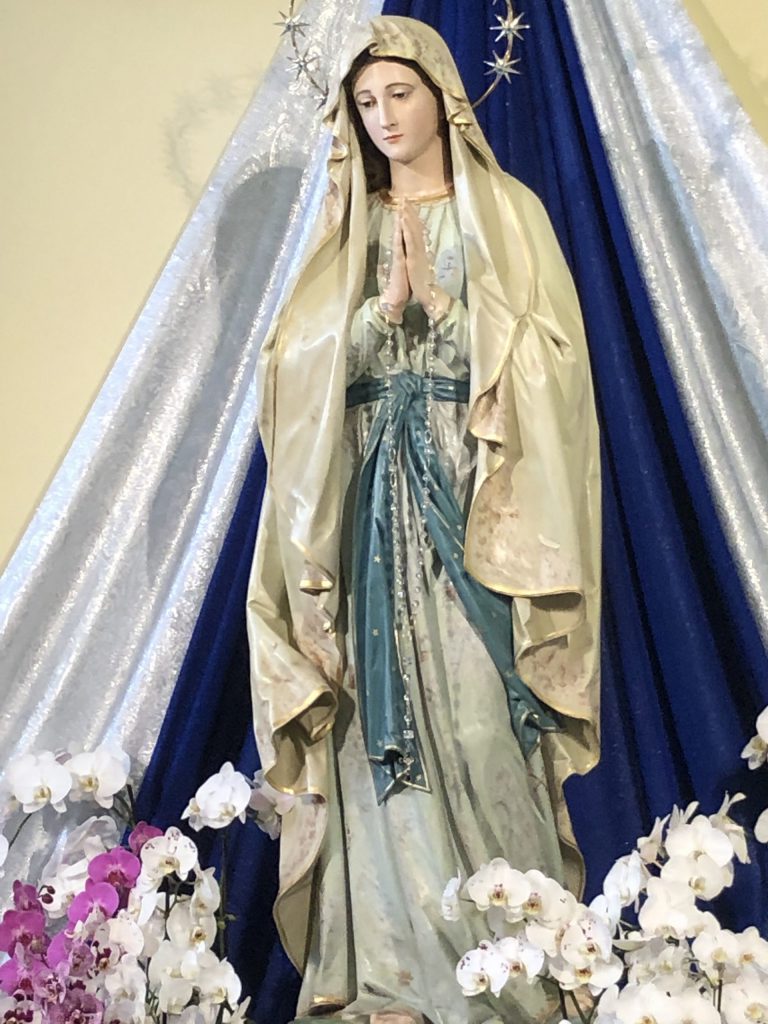
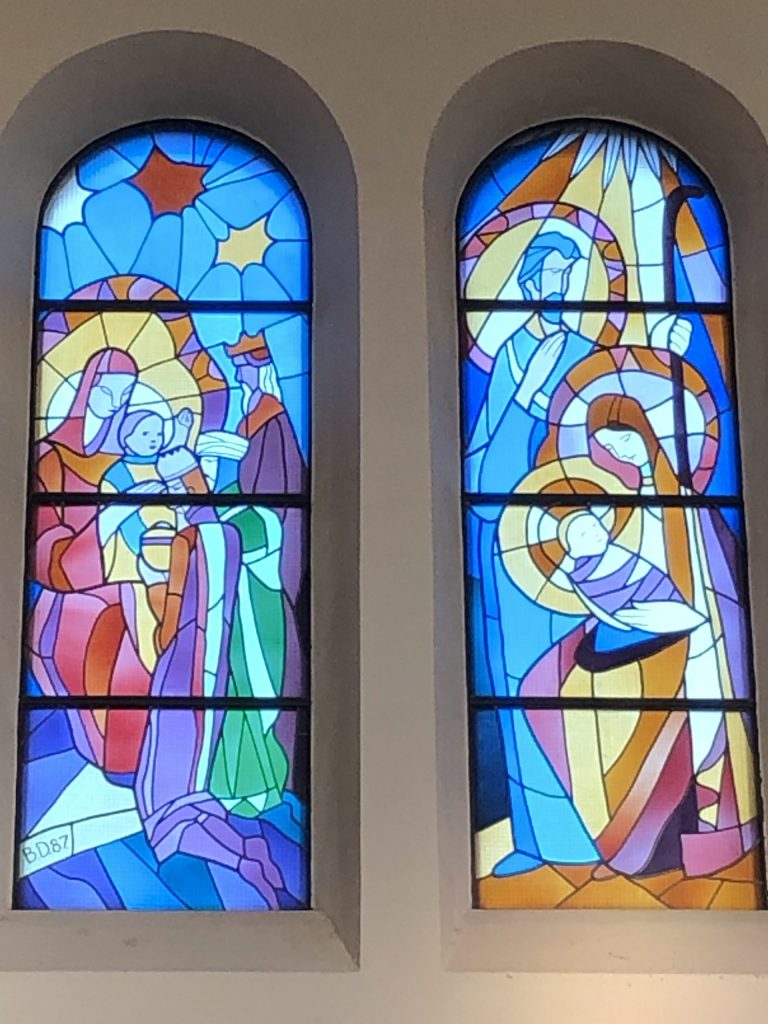
Next to the altar, I see the statue that draws by far the most attention; the statue of Mary. Many white flowers keep their distance between Her and the praying worshippers. Mary is depicted with dark hair and wears a white robe with a gold trim. The Madonna shows a lovely, young face. She holds her hands together upwards and has the rosary, with blue beads, with her. Around her waist, she has a greyish wide cloth with stars. Mary holds her head slightly tilted forward, and in this way, she looks at the visitors. The bench in front of the flowers is occupied by kneeling, praying pilgrims. Above the head of the Mother of God is a glittering symbolism with 12 shining stars, which belongs to a saint. Above Her flies a dove; the Holy Spirit. Between Mary and the wall behind Her, in a triangle, a white, somewhat yellowish cloth with a gold edge is attached. The people praying and looking at the statue of Mary form a continuous line. I also see others who are lost in thought; they are sitting or kneeling. Many have the rosary in their hands. Some visitors are also looking at the stained-glass windows, which tell a lot about Mary. In this church, apparitions have taken place in the Chapel of Apparitions, which is now the sacristy.
What fascinates me most is the devotion to Mary and this by thousands of visitors. Then I think of the war waged in this region not so long ago. The communist regime ensured an unpleasant course to make it difficult for people to profess their faith in public. This is how it happened for years. Now times are different. It is also busier than in the war years, and all this due to the apparitions, which began in 1981 and continue to this day. I see and hear the words MIR (peace) and MOLITE (pray) multiple times. This also fits with the content of the apparitions.
My next goal is uphill to the cross, high on the mountain. First, I'll pass the graveyard, which lies behind the church. After about 15 minutes of walking, I'll reach some souvenir and religious item shops. I notice that a lot of people are sitting on benches or have taken a seat on a terrace. When I look at the high-up mountain cross on Krizevac and see the path ahead, I understand. The route is nothing but pointed rock blocks and boulders, which are far from worn down. Only a select few are taking the path upwards. Unfortunately, my lungs are letting me down today for an arduous mountain trek, as I've been wheezing since waking up.
After having been at the foot of Krizevac, I am visiting the “Cenaculum” or “Last Supper”. This centre, established by Sister Elvira, focuses on the treatment and healing of drug addicts. This ever-growing organisation is located between Krizevac and Podbrdo.

Next, I will go to the hill (Podbrdo) where the apparitions took place. This is a fifteen-minute walk from “Cenaculum”. The apparition hill is not as high as the one with the large cross. However, the rocks are similarly pointed. The blue cross with a statue of Mary, which stands at the foot of Podbrdo, is a place for many to pray and rest. After greeting Mary at the blue cross, I continue upwards. I notice my lungs are giving me less air compared to my previous visit. With a little more effort and perseverance, I hope to reach the place of the apparitions as well. It's step by step, paying close attention to where I place my feet and maintaining my balance. After a good fifteen minutes, I arrive at the historical site. A large, white statue of Mary welcomes me. I get to experience a memorable event and begin to pray.
The other day I visited the church again. Busy or not, I like to be close to the statue of Mary for a little while. That means finding prayerful patience, as the queue waiting for the statue is tens of metres long. After more than an hour, I am kneeling on the brown communion bench by the statue of Mary. Here I feel welcome. The statue stands on a platform, and beneath her feet, in Croatian, is written “Medugorje”. Below that, a white cloth is attached with intertwined letters “M” and “A”.

Maria has opened “the school of peace” in Medjugorje. She says that in order to experience peace, people must first show love and know how to forgive. This school visit is strenuous and long-lasting. After all, this school has more academic years than any other school. Maria teaches believers to pray. Through this prayer, they understand more than ever what the Mother of God expects from everyone to save humanity. This primarily concerns the core values of Mir (peace), Molitva (prayer), Obracenje (conversion), and Post (fasting).
Environment
Near Medjugorje lies the tourist destination of Mostar with a famous bridge.
To visit Croatia, it is only a few kilometres to travel.
~~~

 Nederlands
  English (UK)
  Deutsch
  Français