In the “pilgrimage” section, the following are discussed:
History
well-known pilgrimage sites
-network of major pilgrimage sites
Meaning
en route
preparation
Thank you
atmosphere
individually or together
feeling
rituals
Culture against atheism
-back home
History
Going on a pilgrimage is following in the footsteps of countless pilgrims who have trod the path to Mary. It is connecting globally with believers of the past and present. Going on a pilgrimage is independent of strong, little, or no belief and is not bound to one religion. It means embarking on a journey. Pilgrimages to a meeting place with Mary have existed for centuries. A place of apparition often becomes a pilgrimage site, as has happened with Fatima (1917) and Lourdes (1858), for example. The place where a statue of Our Lady has been found also frequently becomes a place of pilgrimage, as has occurred in Scherpenheuvel (1604), among others.
Since the 8th century, there have been pilgrimages in the German region of Bavaria; a true land of Mary. Mary is also known as the Duchess of Bavaria.
Centuries ago, pilgrims went on religious journeys, travelling from one monastery to another. This led to the establishment of eating and accommodation facilities in many places along the routes.
The judge has imposed a pilgrimage on many convicted individuals as a fine or other punishment. Such a ruling has advantages, such as no costs for imprisonment, no strain on scarce cell space, and the convicted person is away for some time to reflect on the future. In the past, such a pilgrimage was not without its dangers, and not everyone survived the imposed journey.
Famous pilgrimage sites
A place of pilgrimage appeals to different groups of people, including young and old, believers and non-believers, religious individuals and clergy of high and low rank.
Places of pilgrimage, such as Fatima, Lourdes, La Salette, Montichiari, Loreto, Medjugorje, Banneux, Beauraing, Heroldsbach, Marienfried, Marpingen, Altötting, Mariazell, Handel, Heiloo, Meersel-Dreef and Scherpenheuvel, strongly capture the imagination of many.
Network of major pilgrimage sites
In 2003, “Le Réseau Marial Européen” (“The European Marian Network”) was founded, connecting over 20 shrines in Europe, including Altötting (Germany), Banneux (Belgium), Brezje (Slovenia), Fatima (Portugal), Loreto (Italy), Lourdes (France), and Mariazell (Austria). The aim of the cooperative is to promote meetings and exchanges, with the power of a pilgrimage site frequently discussed as a topic to continue receiving pilgrims. The initiator of the organisation is Frenchman Jacques Perrier (born 1936), Bishop of Tarbes-Lourdes (1998-2012).
Meaning
Historically, a pilgrimage has been a search for the meaning of life. Millions visit a pilgrimage site and return. These people need something tangible, and that is a pilgrimage site. It seems that many are seeking mediation and are in need of a higher power. In a Marian pilgrimage site, people come to experience meaning in their lives. A feeling directed towards Mary is always expressed at a Marian pilgrimage site. This often concerns establishing contact with something supernatural in order to find more meaning in life. People gather at a pilgrimage site to be with Mary. In doing so, they leave the cold environment of a secularised world and seek warmth with Our Lady in a welcoming context, rather than in a world where faith is not a common good.
When making a pilgrimage, there is a goal. Setting off on a pilgrimage is being on the way to arrive somewhere. This journey has significance for the pilgrim. Going on a pilgrimage touches the inner self and brings encounters, peace, and reflection. Through this, a pilgrimage gains meaning. Travelling to and reaching a Marian shrine adds value to life.
Undertaking a pilgrimage and experiencing a sense of purpose can also lead to a deeper immersion in faith. The religious significance of a pilgrimage is highly subjective. For some it is a relevant factor, while for others it is not at all. However, it is a fact that a pilgrimage can change a person.
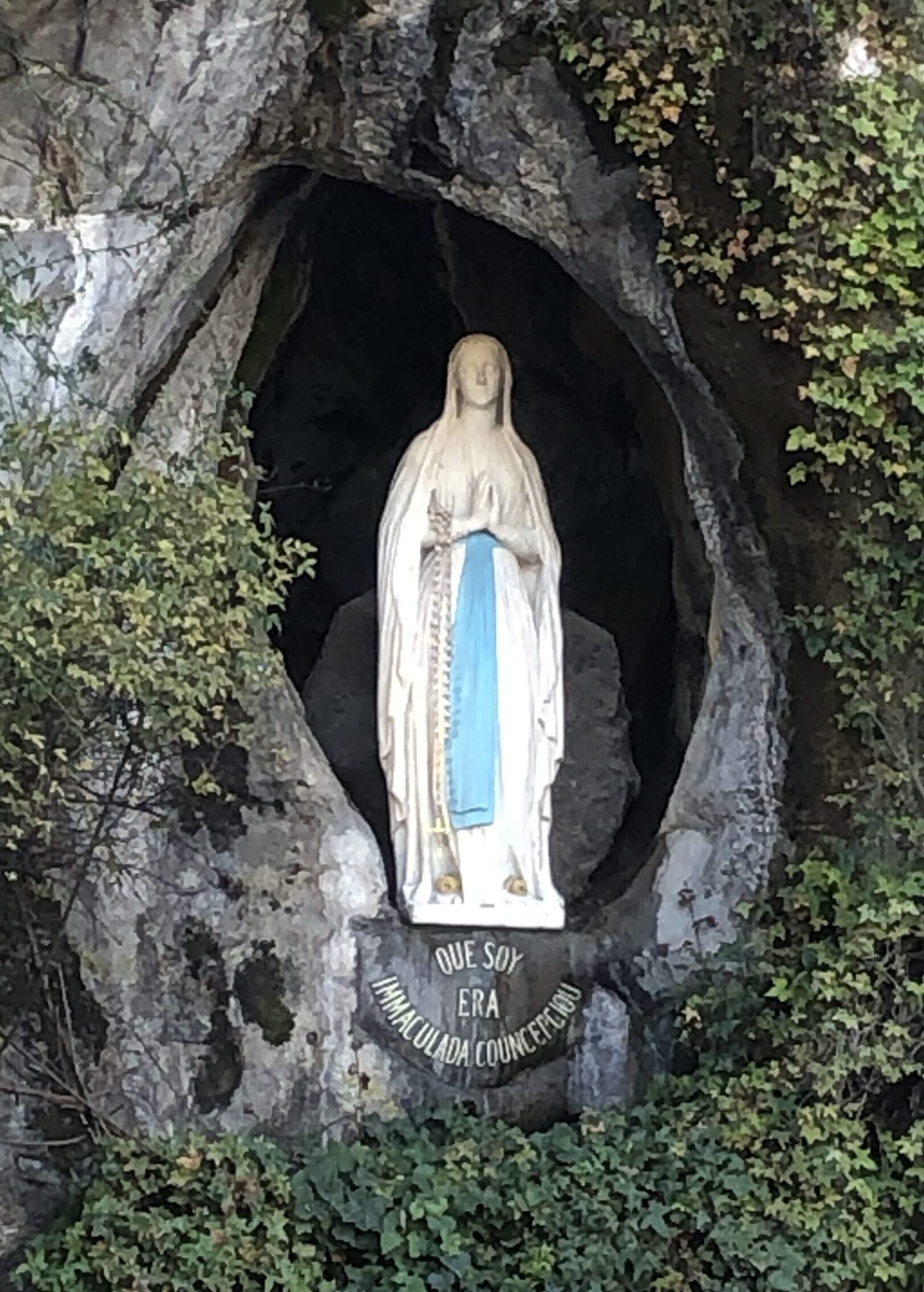
Shrines and apparition sites have become known over the many years as places with a high density of Mary's presence. Examples include the Grotto at Lourdes and the mountain at Medjugorje; places where Mary has appeared multiple times. It is the history and current context for prayer, meaning-making, and reflection at such locations that draw pilgrims to them. This is also how it affects me. A pilgrimage undertaken on foot is a means to experience values in life, such as simplicity, effort, and silence.
On the way
Going on a pilgrimage is common, with millions doing so every year. It is about visiting and meeting Our Lady. Going on a pilgrimage is about being allowed to come close to the Virgin Mary. After all, in a pilgrimage, the experience of Mary is central. The pilgrim is on their way for an encounter with the Mother of God. Being on the road is an essential part of the pilgrimage to come to an encounter with Mary. I experience the path to a place of pilgrimage as a spiritual, deeply touching prelude.
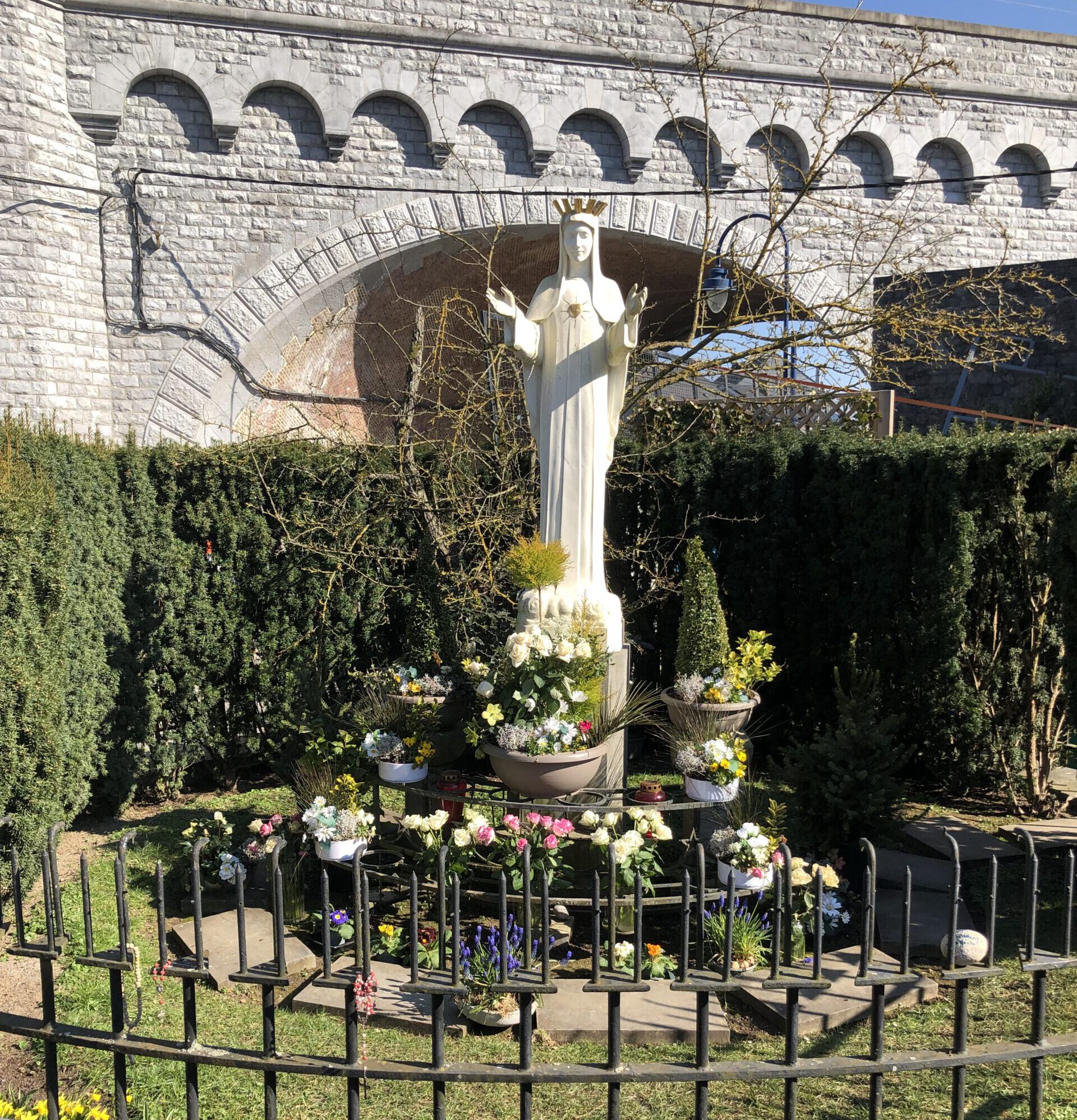
Going on a pilgrimage is travelling to a place where one or more miraculous events have taken place. The pilgrimage can be made alone or in company, and the journey is often made by car, bus, train, motorbike or on foot.
A place of pilgrimage is a point
What do I mean to myself?
What am I to others?
What does that day mean to me?
Which way will I go?
What can I do for Maria?
A pilgrimage is primarily a journey, where contemplation can play a significant role. Through contemplation, mysticism can be experienced. The silence and tranquility encountered can have a healing effect on the pilgrim.
The pilgrim is on their way to soon find their own path, even though there is still a long way to go.
Walking on a pilgrimage can be healing. You are alone with your thoughts, and this can be an emotional experience. A long foot journey to a shrine should not be underestimated. The many kilometres, hours of walking per day, a full backpack, heat, rain, and fatigue become palpable. Ultimately, it is an experience of feeling that you are capable of more than you think. You rise above yourself. The reasons for a long pilgrimage can be manifold, such as the death of a partner, finding more purpose in life, choosing a new path in life, making different plans... Along the way, friendships are often made with other pilgrims who are also on a pilgrimage. A long-distance pilgrimage is popular, and not just to places like Santiago de Compostela, but also to Lourdes and Fatima.
Preparation
To go on a pilgrimage, some preparation is needed. This involves asking questions and finding answers to them. Through these questions and answers, the pilgrim increases the chances of the journey's success.
Questions include:
Why go on a pilgrimage?
-Where is the pilgrimage going?
With what intentions to set off?
How to be in prayer?
How to travel?
-How to persevere?
A novena can also be held in preparation for a pilgrimage. This is an old custom for spiritual preparation before undertaking a pilgrimage, for example to Lourdes.
Travel agencies can offer a pilgrimage or Camino as a complete package with hotels, transport, luggage, route, and return journey.
Thank you
Visitors also come to Mary to thank Her for favours granted. This gratitude can relate to, among other things: keeping one's job, experiencing the love of neighbours, passing an exam, recovering well from an operation, or feeling well again. Pilgrims find healing and solace with Mary. Furthermore, it is for me a renewed expression of gratitude to Mary for the good things I am allowed to experience in life. Through encounters with Our Lady, I notice growth in my life.
Other reasons for making a pilgrimage include experiencing a pilgrimage as an event, and having undertaken a pilgrimage looks good on a CV (curriculum vitae). A pilgrimage can therefore also be used when applying for a job.
Atmosphere
I always experience a particularly pleasant atmosphere at a pilgrimage site dedicated to Mary. I find this strikingly beautiful because every pilgrimage site is different. At one site, only prayer takes place; at another, there is a lot of singing, and there are shrines with processions.
In a small pilgrimage site, I experience an intimate atmosphere. Visitors say they experience great intimacy, as can only be felt in a small shrine. The small scale, such as just a church with a statue of grace or a cave with an image of Mary, touches me deeply. Being alone or with a few people at Mary's shrine allows for quiet reflection on life. It is then a time for silent prayer and contemplation.
Visiting a major Marian shrine is different when many people pray together or attend a celebration. It is then a journey towards Our Lady. I see many people withdrawing to come to prayer in silence to Mary, and I do that myself too.
Individually or together
Going on a pilgrimage and arriving at a Marian shrine is a coming together, as a pilgrimage is a collective and/or individual experience of faith. After all, Our Lady brings people together. This gives pilgrims a warm welcome and a pleasant atmosphere. People experience a connection with each other and with Mary. A stay in a pilgrimage site therefore brings encouragement for the rest of one's life.
During a pilgrimage, people come into contact with others on multiple occasions. They talk about their past and find a sympathetic ear when sharing what concerns them.
Feeling
During a pilgrimage, the desire for Mary grows. The feeling of having contact with Our Lady gradually increases. Consequently, the pilgrim and the Virgin Mary have a connection. There is a sense of attraction. For one, this is the maternal feeling received, and for the other, it is experiencing support. It can also be salvation, simplicity, strength, and comfort that is felt, amongst other things. Sadness is shared and thanks are expressed to Mary. There is then a great trust between the Mother of God and the pilgrim to share and receive much. This is fascinating popular devotion of great value for the pilgrim's well-being.
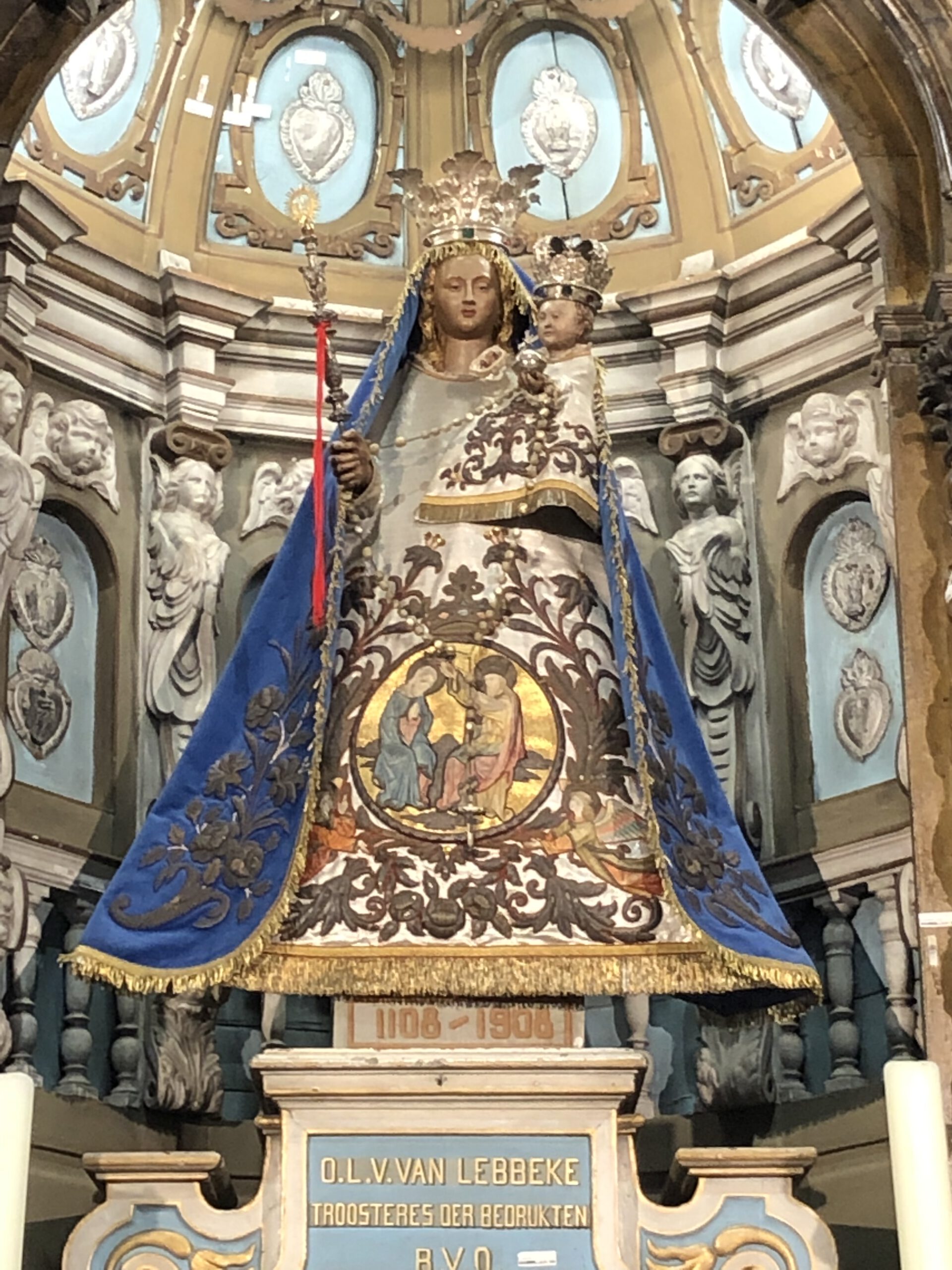
Visitors to a place of pilgrimage experience a special feeling. This is partly due to the reason for visiting Mary. Pilgrims take a backpack on a pilgrimage, and this is not only in the literal but also in the figurative sense. Pilgrims carry a mental backpack, in which all sorts of past events are stored. For some, this may be an illness, and for others, an argument, a loss, or an accident. These are intense experiences that the person has gone through. At a place of pilgrimage, certain events can be shared with Mary. By presenting aspects of the past to Mary, such as pain, sorrow, betrayal, illness, or worries, pilgrims hope to receive the strength to bear that past. This faith in Mary gives a special sensation.
Every time I receive a joyful feeling seeing what Mary brings about in a pilgrimage site for me and the pilgrims. Furthermore, I have enormous admiration for those who dedicate themselves to the sick and elderly in a Marian shrine, such as in Lourdes. Without them, it is not feasible for many people to go on a pilgrimage. People who are dependent on others also want to share their feelings with Mary.
Rituals
Pilgrimages involve rituals, such as singing, praying, processional walking, and lighting candles. At many pilgrimage sites, these have been passed down through generations for centuries. As a result, Marian devotion has held an important place in society for centuries. Marian devotion has endured over time because Our Lady belongs to both the heavenly and earthly realms; she thus occupies a unique place for many. This is reinforced by the experience of a receptive ear in Mary.
A ritual also includes making offerings to Our Lady, such as silver and wax objects, effigies, votive paintings, children's drawings, and other tokens of gratitude, including ex-votos, often with the date, name, and words of thanks on a plaque.
As a memento of a pilgrimage, items such as pilgrimage books and pennants have been made. This tradition dates back to the 17th century. For me, the memories are first and foremost beautiful thoughts, which I cherish for a long time, and also candles and figurines, rosaries, photographs, and little books that I brought back. In this way, the pilgrimage is re-experienced at home more than once.
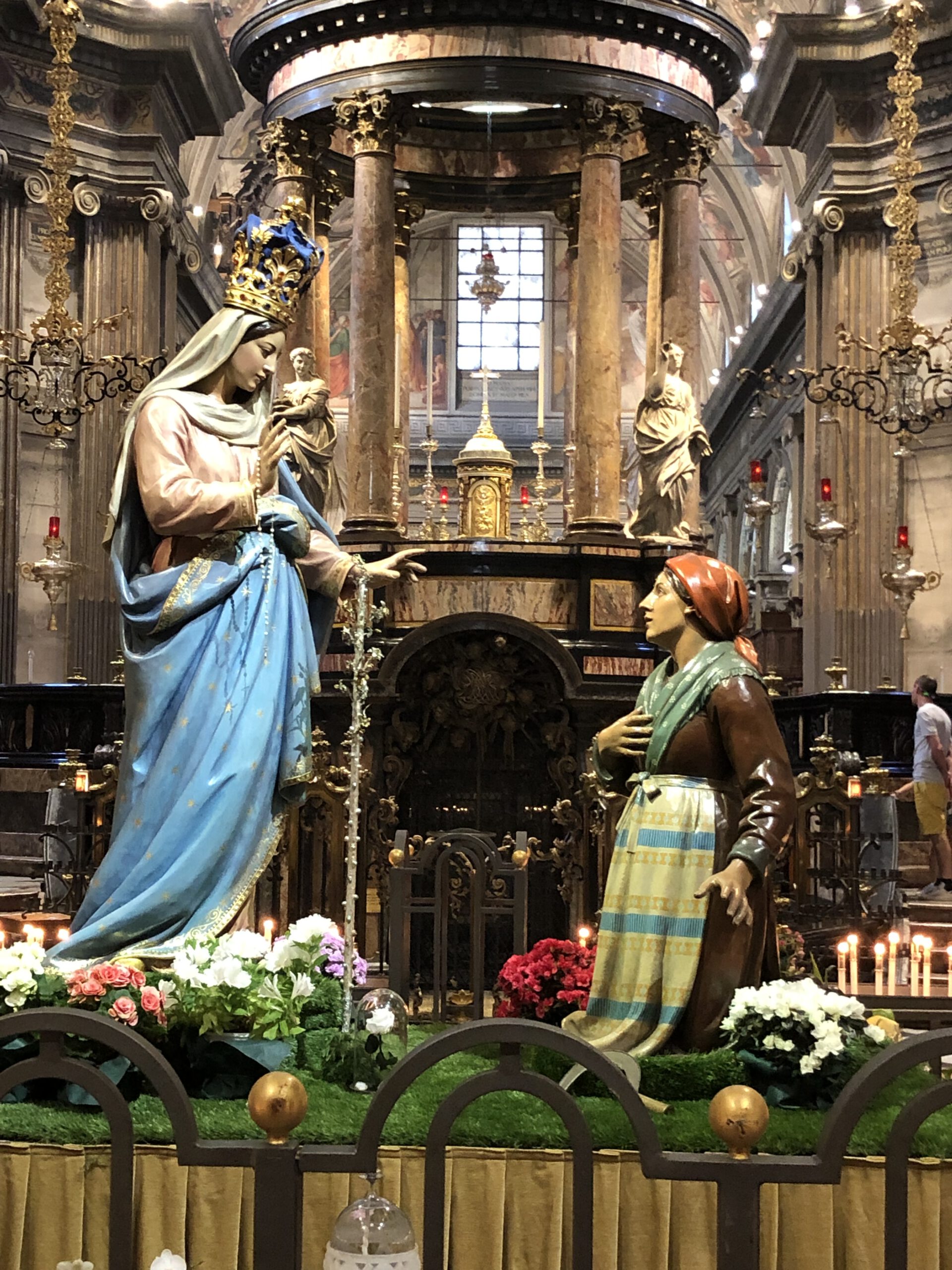
When going on a pilgrimage, praying the rosary and attending various special beautiful activities, such as a eucharistic celebration, an evening prayer and a Way of the Cross. It also includes sharing the sense of faith with others and participating in a candlelit procession with many candles. Seeing the lights reminds me that everyone can use some light. I also find it special to visit various places with constant messages from Mary. In every place there is much to see, hear and experience from and with Our Lady. Thus, encounters with Mary enrich my thinking and doing. However, going on a pilgrimage can also be a completely different experience, such as experiencing silence and coming to reflection. A pilgrimage can therefore also aim to find peace and get to know one's “inner self” better. This can be done by taking a long journey or by experiencing peace in a place of pilgrimage, reflecting on life and sharing it with the Mother of God. In this way, one can come to terms with oneself, receive strength and inspiration to move forward. How valuable it is to experience such great love and to discover the unique charm in each Marian shrine.
Many people live on by staying at a Marian shrine and then praying before an image of Mary. A miracle then occurs, and as a result, more meaning in life is experienced.
Culture versus atheism
Many pilgrimages toMarian shrines prove remarkably resilient to dechristianisation and the erosion of faith in Our Lady. The number of visitors to places such as Scherpenheuvel, Medjugorje, Loreto, Covadonga, Fatima, Lourdes, Kevelaer and Heiloo appears to be declining little, if at all. It follows that pilgrims continue to find time and are willing to spend money to go on pilgrimage individually or in groups. They experience pilgrimage as meaningful and life-affirming. Pilgrims frequently view the pilgrimage as a means to spiritually recharge and receive inspiration. It is also a way to thank Mary for energy, healing, feeling, strength, solace, safety and friendship. A Marian pilgrimage site is a beacon of faith in Our Lady and a formative experience. In times of dechristianisation, a pilgrimage site is a culture against atheism. It is remarkable that in countries with increasing numbers of non-believers, such as Belgium, Germany, France and the Netherlands, Marian shrines are visited frequently.
Traditionally, a pilgrimage is a religious journey and is immensely popular among believers. There are numerous pilgrimage sites, and consequently, there is a wide choice of pilgrimages to undertake. The choice is based on devotion to a saint, and very often this is Mary. Personal preference brings a pilgrim to a desired destination. Until recently, a pilgrimage was mostly undertaken by a believer. This situation has changed, as more and more non-believers are making pilgrimages.
More and more pilgrimages are becoming pilgrimages or pilgrim journeys. On such a journey, the pilgrim is often travelling by bicycle, horseback, or on foot. In recent years, there has been increasing interest in undertaking a pilgrim journey to a destination. In this context, the journey itself is considered more important than arriving at the destination. The pilgrim's religion is irrelevant; undertaking a journey while not being religious is becoming increasingly common. This journey is a cultural trip or the covering of a route to be more contemplative and introspective. If there is an element of faith for the pilgrim, it is more about reflection during the journey. Such a pilgrimage is then not a pilgrimage to a place where Mary has appeared or where She or another saint is worshipped. A pilgrim journey is a personal, spiritual quest for what is considered “holy” but is not a shrine. There are no religious motives involved. It is noteworthy that pilgrimage sites are responding to the trend of travelling and being on the move. A pilgrimage site then advertises itself as a pilgrim destination, hoping to generate more interest. The distinction between the meaning of a pilgrim journey and that of going on a pilgrimage is thus becoming blurred.
Back home
After visiting a pilgrimage site, it's time to go home. Praying to Our Lady also happens during the return journey, as the entire pilgrimage encompasses the preparation, the outward journey, the visit, the return journey, and looking back.
The journey home is made with a good feeling, as many experience that Mary helps by healing, giving strength, and bringing inner joy. So many miracles happen during a pilgrimage. Long-lasting memories are born through the pilgrimage to Mary. Feeling reborn upon return is heard more than once. It can change one's life.
Reflecting on visiting a pilgrimage site conjures up a film in one's mind. The pilgrim has experienced that going on pilgrimage to a Marian shrine means giving Mary a place in the light. This is a consequence of revering the Woman who, through her life of faith, worked immensely hard for the well-being of people. As a result, Mary is a strong example for many, who take Her as a role model.
I come home and feel like the light stays on when I think of Maria.
~~~

 Nederlands
  English (UK)
  Deutsch
  Français