History
The fame of Liesse Notre-Dame (Our Lady of Joy) stems from an event in the Middle Ages, during the period of the Crusades.
Three brothers, Hector, Henri, and Jehan, have joined the religious knightly order of the Knights Hospitaller. They come from the vicinity of Laon and set off for the Holy Land around 1110 to fight against Muslims. In 1134, the three men are ambushed and captured in Ascalon, 20 km from Jerusalem. They are subsequently taken to Egypt. They are brought to Cairo. The Sultan in Cairo presents them with a choice: renounce their Christian faith and become Muslims, or go to prison and later face the death penalty. The Sultan employs servants to convert them. These servants are unable to turn the three men from their faith.
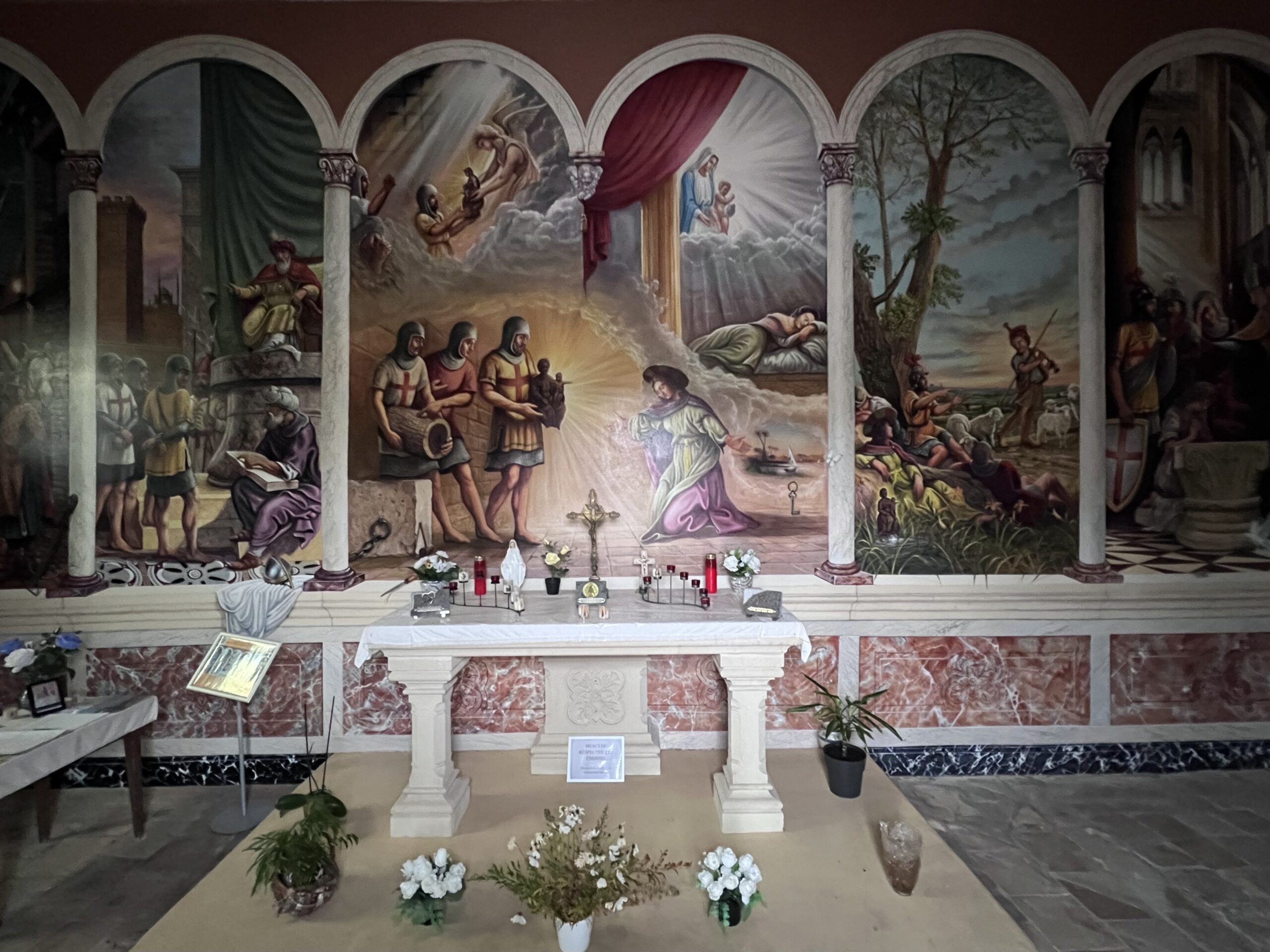
The sultan has a beautiful daughter named Ismeria (Ismérie). He sends her to the three imprisoned brothers to convert them to Islam. If she fails, the three prisoners will face the death penalty. Daughter Ismeria strikes up a conversation with the three men and shows an interest in their faith. After Ismeria hears more about the Christian faith, she asks if one of them can show her an image of the Virgin Mary, because this woman has such a beautiful face. Jehan responds by offering to carve a wooden image of Our Lady of Joy. That night, Mary appears and a great light fills the prison, whilst angels sing. This wakes the three brothers; they fall to their knees and see an angel placing a small wooden statue of Mary at the feet of the eldest brother. It is the image of a joyful Our Lady. They name it Our Lady of Joy (Notre-Dame de Liesse), because Mary brings joy to people. A little later, Ismeria comes to the prison and is curious about the brothers’ work. Ismeria is utterly delighted with the small image, and the brothers tell her that this is Our Lady of Joy, because Mary brings joy to the heart. Ismeria thinks it is a beautiful statue and says that no human could have made it, but that it is from God. She is given permission to take the statue home, and there she gazes at it all day long in complete adoration. That evening, Mary appears to her in a dream and instructs her to free the three knights. She asks Mary that, if she becomes a Christian, the three brothers will be freed from captivity. The following night, Ismeria takes the statue to the prison and tells the three brothers about her dream. A little later, Ismeria and the three men escape. After travelling for hours, the four reach the River Nile, get into a boat and sail to the other side. They then continue on foot and, after hours of walking, grow tired, rest and fall asleep. Through Mary’s intercession, angels lead them to a spring. After a few hours, the four awaken by a spring in the northern French village of Lientia, near Laon. A shepherd tells them that they are in northern France. This takes place on 2 July 1134. They go to the castle at Marchais and suddenly realise that the statue of Mary is no longer there. The four then return to the spring and see the statue standing in the water. This is a miraculous event. The men take the statue back to Marchais, but the burden becomes so heavy that the statue can no longer be lifted. They stop and place the statue where the basilica now stands. From then on, this place becomes a Marian pilgrimage site.
Ismeria, daughter of the Sultan, marries Robert d’Eppes, after she is baptised on 8 September, the birthday of Mary, in the year 1134 and receives the name Maria (Marie). The baptism is performed by Barthélémy de Jur (c.1080-1158), Bishop of Laon (1113-1151). That is the story of the three brothers and the princess.
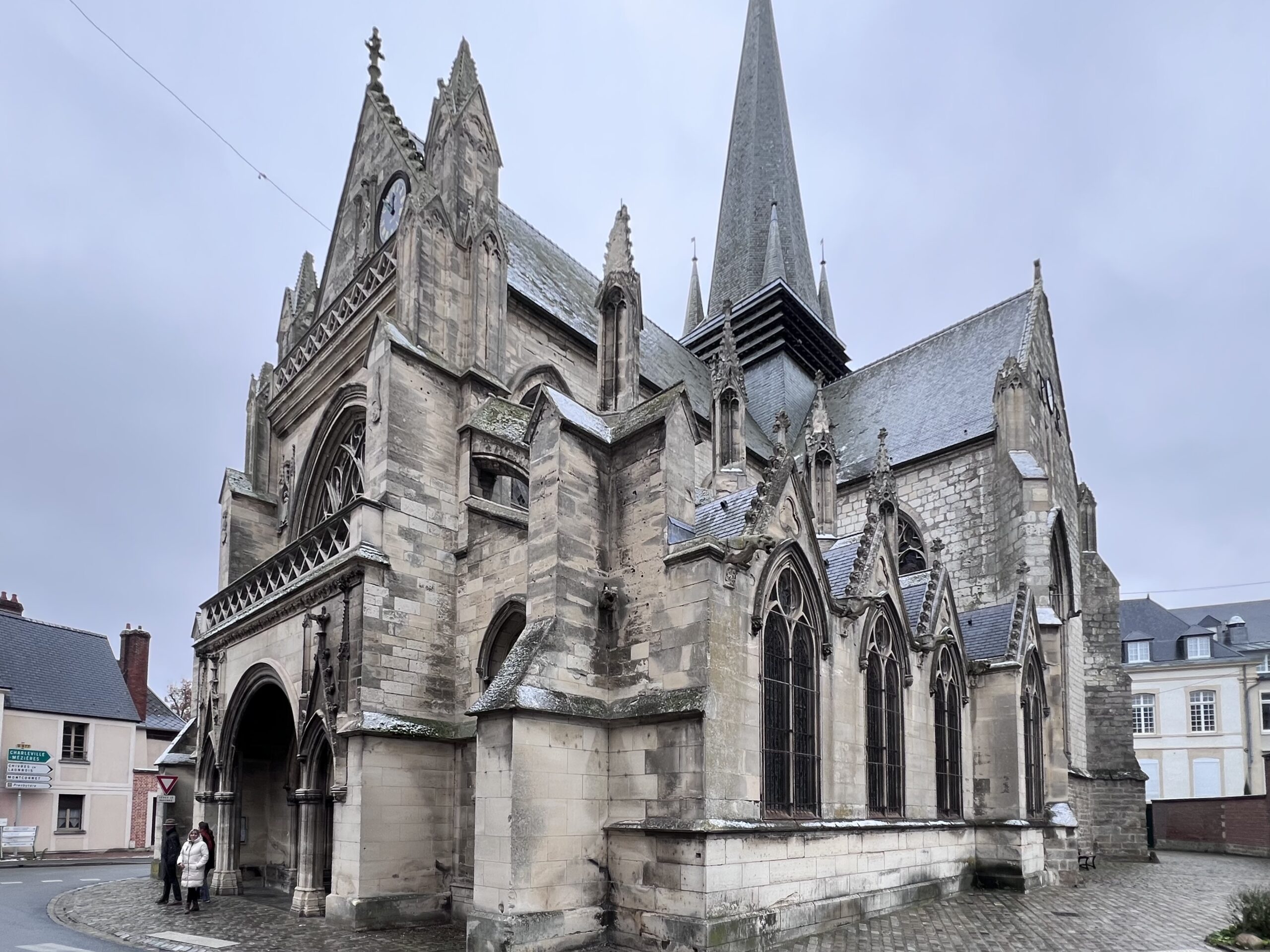
The church was built in the Gothic style in 1134. The church was initially a chapel and was built using leftover stones from the construction of the cathedral in Laon. Bishop Barthélémy de Jur was responsible for this. The chapel was rebuilt in 1384 and enlarged in 1480.
In 1139, the first miracle known to have taken place occurred. An unfortunate man had stolen to provide food for his family. He was caught and sentenced to death by hanging. He was hanged and invoked Our Lady of Liesse. Three days later, a shepherd found the man, with the noose still around his neck, but alive. The condemned man said that the hand of Mary around his neck had saved him. This miracle became widely known throughout the region, and the number of pilgrims increased. Subsequently, many miracles were performed at Our Lady of Liesse.
From the very beginning up to the 18th century, many French members of the royal family visited Liesse Notre-Dame. Partly due to this, Liesse Notre-Dame became the pilgrimage site for the French. Among those who came on pilgrimage to Liesse Notre-Dame were:
-Louis VII, the Younger (1120-1180), King of France (1137-1180).
-Louis XI (1423-1483), King of France (1461-1483).
-Maria de’Medici (1575-1642), Queen of France (1600-1642), wife of Henry IV (1553-1610), King of France (1600-1610).
Louis XIII (1601-1643), King of France (1610-1643) and his wife Anne of Austria (1601-1666), Queen of France (1615-1643).
- Louis XIV (1638-1715), King of France (1643-1715) and his wife Maria Theresa of Austria (1638-1683), Queen of France (1660-1683).
In 1568, the pilgrimage site suffered from a religious war. Troops of the Prince of Orange destroyed statues and took away art treasures. The statue of grace was brought to safety in time to the cathedral of Laon.
The large ox-eye, halfway up the church, was built in 1616.
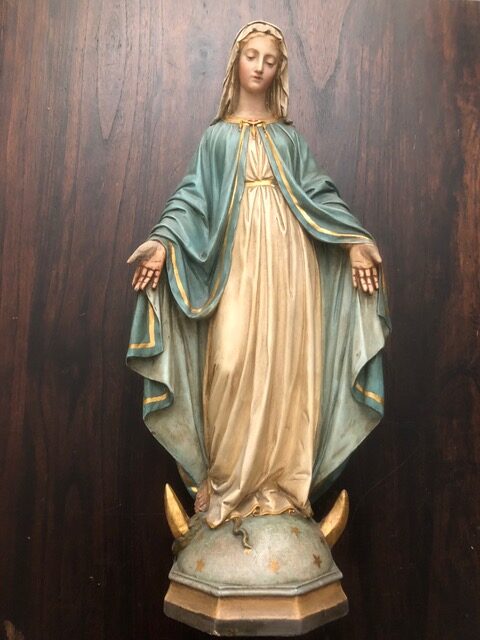
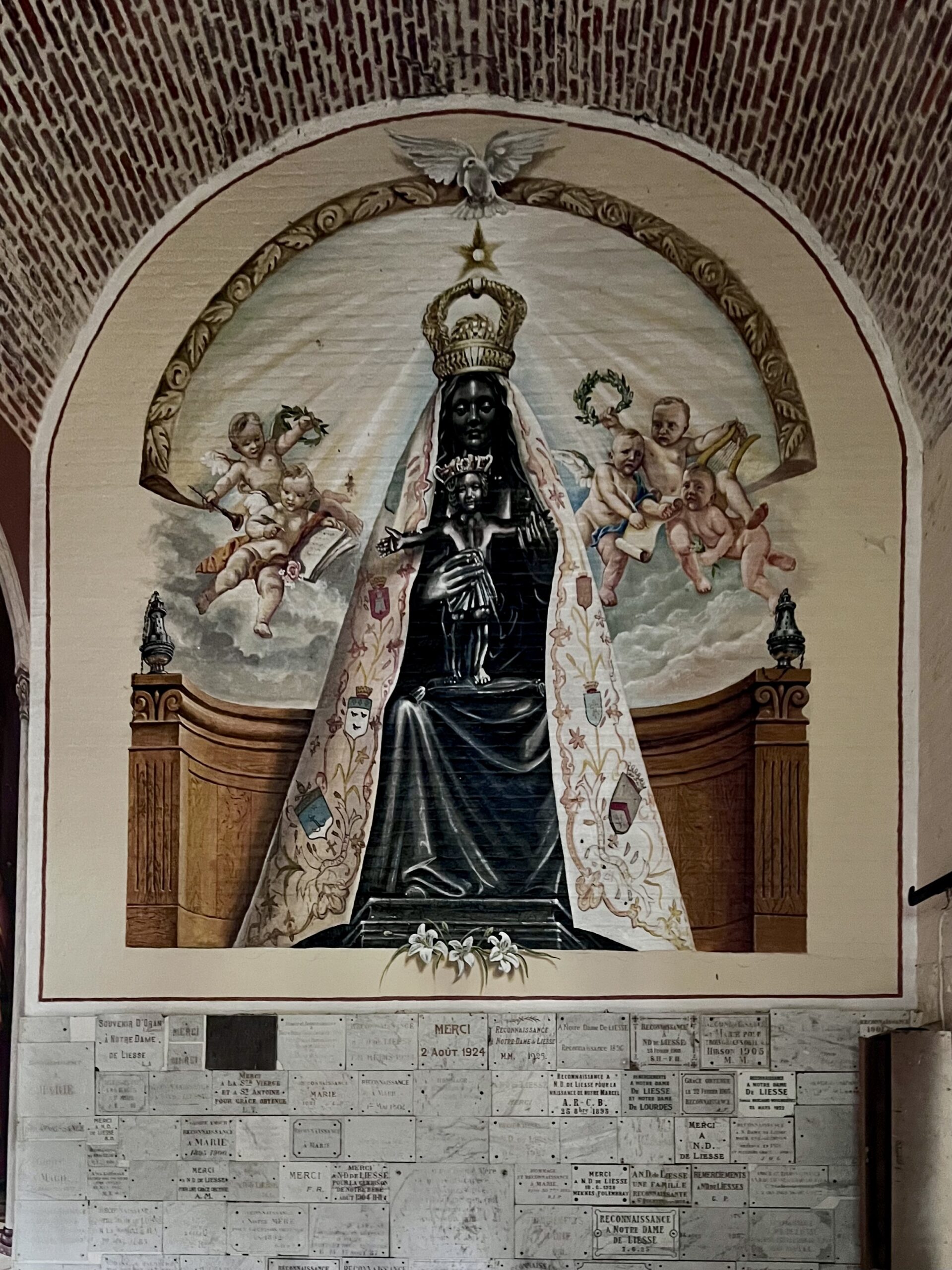
The current, seated statue of the Black Madonna dates from 1857 and was created by sculptor Charles Buisine-Rigot (1820-1893). The previous statue was burned in 1793. The statue of Mary was crowned on 18 August 1857 with the approval of Pius IX, Pope from 1846-1878, born Giovanni Maria Mastai-Ferretti (1792-1878). The coronation was performed by Jean-Pierre-Jules Dours (1809-1877), Bishop of Soissons from 1863-1876. Following this, the fame of Notre-Dame de Liesse spread to many countries and its name was adopted in places including America, Japan, China, Ceylon, Gabon and Madagascar.
In the period 1860-1890, major restoration works took place in the basilica.
In 1913, the church was elevated to the status of a basilica. This occurred after approval from Pius X, who was Pope from 1903 to 1914 and was born Giuseppe Melchiore Sarto (1835-1914).
In 1917, during the First World War (1914-1918), the basilica was requisitioned and subsequently used as a hospital.
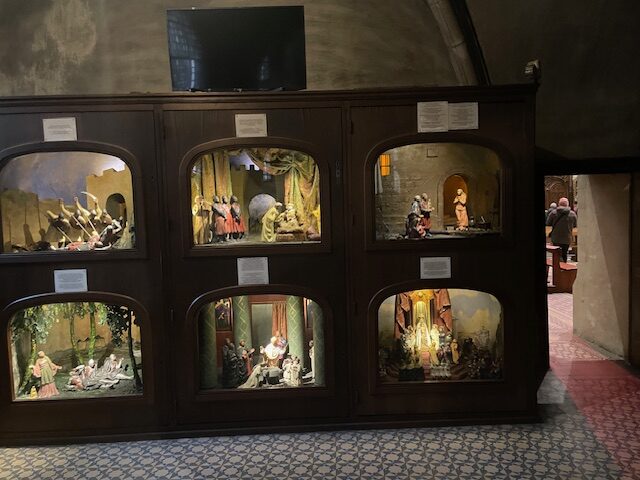
In 1934, the diorama arrived in the basilica, behind the choir screen, and showcases the history of the pilgrimage site in several display cases with colourful figures and scenery. The miniature replicas are by French artists Susanne Soutra (1897-1986) and Yvonne Soutra (1905-1993).
In 1940, on Whit Monday, the basilica was bombed as a result of advancing German troops during the Second World War (1939-1945).
On 26 July 1949, the crowning of the grace image took place, as the previous crown had been stolen. The crown was made by the Italian company Mellerio, which was founded in 1613.
In 1964, the esplanade was constructed.
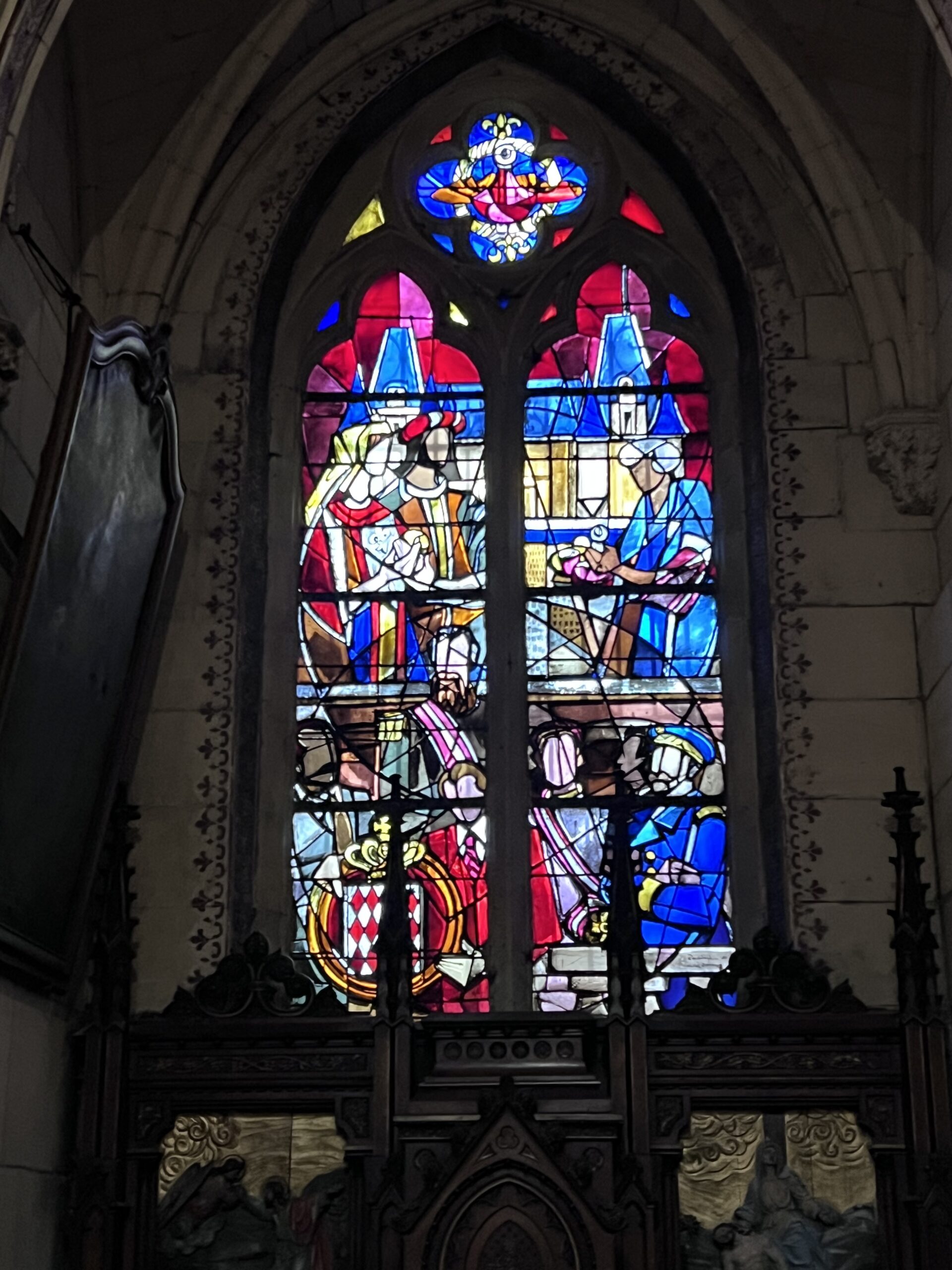
The new stained-glass windows in the basilica were blessed in 1976. The coastal works were created by Jacques Despierre (1912-1995).
In 1982, Notre-Dame de Liesse is appointed patron saint of the diocese.
The restoration of the Holy House (Santa Casa) is taking place in 2017.
In 2021, painter Pierre-Emilien Grenier (*1950) created a large fresco in the Santa Casa depicting the experiences of the three knights.
The image of grace was blessed in Rome on 7 January 2022 by Francis, Pope in the period 2013-2025 and born Jorge Mario Bergoglio (1936-2025).
In 2023, the basilica's new altar was consecrated.
At the spring in Liesse-Notre-Dame, miraculous healings have taken place over the centuries. The current chapel by the spring dates from 1857. Next to it stands a building that resembles the Holy House (Santa Casa) of Mary from Loreto in Italy.
Pilgrimage site
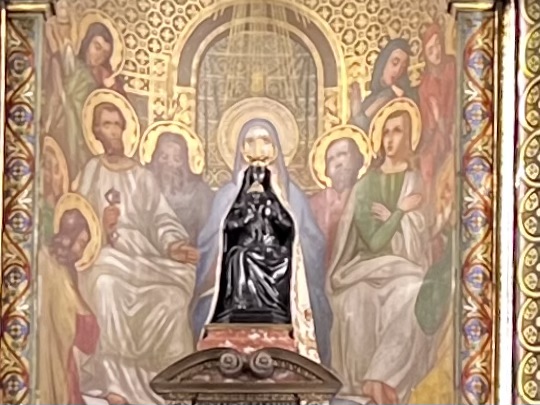
In the village stands an imposing basilica containing the miraculous statuette of Mary, where prayers are answered and graces are obtained. The miraculous image in the basilica is the Black Madonna.
Of the town with the pilgrimage site, it is said, “Notre-Dame de Liesse, source et cause de notre joie” (Our Lady of Liesse, source and cause of our joy).
In the basilica, display cases showcase depictions of the history of the pilgrimage site's origins. Honouring the Black Madonna refers to the story of the daughter of the Sultan of Cairo.
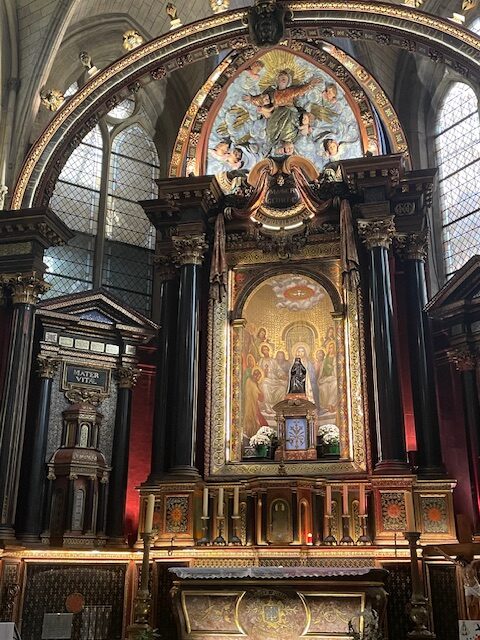
The altarpiece for the high altar, dating from 1610, is in the style of the Italian Renaissance. It is a gift from Maria de' Medici (1575-1642), the second wife of Henry IV (1553-1610) and Queen of France (1600-1610). She is the mother of Louis XIII. In front of the altarpiece stands the effigy of the Black Madonna, made of ebony. At the top of the altarpiece is the depiction of the Assumption of Mary.
The colourful stained-glass windows are from 1976. The previous window decorations were destroyed in 1940 during the Second World War (1939-1945).
The pilgrimage site experienced a peak in pilgrims in the 19th century.
On Whit Monday, it is the feast of Our Lady of Liesse.
Around 100,000 pilgrims visit Liesse Notre-Dame every year.
The basilica is open daily.
The miraculous fountain and the “Santa Casa” (Holy House) are a few hundred metres from the basilica in the direction of Laon. Here too, the story of the three knights and Ismeria is depicted.
Since 2022, there has also been a Way of the Cross.
ACCESSIBILITY
Liesse Notre-Dame is located north-west of Reims, in the Aisne department of Hauts-de-France.
Address: Place du Parvis, 02350 Liesse Notre-Dame
Current information can be found at www.liessenotredame.fr and www.notredamedeliesse.fr.
Experience
Upon entering the basilica, I see a ship suspended from the ceiling. I learn that this vessel was donated in 1692 by Admiral de Tourville, a Knight of Malta. He had asked Our Lady of Liesse to protect him during a naval battle and he survived the fight.
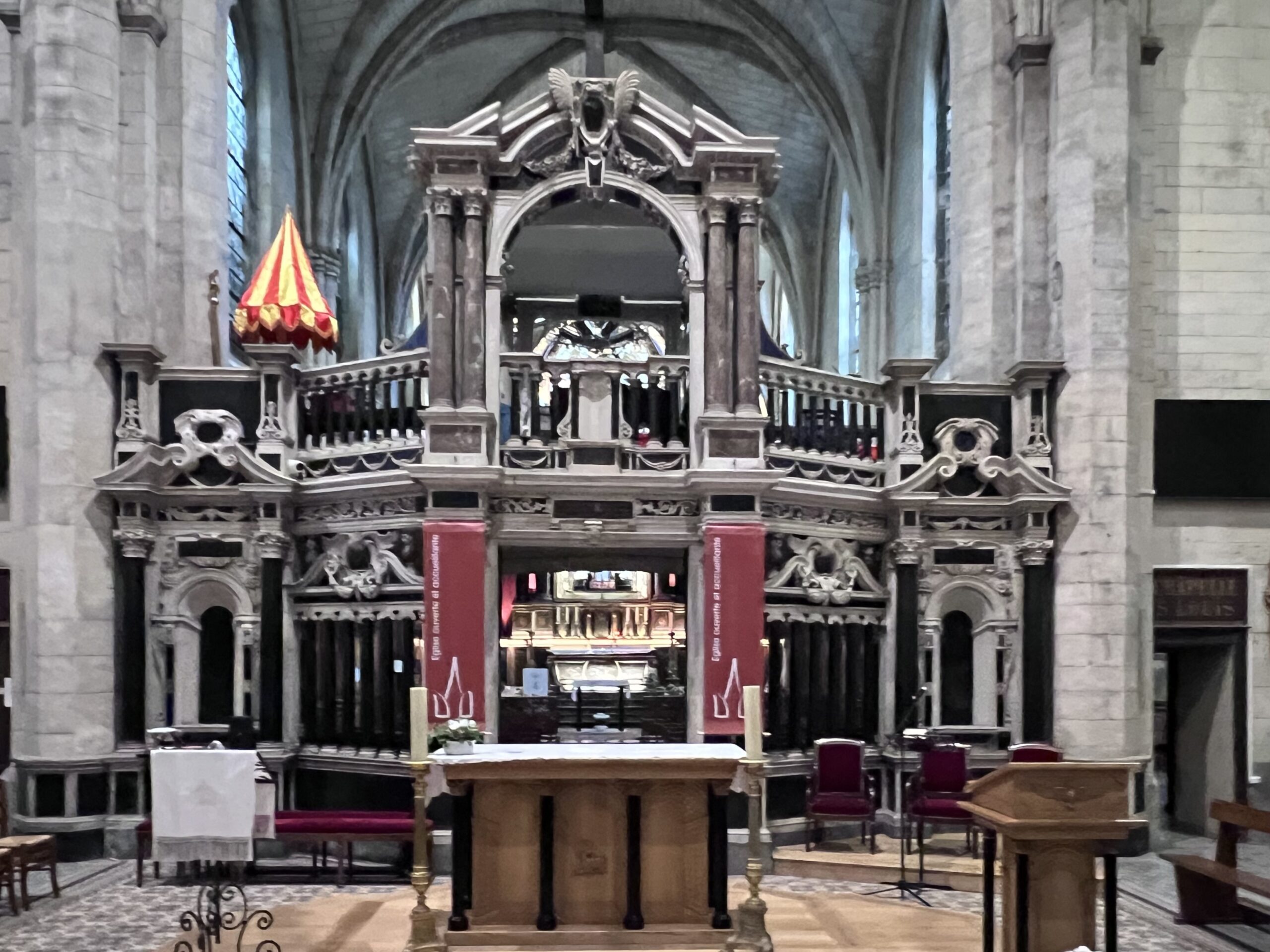
Next, you go further into the basilica and I stand for a long time at the impressive rood loft. What a work of art this is!
Next to the chancel stands the diorama with display cases featuring the history of this Marian shrine. I see figures representing the past, such as the three brothers and Ismeria, the daughter of the Sultan of Cairo. This woman saved the lives of the three knights of Eppes, who were taking part in the Crusades and were captured. Ismeria converted to Christianity, and Mary played an important role here.
After that, I will go to the shrine. The Black Madonna! You have been through so much, it occurs to me. I stand for a long time at the shrine and afterwards it is admiring the stained-glass windows, frescoes and paintings.
After going all the way around the basilica and buying some devotional items, I'll go to the spring and the Holy House. When I come to the Santa Casa, I imagine myself back in the Italian Loreto. At the spring, I think of the awakening of the three brothers and Ismeria in 1134.
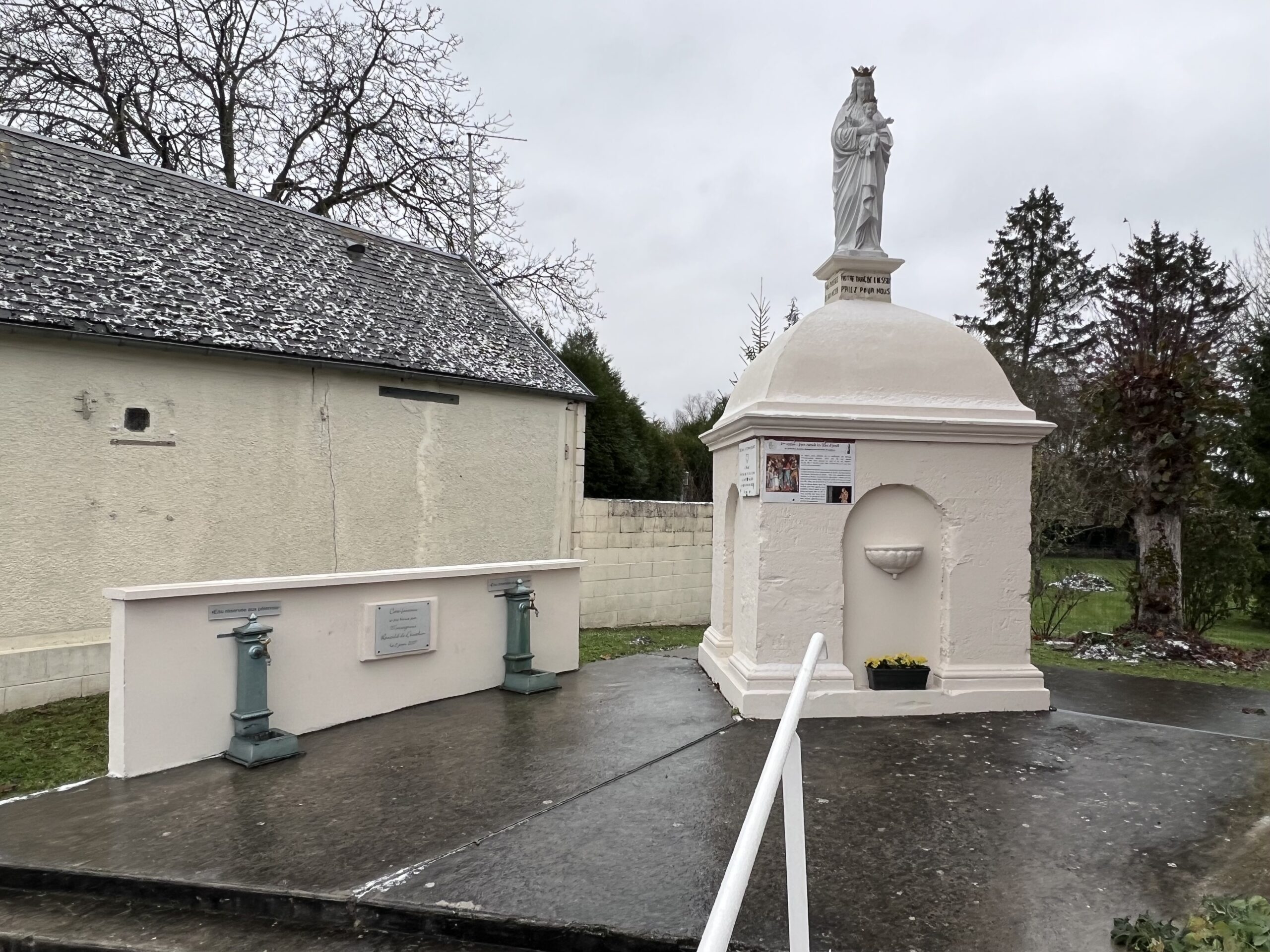
After visiting the spring and the Holy House, I will return to the basilica. Take a seat in the old building and reflect on the many visitors, also of noble birth, who have come here. This has been a very popular place of pilgrimage and for me it still is.
Environment
From Laon to Liesse-Notre-Dame is 17 km to the north-east.
Travelling from Reims to Liesse Notre-Dame means covering 52 km to the northwest.
Travelling from the French capital, Paris, to Liesse-Notre-Dame, involves covering 157 km to the northeast.
Leaving the Walloon pilgrimage site of Beauraing to go to that of Liesse-Notre-Dame requires travelling 128 km to the southwest.
Leaving Namur in Wallonia to arrive in Liesse-Notre-Dame is a distance of 158 km covered in a south-westerly direction.
~~~

 Nederlands
  English (UK)
  Deutsch
  Français