History

It is 17 January 1871, and France is at war with the Prussians, who are ravaging the countryside around the village of Pontmain. There is great fear among the population of impending violence from the war. Most families are poor and live mainly from agriculture and livestock. On this day, something very unusual happens in the evening…

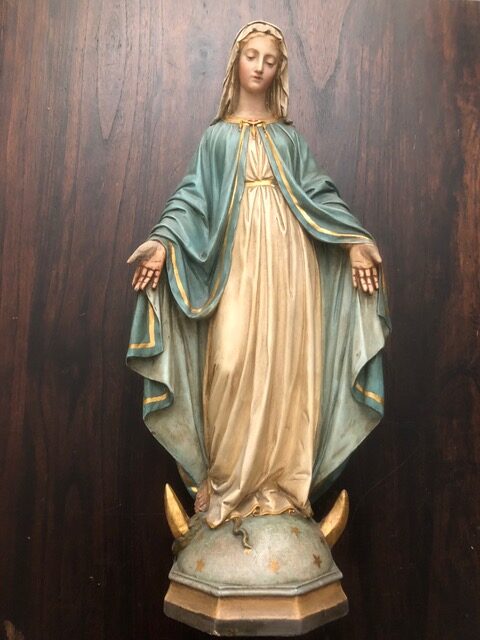
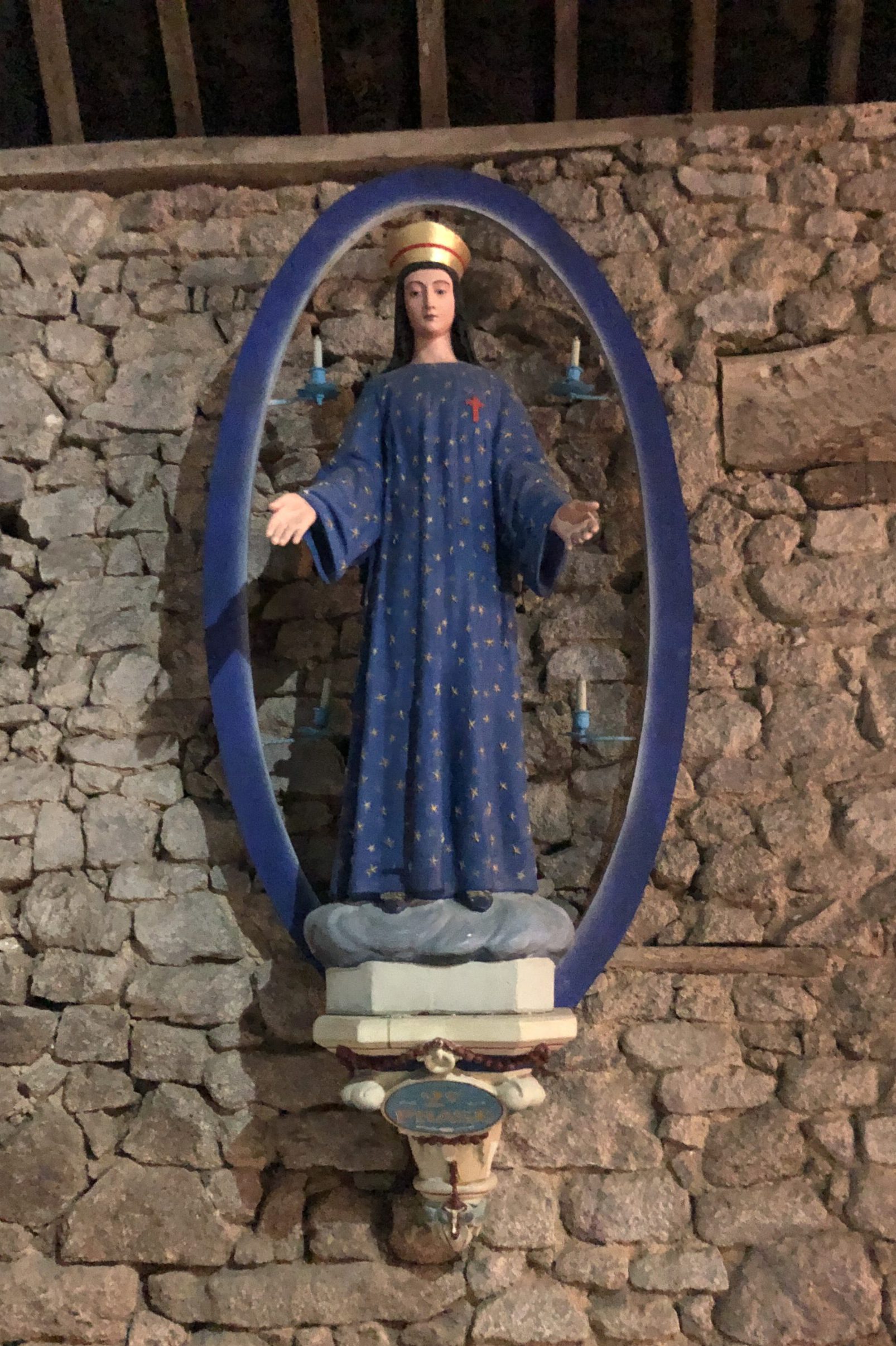
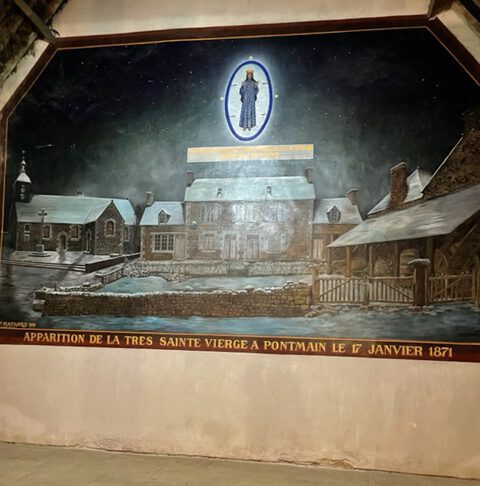
On the evening of 17 January 1871, two boys, Joseph Barbedette, aged 10, and his brother Eugène, aged 12, were helping their father in the barn. Eugène went outside briefly to check the time on the church clock. It was 5:30 PM, and he looked a bit higher. The boy saw the stars, but in one part of the sky, the stars were absent. Suddenly, above a farmhouse, he saw a beautiful Lady looking at him. He called his father and brother, who quickly came outside. The father saw nothing, but the brother also saw the Lady. She was wearing a blue dress, entirely covered in stars, a black veil, and a gold crown. The Lady wore blue shoes and extended her hands slightly. The Lady remained silent, motionless, and smiling. This lasted until 9:00 PM. During the time of the apparition, others joined them, including Father Michel Guérin (1801-1872). Two girls, Jeanne-Marie Lebossé, aged 9, and her 11-year-old niece Françoise Richer, also saw the apparition. The attendees prayed the Rosary, and the boys saw the Lady grow larger, and the stars on her dress became more numerous. A banner became visible beneath the apparition's feet. Gold letters appeared on it one by one, eventually forming the message “but still pray, my children”. The people then prayed the Litany of Mary, and letters appeared that formed the words “God will hear you in a short time”. They continued praying, and then the boys saw two words: “My Son”. The attendees now knew that the Virgin Mary was appearing to the children. The “Salve Regina” was prayed, and then the words appeared: “my Son opens himself to you”.

During the apparition, Our Lady suddenly has a red cross in her hands with “Jesus-Christ” written on it. She looks sad. Later, the smile returns to her face, while a small, white cross appears on each shoulder. During the apparition, Mary assumes five different positions.
On the evening of 17 January 1871, the Prussian troops suddenly halted their advance. The commander of the enemy army, along with his men, was stationed near Laval, close to Pontmain. He received orders from his superior not to enter the town. This began around the time the apparition in Pontmain revealed itself. On 23 January 1871, the armistice came into effect.
In 1872, Monseigneur Casimir Alexis Joseph Wicart (1799-1879), Bishop of Laval from 1855 to 1879, declared that the Mother of God had truly appeared in Pontmain on 17 January 1871.
In 1875, just four years after the Marian apparition, it was recognised by the Vatican in Rome.
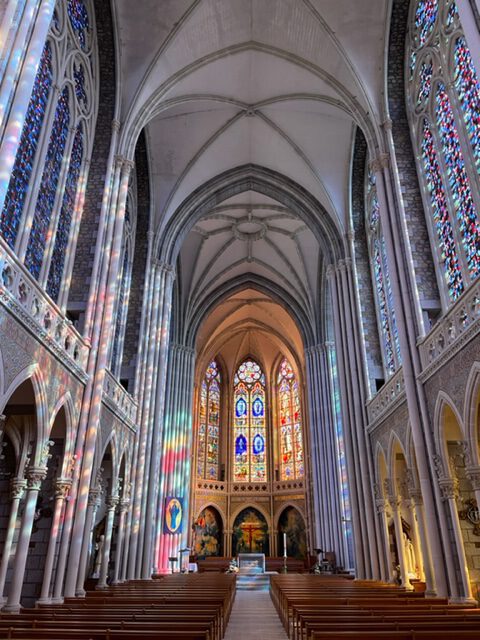
Construction of the church began in 1873. The extensive works were completed in 1894, and in 1990 the impressive building was consecrated. The church is built in the Neo-Gothic style and is almost entirely constructed from granite stones. The columns are made of white limestone, mixed with heavy granite to reinforce the structure. The church features numerous stained-glass windows. Images of the apparitions in La Salette, Lourdes, and Pontmain can also be seen.

In 1904, the statue of Mary in the church was consecrated and a year later, the church was elevated to a basilica.
The statue of Mary is crowned in 1934, after Pope Pius XI, Pope from 1922 to 1939, granted permission for this.
In 1945, a municipality in Canada was named after the apparition, namely Notre-Dame-de-Pontmain in the Quebec region, and this was after the parish of the town had already received this name in 1884.
Researcher and writer René Laurentin (1917-2017) hands over, around 100 years after the apparitions, very extensive documents concerning the events in Pontmain to Charles-Marie-Jacques Guilhem (1897-1975), Bishop of Laval (1962-1969). These documents clarify, among other things, the secretly held retraction of the events by Jeanne-Marie Lebossé. She is a resolute woman who was harshly treated by the ecclesiastical authorities, causing her great suffering. She is exculpated by the scientific research of René Laurentin. The suffering inflicted upon Jeanne-Marie Lebossé is regretted by Guilhem.
Pilgrimage site
In the place of apparition, Pontmain, there is a lot to visit, such as the basilica, the farmer's barn, the parish church, and the column of the apparition.

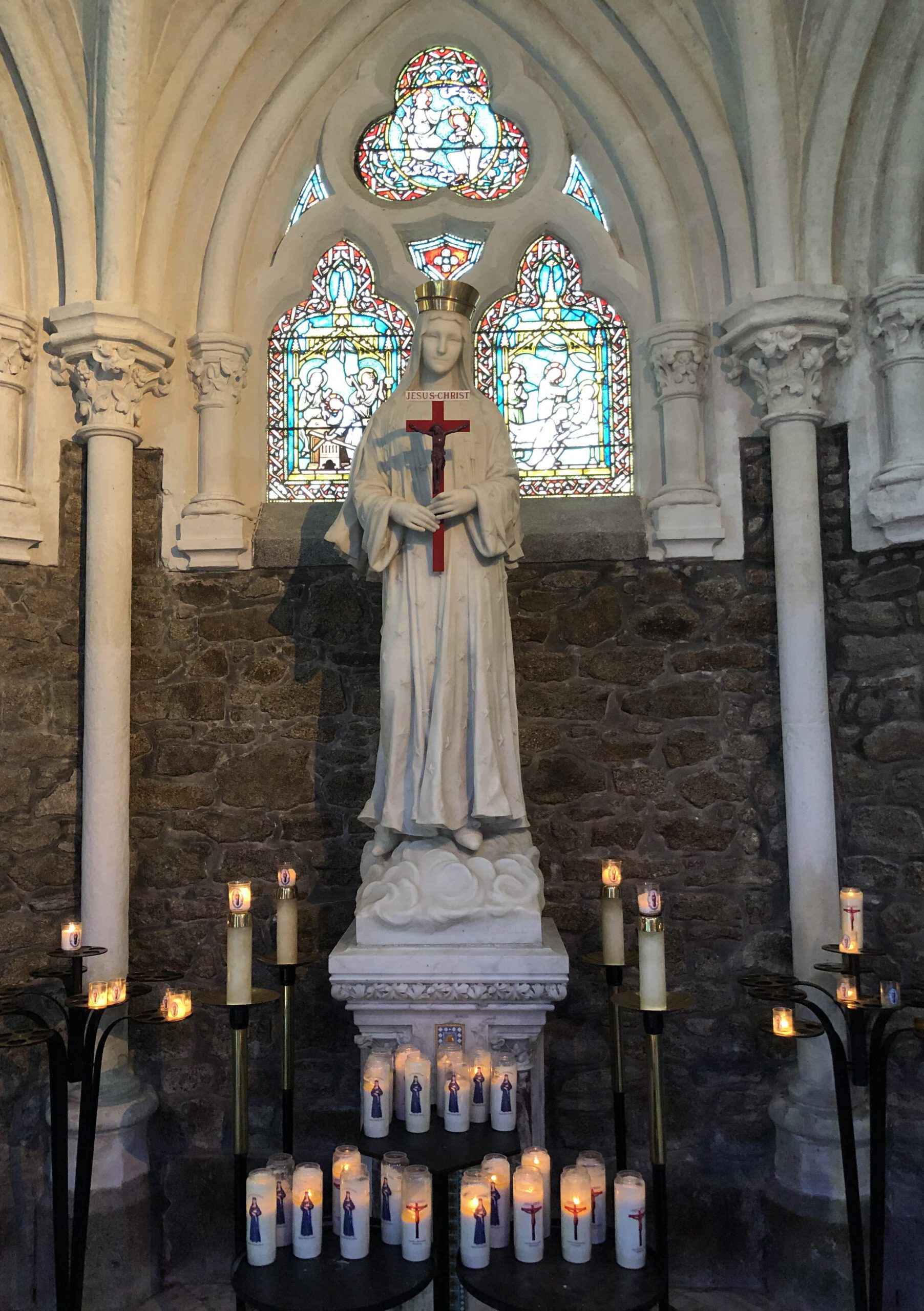
The basilica is very special because the entire building is coloured blue on the inside, which is unique. In the large church, many images of Our Lady can be seen, including a white marble statue of Mary. This effigy is located in the chapel of the left transept. The statue was consecrated in 1904, on 17 January, the commemoration day of the apparition. The effigy of Mary is the object of veneration, and it is here that pilgrims pray to the Mother of God.
The apparition is called “Mary Mother of Hope” in Pontmain. In the farmer's barn where the apparition took place, there are statues of Mary and she is dressed in blue.
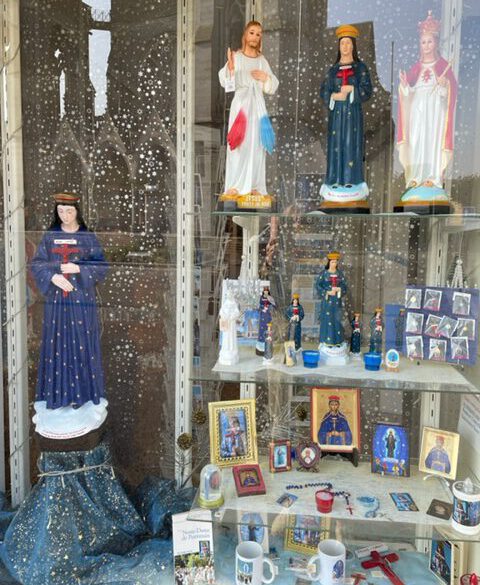
In front of the basilica stands the Column of the Apparition, depicting Mary in a blue robe adorned with many stars. She wears a golden crown and holds a red cross in both hands, inscribed with the words “Jesus-Christ”. Beneath Mary's feet is an inscription reading: “But pray, my children. God will hear you in a short time. My Son allows himself to be approached.”
ACCESSIBILITY
The village of Pontmain is located in western France, not far from Le Mont-Saint-Michel and Alençon, between Saint-Hilaire-du-Harcouët and Fougères.
The address is:
Pastoral Centre of the Sanctuary
3 Notre Dame Street
F 53220 Pontmain.
Current information can be found on www.sanctuaire-pontmain.com.
Experience
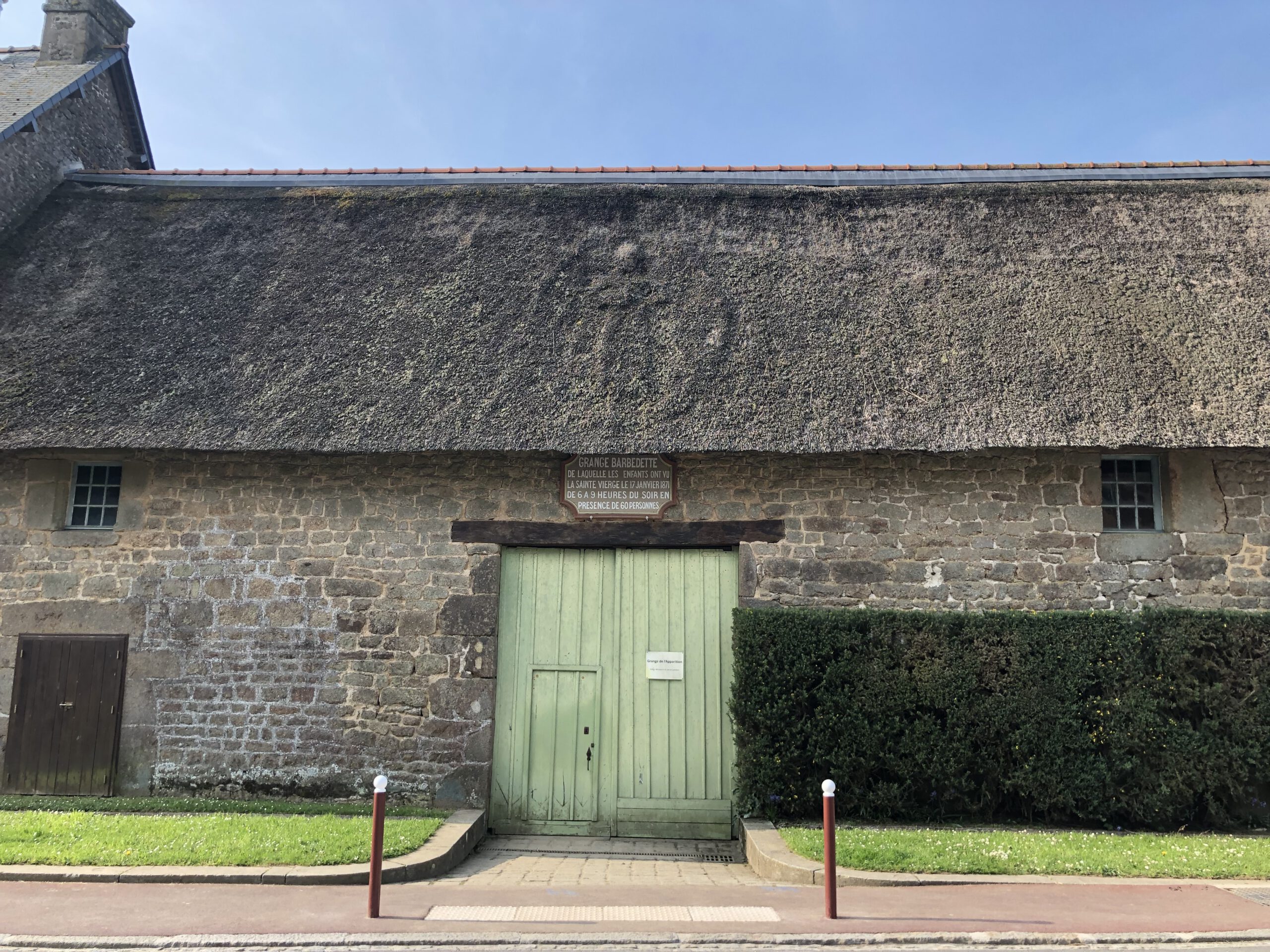
In “Rue de la Grange” stands the farmhouse barn, near the basilica. This is the site of the apparition in 1871. In the barn, I see images of Mary and a large mural of the apparition, approximately 6 by 4 metres. This fresco was created in 1919 and restored in 1990. In this space, there is more to see, such as the farmer's original tools from 1871. The walls and floor from the time of the apparition are still completely intact. Mary is depicted on the thatched roof of the farmhouse.
In the basilica, I stand still for a long time. The colour blue is visible everywhere. How special this is! Then I go to the large statue of Mary. What a beauty this is!

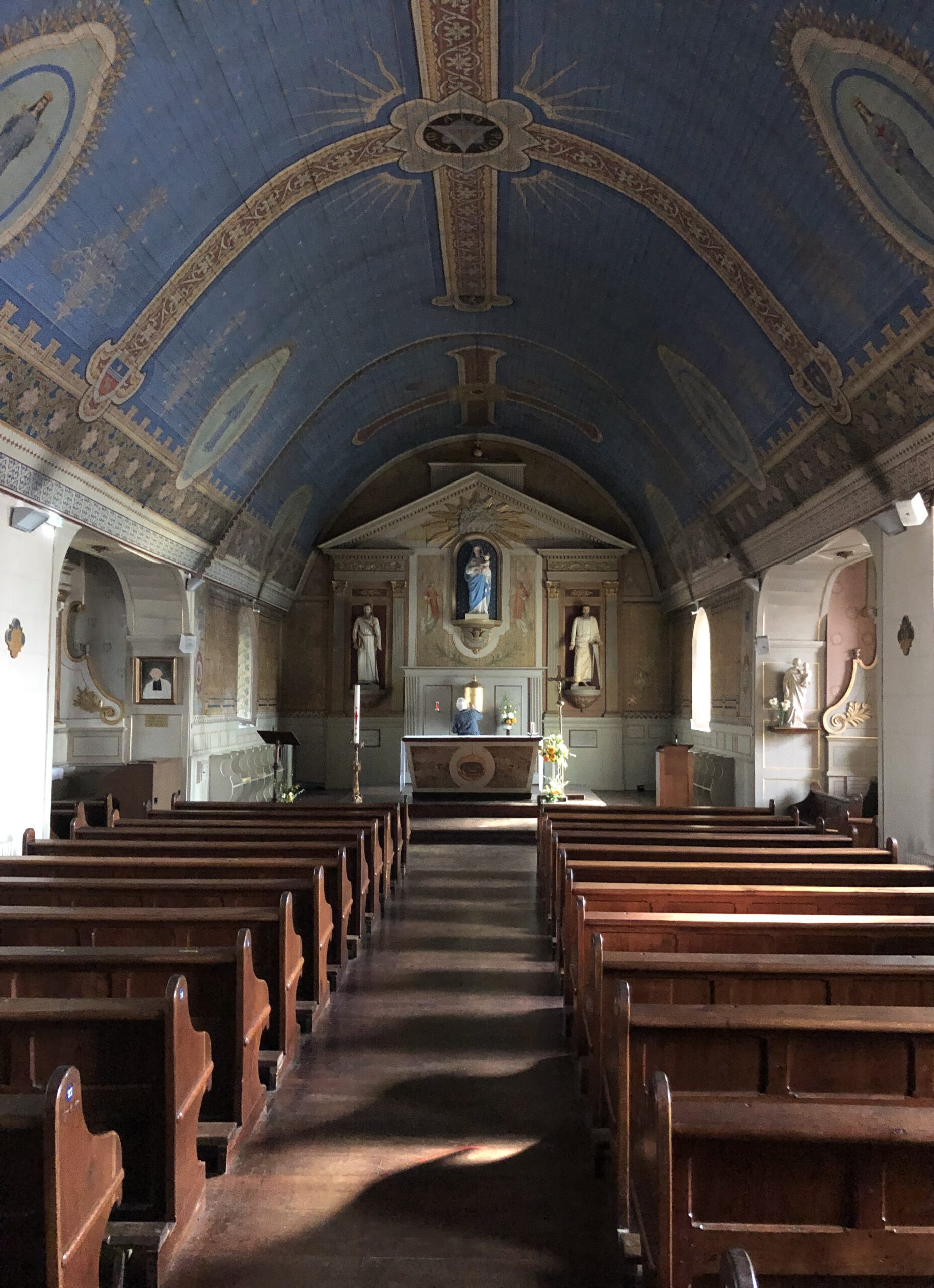
The parish church displays much concerning Mary, and the colour blue is also prominently featured here. Images of Mary and ceiling paintings can be admired.
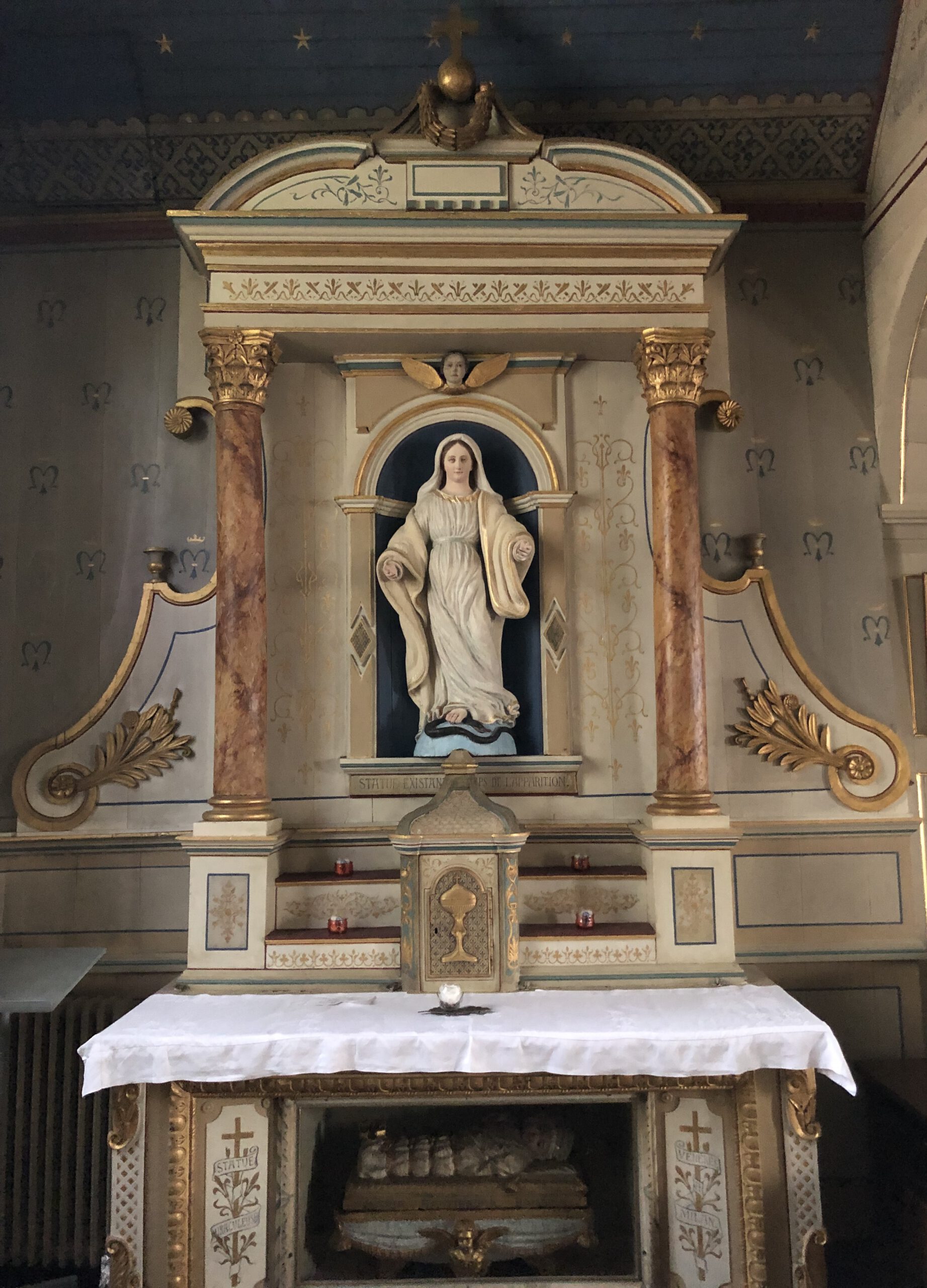
Later in the afternoon, I'll go for a walk to the arboretum, which is located behind the basilica. There's a walking path of about 20 kilometres laid out. Along the way, I'll come across a sculpture group from 1901 featuring Jesus on the cross, with the grieving Mary and Mary Magdalene beneath him.
I am spending the night at the former convent in Pontmain. This is now “Relais Le Bocage” (The Copse Inn) at “Rue de Mausson 2”. This large building is a real resting place with wide wooden staircases and long corridors. I have a triple room all to myself. What a lot of space, and without any nuns! I am very impressed by this historic former convent. If only the walls could talk about what they have seen, there would perhaps be much to tell. However, nothing is said. It is quiet, which is remarkable because the many rooms are fairly well occupied. Late in the evening, I walk through the long convent corridors. I feel transported back over a century...
~~~

 Nederlands
  English (UK)
  Deutsch
  Français