~~~
History
This has already been a Marian pilgrimage site in the late Middle Ages. In 1296, “Sanctam Mariam” is mentioned, and in 1381 an official document refers to “Sand Marein”. Around 1500, a wooden chapel was built near a farm. In 1619, a farm next to the chapel went up in flames. Burning branches from nearby trees fell on the roof of the chapel without setting it alight. A quince tree, growing very close to the chapel, with a pear and berry flavour, was completely scorched by the fire from the farm. Burning branches landed on the chapel, but it did not catch fire. To everyone's great surprise, the branches began to bloom again a few months later and bore particularly beautiful fruit.
Elizabeth Renata von Lorraine (1574-1635), wife and niece of Maximilian I of Bavaria (1573-1651), Elector of Bavaria (1597-1651), is a princess of the Holy Roman Empire. She receives fruits from the miraculous tree as a gift and says she has never eaten such delicious fruits before.
The wooden chapel, miraculously spared by the fire, remains completely intact, and a church is being built over it, as also happened in Assisi and Loreto. It is the oldest wooden chapel in Germany and has been standing since around 1500. The first stone of the church was laid in 1629, 10 years after the fire, by Michael Kirchberger (+1635), Abbot of the monastery in Aldersbach (1612-1635). The design of the church is by Isaak Bader/Baader (+1635). The miraculous image arrived in the church in 1631.
The old chapel stands in the middle of the chancel and forms the central part of the pilgrimage church.
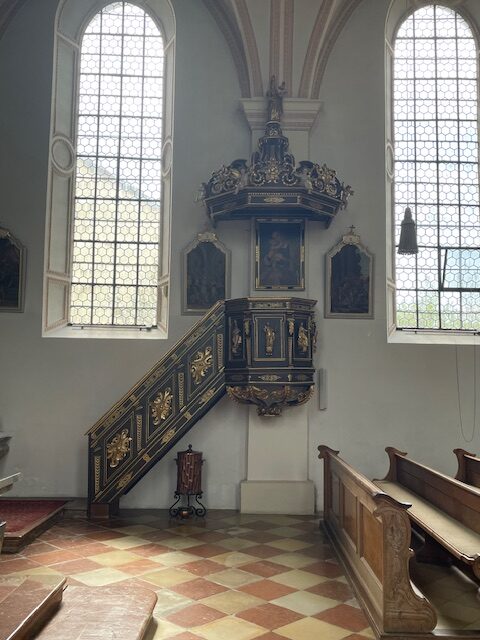
The images of the altar, the altarpiece of the pilgrimage church, and the image of grace were made in 1640 by Jakob Christoph Bendl (c.1585-c.1655). He created the pulpit in 1647 and the casing for the organ in 1651. His son, Johann Christoph Bendl (1624-1690), assisted him with this. The back wall of the pulpit is a painting from 1633, received as a gift. The artwork is a copy of the Passau Madonna of Perpetual Help. Placed high on the pulpit is a standing, crowned Virgin with Child.
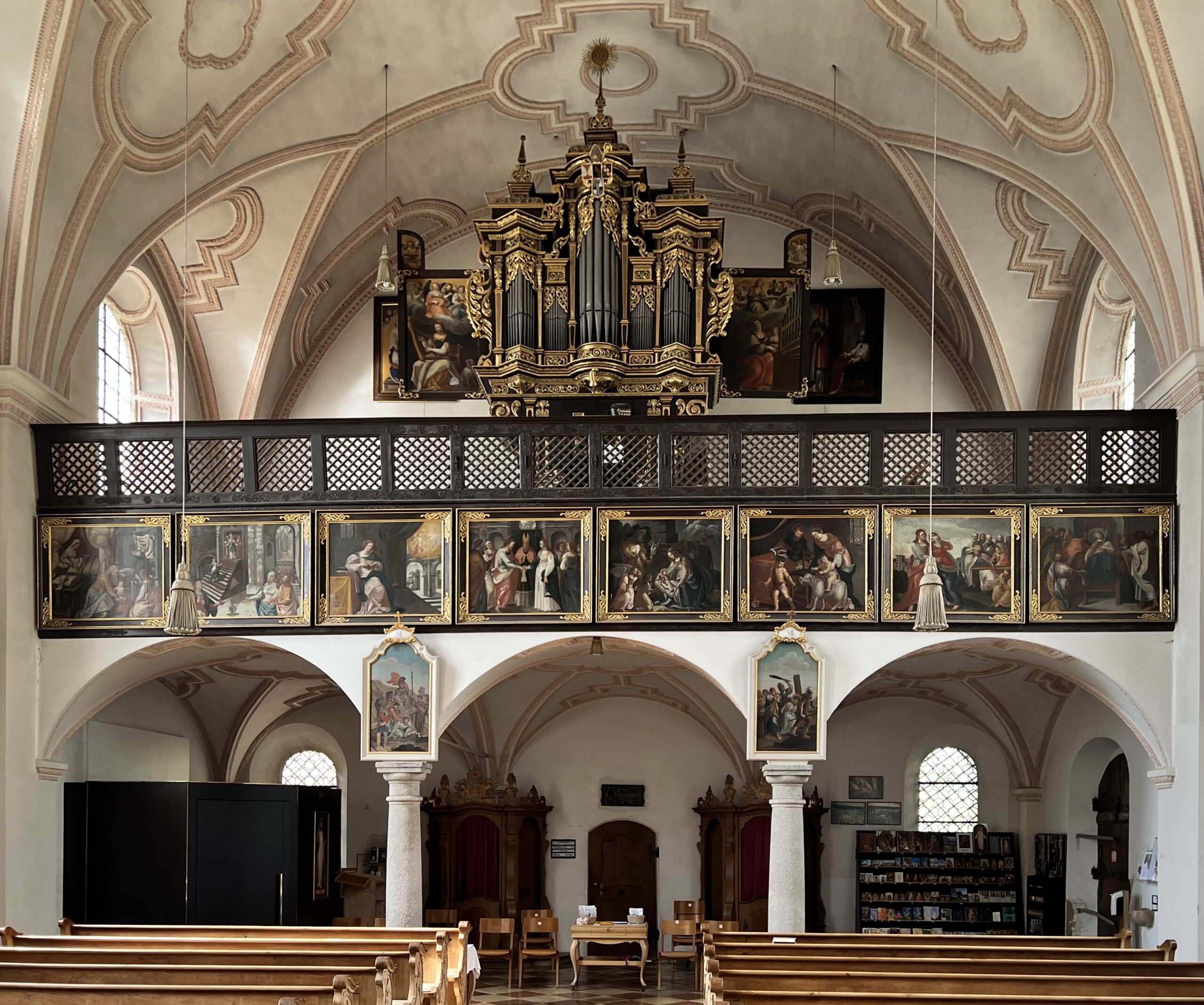
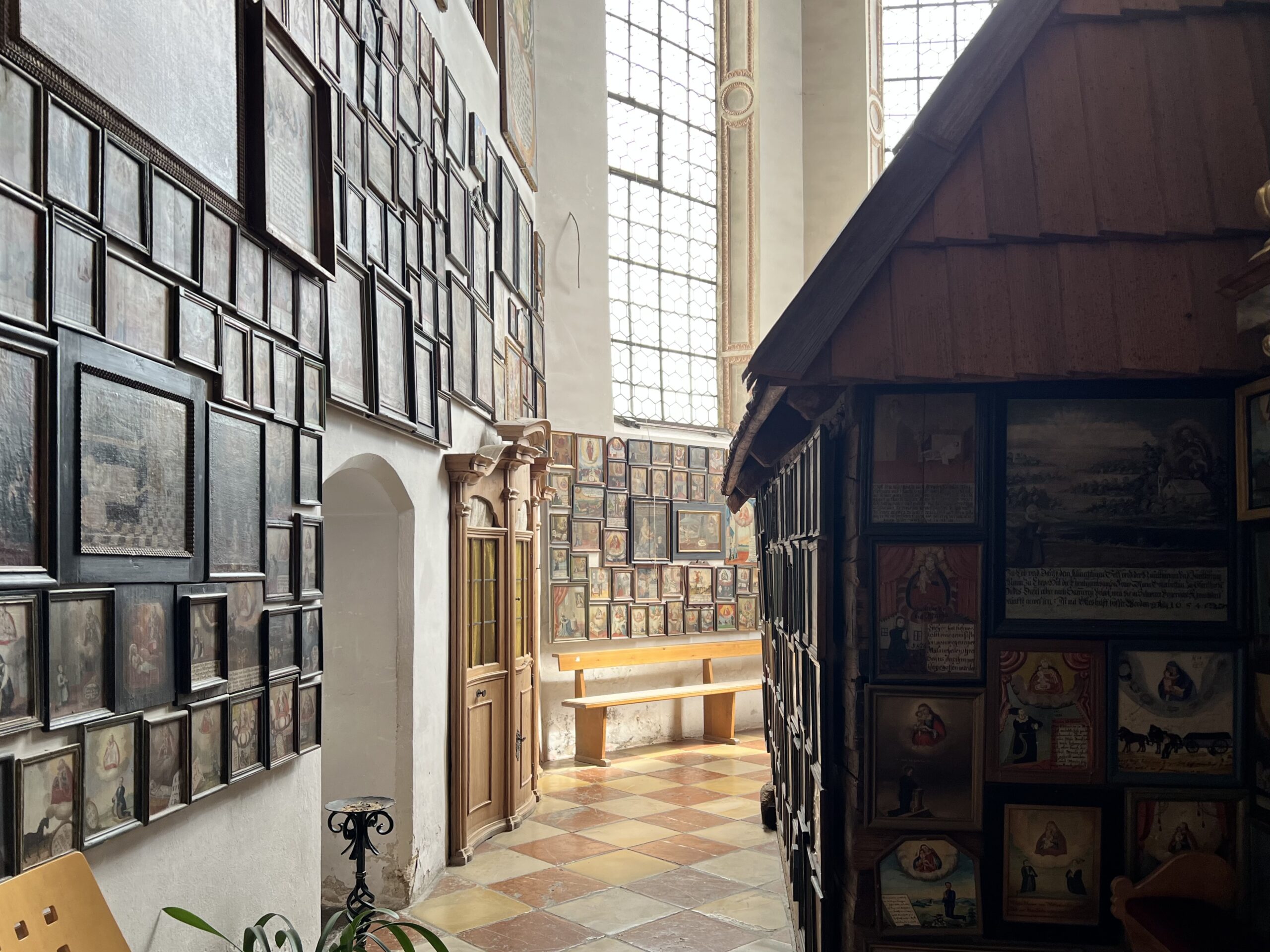
Beneath the organ, oil paintings from 1647 have been affixed. These depict moments from the life of Mary, including the Nativity of Mary and the Assumption of Mary.
In 1690, the foundation stone for the rectory was laid by Joseph Christian (Engelbert) Fischer/Vischer (1647-1723), Abbot of Aldersbach Abbey (1683-1705).
The 14 stations of the cross are from the 19th century.
On 2 October 2011, the miraculous image was crowned by Wilhelm Schraml (1935-2021), Bishop of Passau (2001-2014).
Restoration work was carried out frequently in the 18th, 19th and 20th centuries. In the first quarter of the 21st century, money is needed for necessary repairs to the church.
There is a pilgrimage association in Sammarei, of which every pilgrim can become a member.
Pilgrimage site
Sammarei is the largest pilgrimage site in Bavaria, located in Altötting. A church was built over an old, intact, wooden chapel in 1631, similar to what happened in Assisi and Loreto. Sammarei is therefore referred to in Bavaria as “Bavarian Assisi” and “German Loreto”. The wooden chapel is not always open to visitors, and two gates are then closed. When these gates are open, a pilgrim can enter by stooping slightly. Approximately 1300 ex-votos are attached to the inner and outer walls of the chapel and in the ambulatory of the chancel. The oldest images date back to the construction period of the chapel. Above the ex-votos are rare paintings with text, depicting Mary as an apothecary, a fount of grace, the tree of life in paradise, a life-saving ark, rainbows of hope, and Mary as a rescuer of people from fire, among other things. The accompanying texts are verses in multiple lines in the form of a madrigal (Latin: matricale; meaning mother tongue), making them polyphonic songs for a choir.
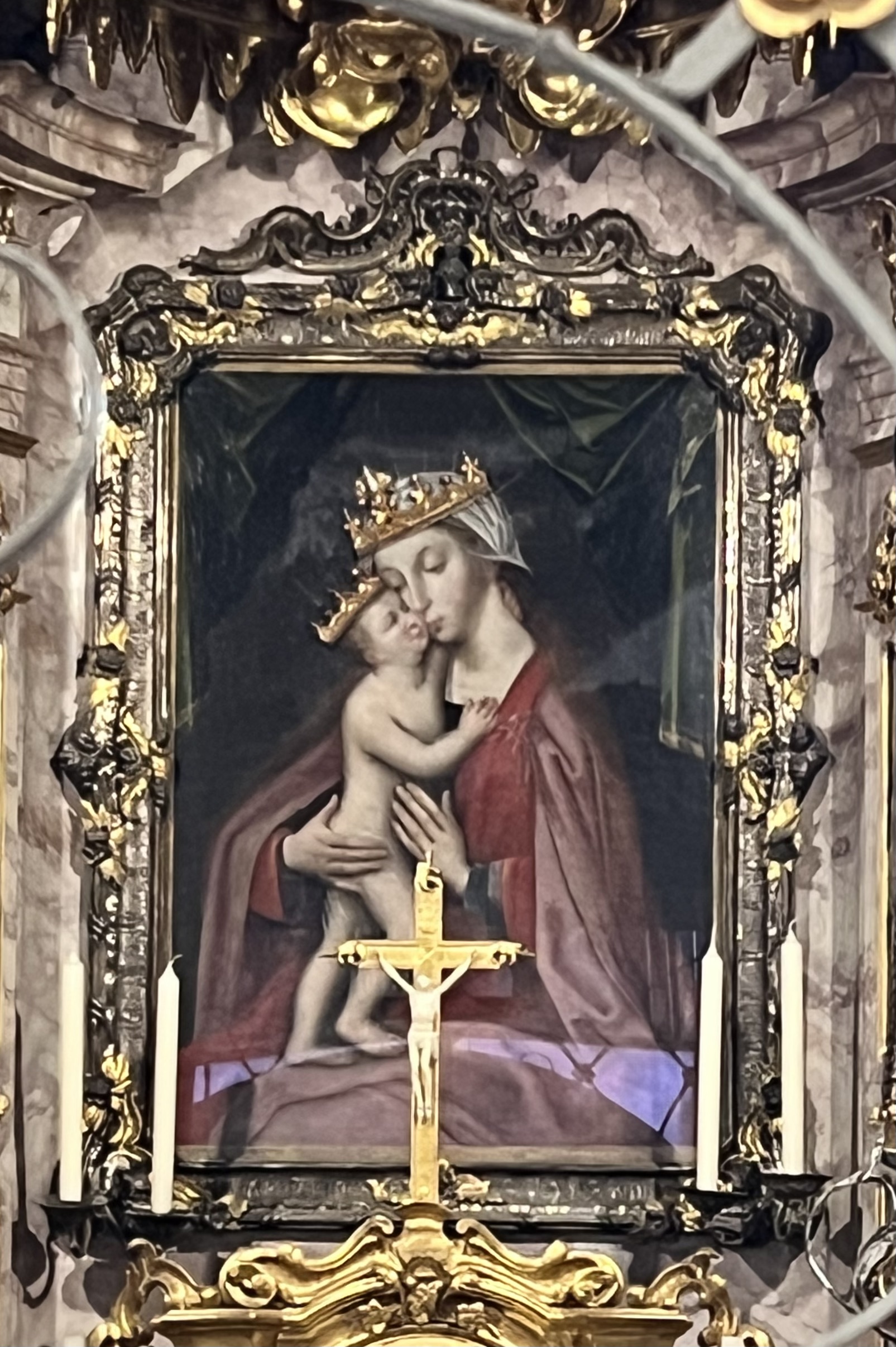
Since 1631, the devotional image has been housed in the wooden chapel. The sculpture depicts a seated Mary. She wears a veil, and her lightly veiled Child stands on her lap. Mary's right cheek and Jesus's left face touch. This embrace shows great affection. Mary's loose hair falls over her shoulders and, from her left ear, is covered by a white headscarf. Mary wears a blue underdress, a red overdress, and a red mantle. The devotional image stands at the heart of the chapel. The artist and date of origin of the oil painting are unknown. It is assumed to be a copy of the late Gothic image in the chapel of Saint James in Straubing. This work has been attributed to Hans Holbein the Younger (c. 1497-1543). A similar work hangs in a museum in Budapest and was created by the Flemish painter Adriaen Isenbrandt/Isenbrant (c. 1490-1551). The chapel, behind the high altar, forms the heart of the church with the devotional image.
In the high altar is a large painting of the Assumption of Mary. Beneath the altar, two particularly beautiful images can be seen. The left predella, the structure upon which the altar is built, shows the Annunciation by the Angel Gabriel to Mary. To the right is the predella with the Sammarei Nativity, which depicts the birth of Jesus.
The pulpit features half-timbering and, as a backdrop, hangs a large painting of the Virgin and Child.
Hundreds of messages from pilgrims are received annually in the pilgrimage book, asking Mary for intercession or expressing thanks for help received.
The new European pilgrimage route “Via Nova” passes through Sammarei.
In a few months of the year, the 13th is a Fatima day. On May 1st, the feast of the patroness of Bavaria is celebrated. On August 15th, it is the patronal feast with a procession of lights.
The pilgrimage church also hosts cultural activities, including concerts.
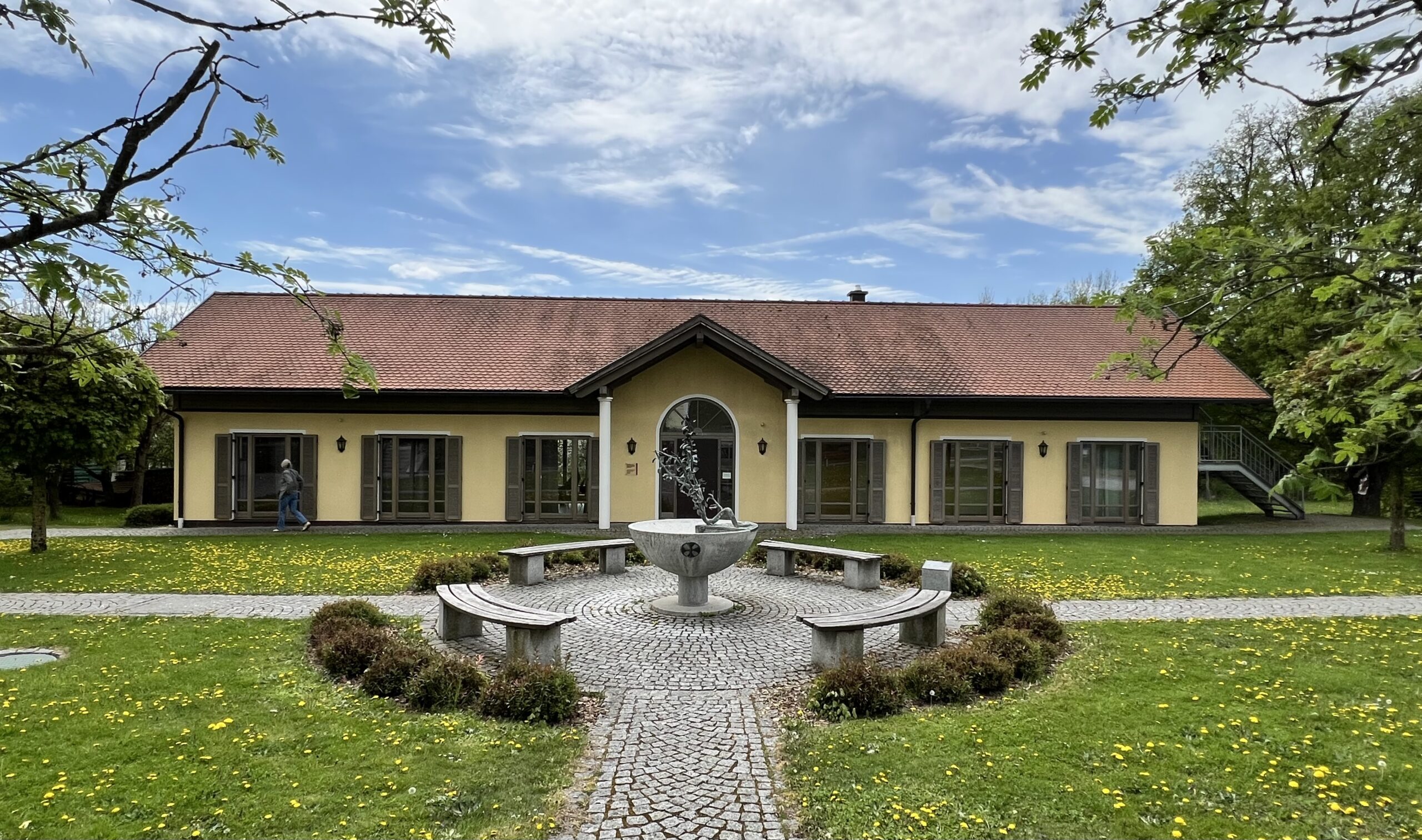
There is a daily morning prayer, silent adoration, the rosary, and a eucharistic service. The pilgrimage church and the prayer room next to the church are therefore open every day.
ACCESSIBILITY
The address for the pilgrimage church “Mariä Himmelfahrt” (Assumption of Mary) is Sammarei 47, D-94496 Ortenburg. The Marian shrine is located in the German state of Bavaria, in the southeast of the country.
Current information can be found at www.wallfahrtsland-sammarei.bistum-passau.de and also at www.wallfahrtsland-sammarei.de.
Experience
On one of my tours through Bavaria, I also visit Sammarei. This is one of the most visited Marian shrines in Southern Germany, and I notice this upon arrival from the cars parked here and the people walking around. This is the second pilgrimage site in Bavaria, after that of Altötting.
I'm wondering where the word “Sammarei” comes from. Inquiries reveal that the word “Sammarei” is a popular variation of the Latin “Sancta Maria” (Holy Mary). “Sancta Maria” becomes “Sankt Marei,” from which “Sammarei” arises. I also hear that Polish priests from the Order of La Salette organise the pilgrimages.
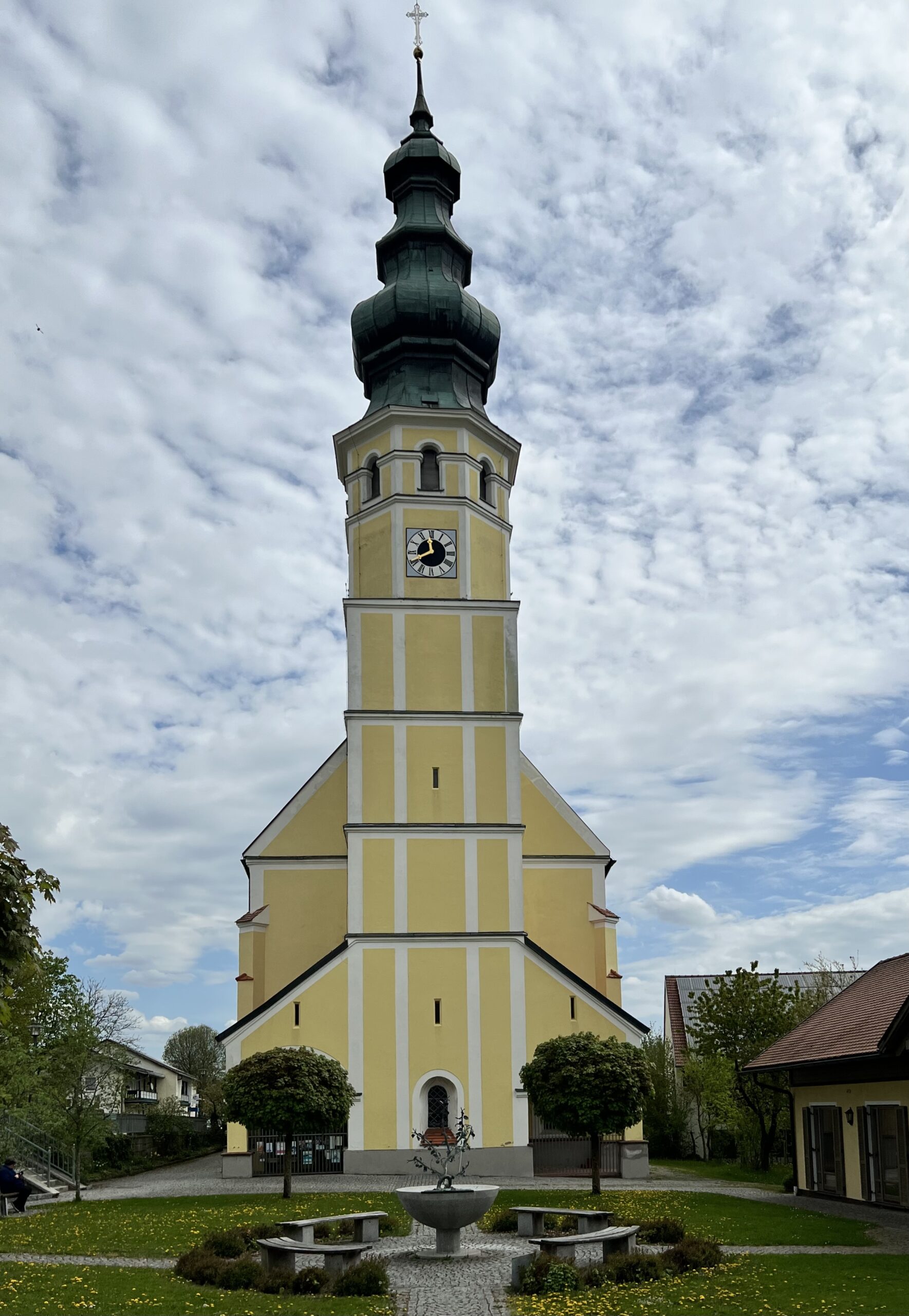
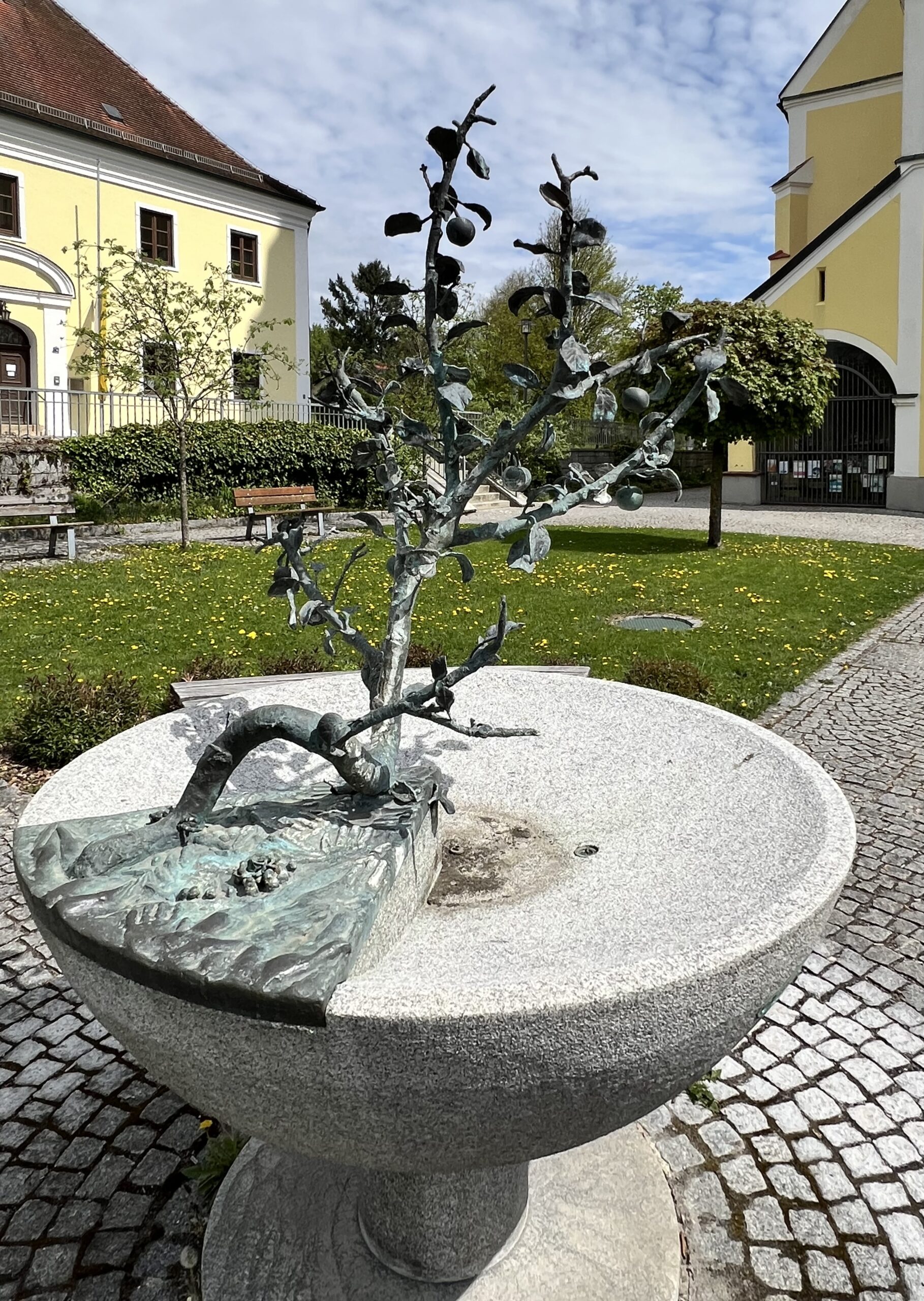
The yellow and white church tower stands majestic, as if always keeping watch. This is true, as there is continuous prayer in the chapel next to the church. In front of the church is the fountain, which unfortunately is without water. Near the dry well, at the edge of this grounds, stands an apple and pear tree. This was planted by the bishop during the inauguration of the well. Such a tree once caught fire here, but the church did not catch fire. A miracle!
When I enter the church, the altar immediately catches my eye. This part of the church is very special due to the high construction of the altarpiece, where horses are also depicted. Martin of Tours is depicted on one horse and Gregory on the other. Under these images on either side of the altar is a closed gate. Behind the gates, countless ex-votos can be seen. Such gratitude to Mary! This sight deeply impresses me! In the middle, behind a decorative gate, stands the shrine's image in a frame. Mary and the Child are crowned and both are depicted cheek to cheek. Mary has her eyes closed. Looking into her eyes isn't possible right now. Mary and the Child radiate so much love!
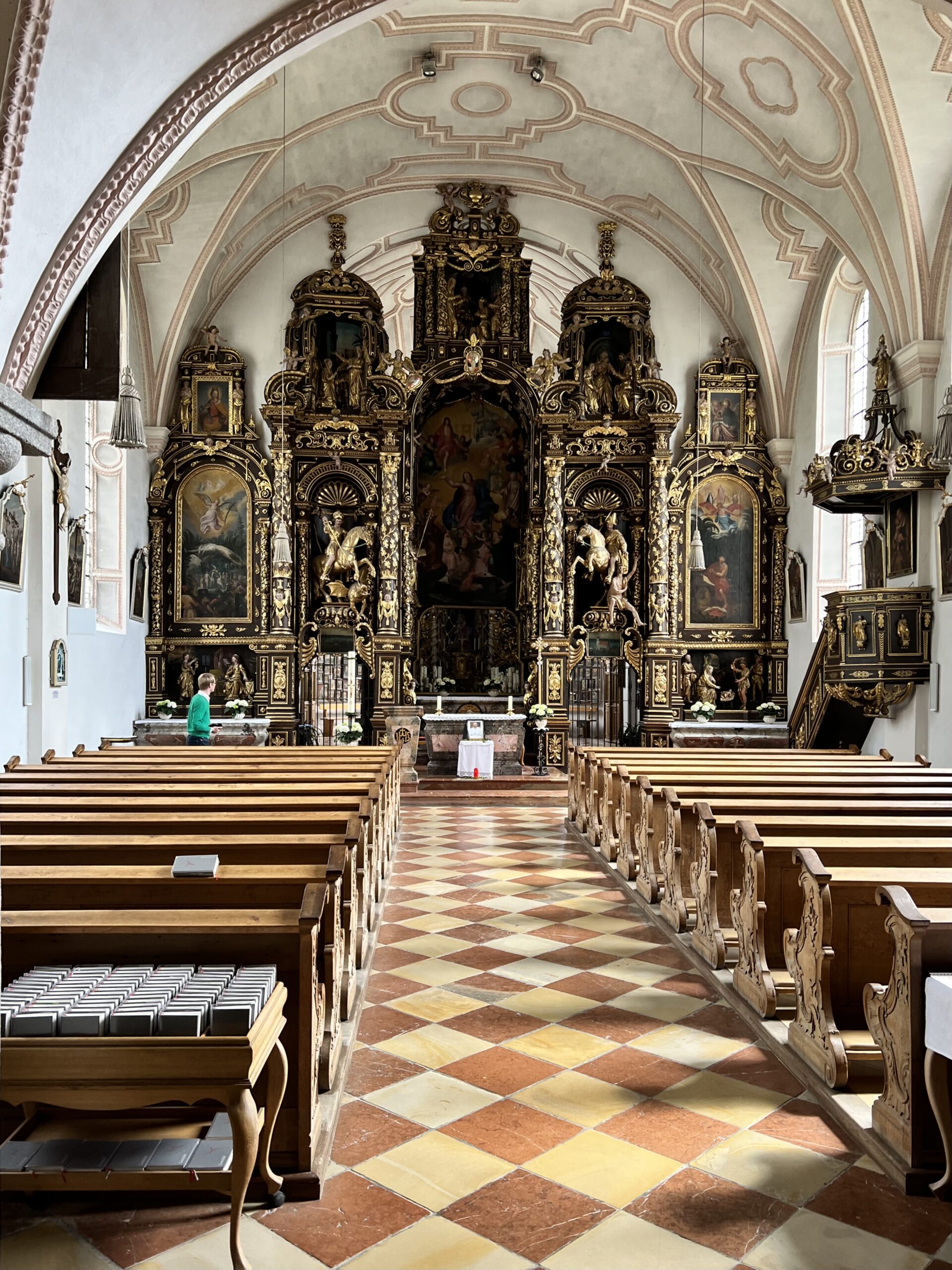
In the adjoining chapel, I'll light some candles. Here too, I see many ex-votos, which have now been placed by a large crucifix. This is a fitting occasion to pray. It's a chance to thank Mary for allowing me to come here, and with friends in my thoughts, I'll stay a little longer.
In the church, devotional items are for sale, and I gratefully make use of them. A candle for a friend, a booklet for a friend, and prayer cards for good acquaintances. There are also bookmarks for sale, and they feature a prayer in German. Translating this into Dutch, I arrive at:
“Our Lady of Sammarei,
Pray for us!
Under your protection and shelter we flee.
O, holy Mother of God,
Do not scorn our prayer in our needs,
maar verlos ons te allen tijden van alle gevaren.
O, You, glorious and blessed,
Our Lady, our Mediatrix, our Advocate.
Reconcile us with your Son,
recommend us to your Son,
Introduce us to your Son.
Amen.”
The visit to this pilgrimage site has pleasantly surprised me. With many impressions as cherished memories, I leave this charming abode of Our Lady. What a beautiful day to frame!
Environment
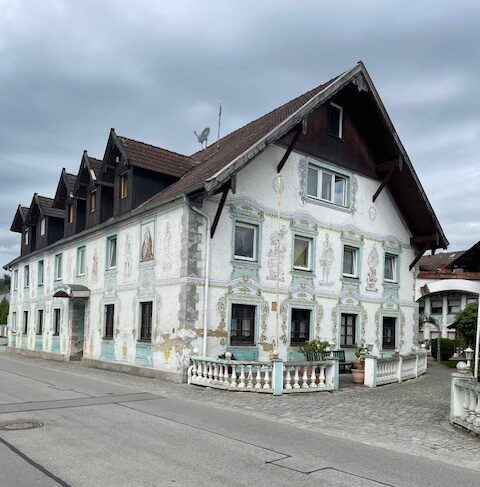
In the vicinity of Sammarei, walking routes have been marked out.
Leaving the big city of Passau to arrive in Sammarei means travelling 29 km to the west.
Leaving the historic town of Vilshofen an der Donau to visit Sammarei involves travelling 13 km south.
From the pilgrimage site of Bogenberg to that of Sammarei is 71 km heading southeast.
~~~

 Nederlands
  English (UK)
  Deutsch
  Français