TRIBERG
History
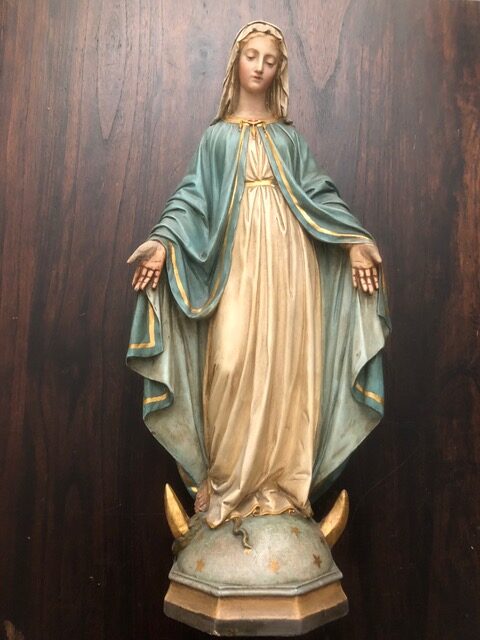
In 1644, a remarkable healing occurred at a large fir tree, at the site where the pilgrimage church now stands. A statue of Mary, painted on parchment, was hung on this tree. Next to this tree, a spring emerged from the rocks. Thus began the pilgrimage “Maria in der Tanne” (“Mary in the Fir”). In that year, 7-year-old Barbara Franz, on her way to the village of Schonach with her mother, encountered the tree. A parchment with a painting of Mary lay on the ground. Barbara picked it up and took it home, despite her mother's disapproval. At home, Barbara placed the parchment by a religious image. However, three days later, Barbara developed an eye ailment, and the threat of blindness loomed. Her parents were deeply worried, as medical help proved futile and the eye condition worsened. Prayers were offered to God for help. During a dream, Barbara heard a voice promising complete healing if she returned the painted parchment to the fir tree. Her parents saw this as a divine sign. Barbara, with her parents, went to the large fir tree, and the parchment with the painting of Mary was returned to the trunk. The three family members prayed, and Barbara's eyes were washed with water from the spring. Immediately, the pain in Barbara's eyes subsided, and after two days, she was completely healed. Barbara waited many years to officially report her healing, only recounting her experience under oath in 1706. She did so to the then pilgrimage director, Johann Baptist Degen (+1730). Barbara's husband and a scribe were also present. The conversation took place in the parish centre in Triberg.
In 1645, another miracle occurred. Friedrich Schwab was 68 years old and partially paralysed. He was on a pilgrimage to the pine tree. No doubt he had heard something of Barbara Franz's healing. In prayer, he promised to donate a carved wooden statue of Mary if he were healed. He then washed himself with spring water by the tree and was immediately cured. In the same year, he fulfilled his promise and, out of gratitude, placed a statuette at the great pine tree. The statuette was 18 centimetres tall and carved from lime wood. After a brief period of veneration of the statuette for a few years, interest waned and eventually disappeared altogether.
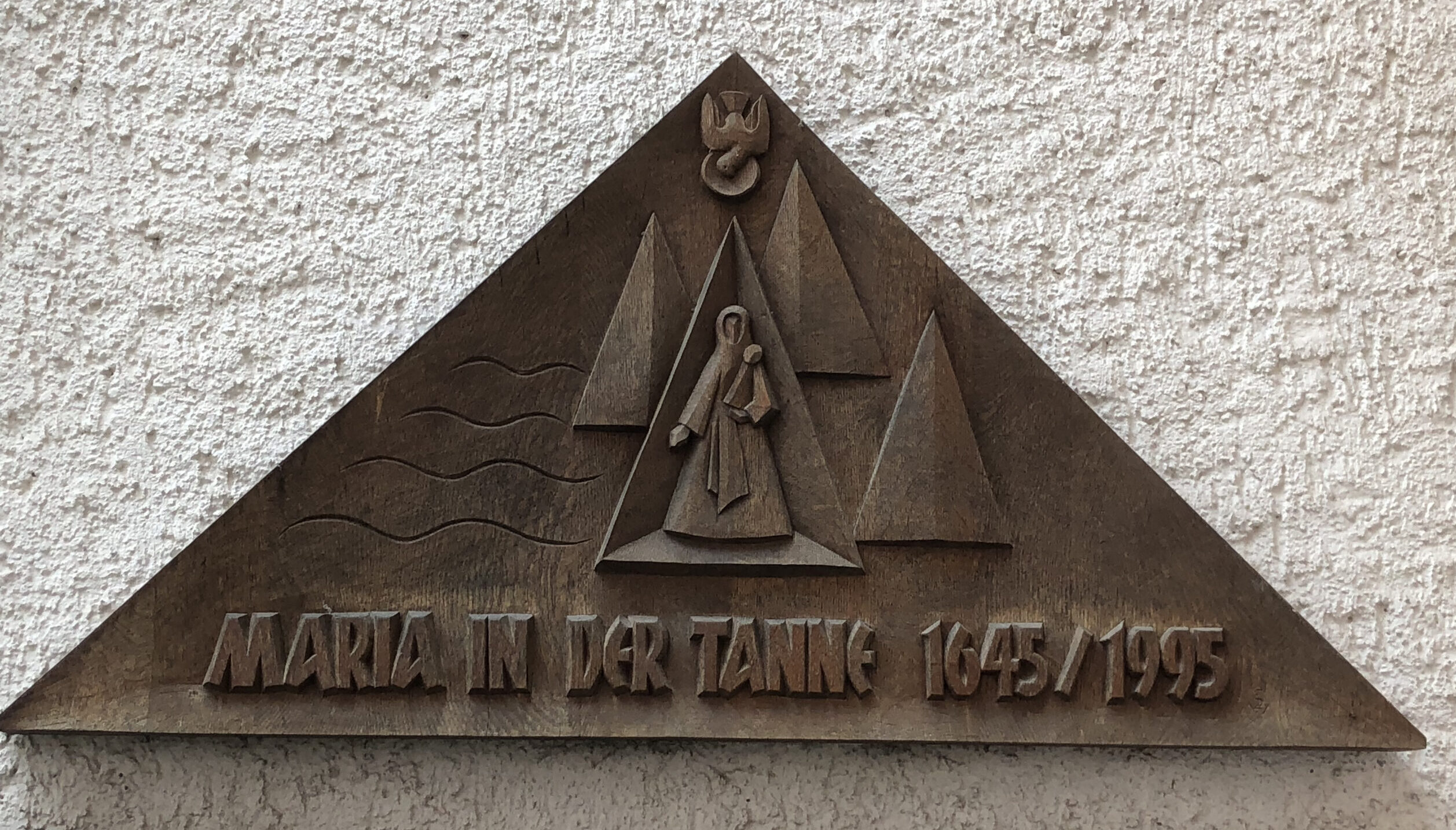
Some 40 years later, another remarkable event occurs. In 1692, three soldiers from Tyrol hear an angelic hymn. A little later, they meet an old man who tells them that a few years earlier, in the same place, a miller from Triberg named Adam Fröhlich also observed such a song. The old man tells the soldiers about the placement of a statue of Mary in 1645. The soldiers become curious and go to investigate the following morning. They find the statuette, Maria in the Den, lying overgrown against the tree. This is where the name “Maria in the Den” comes from. The soldiers clean the statuette, provide a rug, and create a roof over it. They affix the inscription: “Holy Mary, Patroness of soldiers, pray for us.” As a result, local people come to pray there. From then on, interest in the large pine tree grows again.

More is happening...
In 1692, a farmer from Schönwald is cured of a growing ulcer in his neck. The mayor of Triberg witnesses the healing. In 1694, another remarkable healing takes place. The soldier Gabriel Maurer, who has only been able to move with crutches for years, comes to the statue of Mary by the fir tree. He prays and promises that after his healing and military service, he will join the Capuchin order. He leaves the tree, rests a short while later, and falls asleep. Upon waking, he notices a change in his legs. He gets up and can walk without crutches. In 1696, he joins the order, becomes a pilgrimage brother in Triberg, and serves as sacristan for 35 years.
Following the healing of Gabriel Maurer, many more healings take place as a result of visiting Mary at the pine tree. The fame of the pilgrimage site grows, and many pilgrims visit annually.
The first wooden chapel was built in 1695. In 1697, after a diocesan investigation into the healings, the pilgrimage site was approved and a new pilgrimage chapel was built. The construction of the current pilgrimage church began in 1699 and was completed in 1705. In 1697, a verger's house was built near the church.
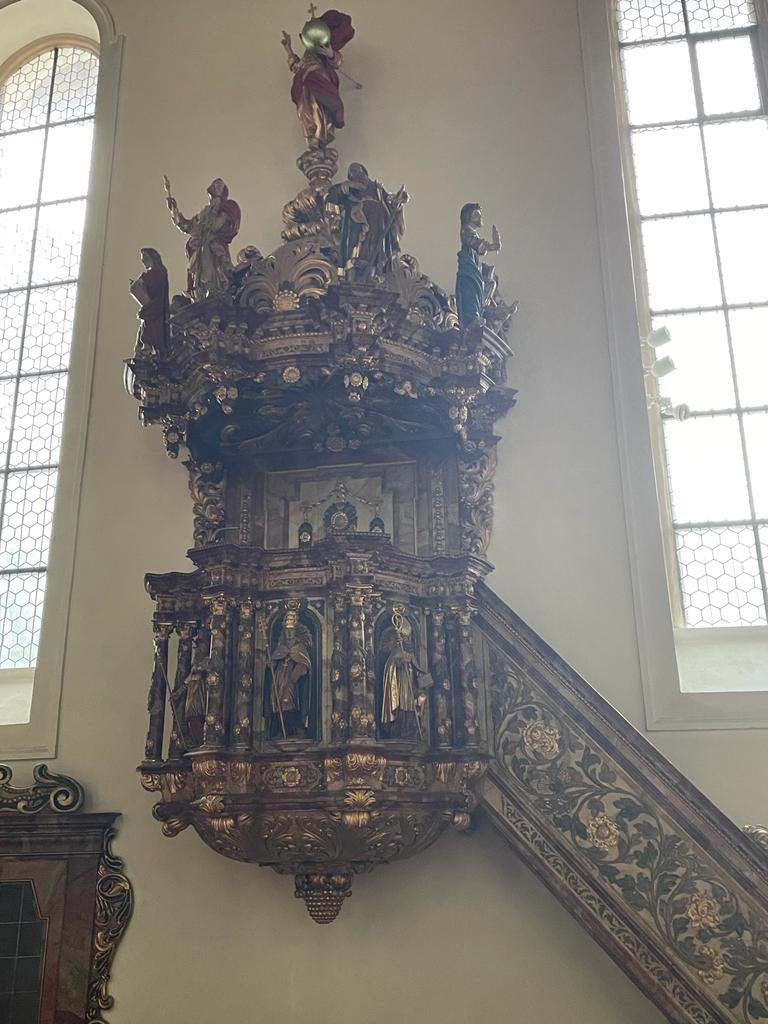
The church's interior was designed by Joseph Anton Schupp (1664-1729) from nearby Villingen. In 1703, he supplied the two side altars. In 1705, he built the main altar and the pulpit. Master builder Peter Geiger completed the work in 1705. The presbytery, located next to the church, dates from 1710.
Margravine Francisca Sibylla Augusta von Sachsen-Lauenburg (1675-1733), Regent of Baden-Baden (1707-1727), donated the antependium, the richly decorated cloth for the altar table, in 1708. This was in thanks for the recovery of her son Ludwig Georg Simpert of Baden-Baden (1702-1761). The silver-plated artwork was made by silversmith Lorenz Biller (+1726) from Augsburg.
The church is consecrated in a festive manner in 1716. This is done by Konrad Ferdinand Geist von Wildegg (1662-1722), who is Bishop of the Diocese of Konstanz from 1693 to 1722.
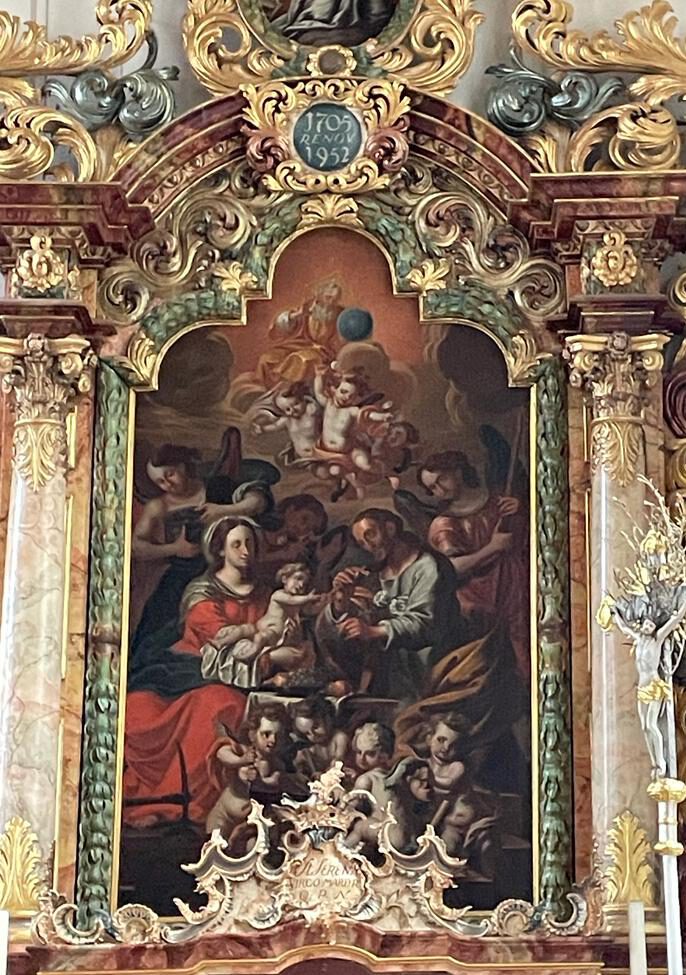
In 1751, the mortal remains of Saint Serena of Spoleto (+291) arrived in Triberg. This was at the initiative of Johann Franz Meinrad von Pflummern (1706-1780), who was the chief guardian in Triberg from 1740 to 1777. The bones of the martyr are housed in a reliquary on the right side altar of Saint Anne. The reliquary is covered with a colourful, wooden lid. The Anna altar features a special, 18th-century painting by Johann Georg Glückher (1653-1731) from Rottweil.
In 1808, the pilgrimage church becomes the parish church in Triberg.
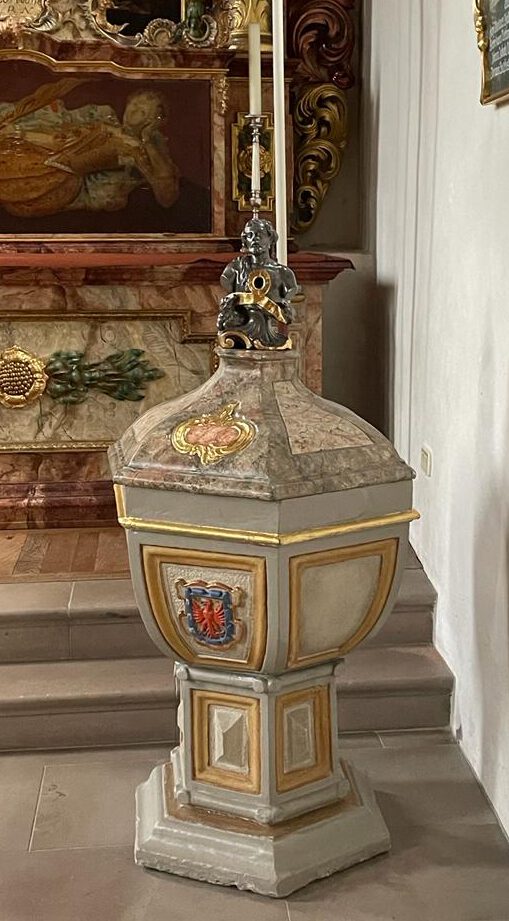
Since 1814, there has been a stone baptismal font in the pilgrimage church. It was made in 1620 and comes from the old, vanished town church in Triberg.
In 1945, at the end of the Second World War (1940-1945), the pilgrimage church was heavily damaged. Repairs and renovation of the interior were completed in 1953.
From 1959, the pilgrimage church ceased to be a parish church, as a new town church, dedicated to the Assumption of Mary, was built in the centre of Triberg.
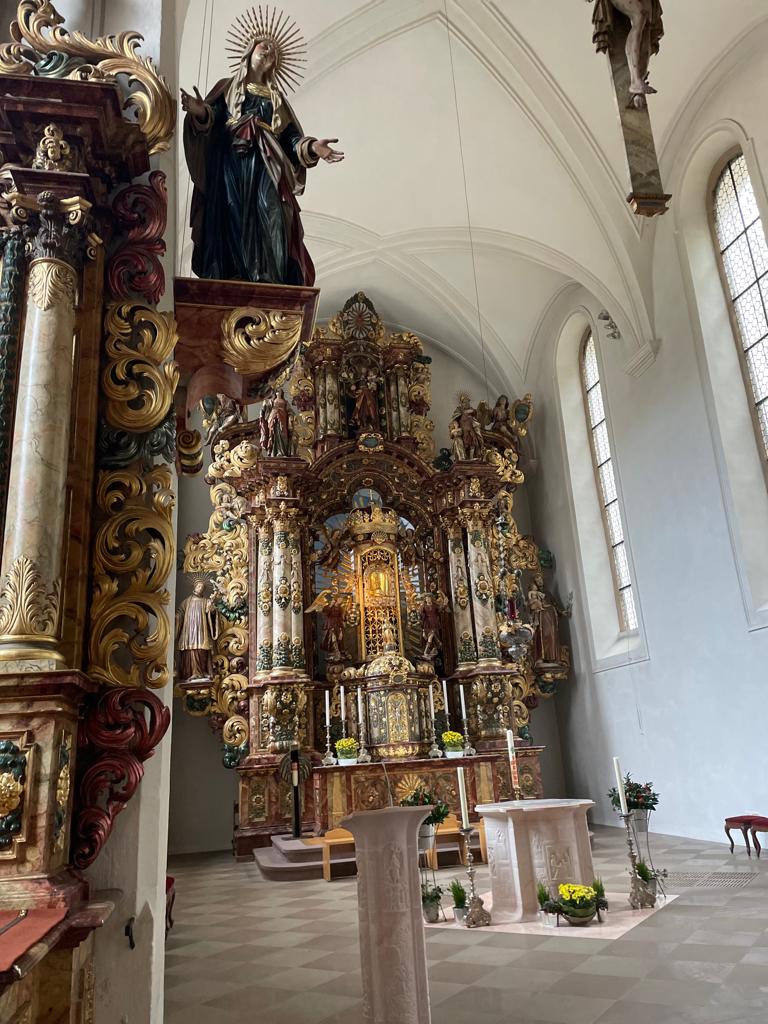
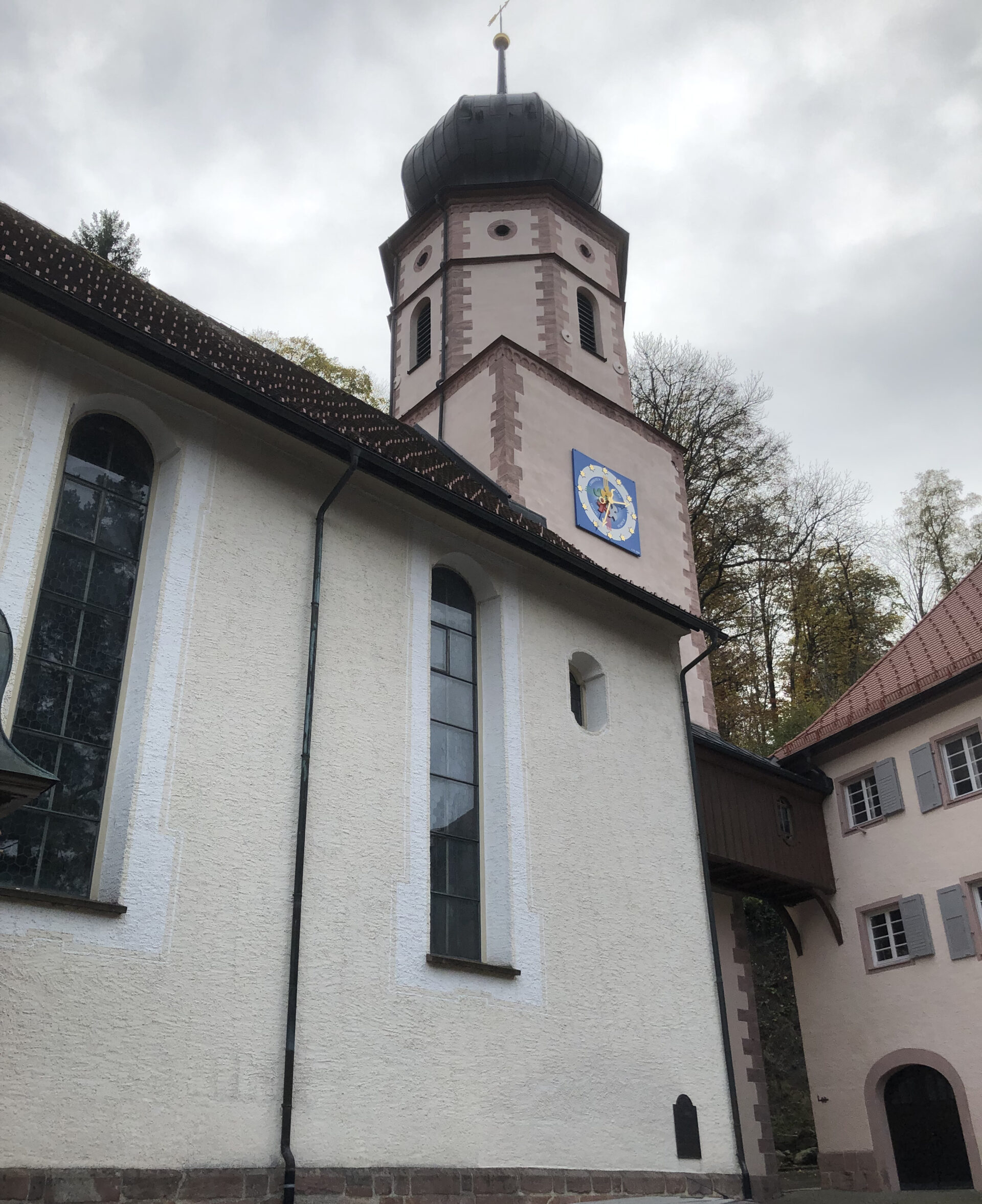
On New Year's Eve 1999 to 2000, a new clock is put into operation in the church tower. In 2000, the chancel is altered and a new altar is installed at the front of the chancel by Elmar Hillebrand (1925-2016) from Cologne. The ambo is also his work.
Pilgrimage site
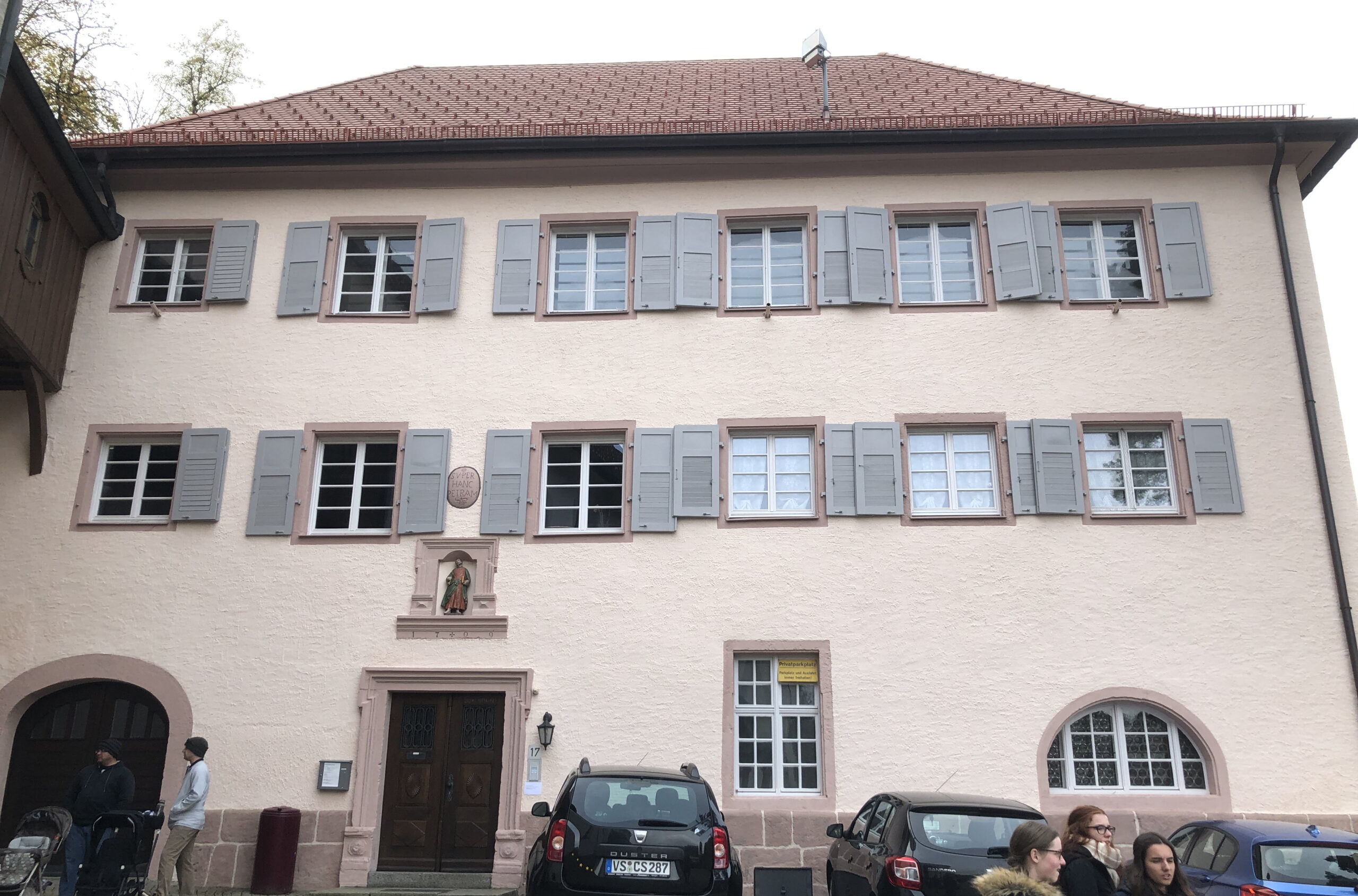
The pilgrimage site in Triberg consists of the pilgrimage church “Maria in der Den”, the sacristan's house and the presbytery.
In the pilgrimage church, behind the statue of grace, is a part of the pine tree trunk, where so much has happened. Pilgrims come here to see and pray before the statue of the Mother of God. The high altar from 1705, by sculptor Joseph Anton Schupp, is also worth a good look. In front of this altar is a small altar table, and this work of art is by sculptor Elmar Hillebrand from the year 2000. The interior of the pilgrimage church is largely in the Baroque style. Baroque is the European style period that began in Italy and lasted in Europe from approximately 1600 to approximately 1750. Baroque is characterised by many forms and expressions of intense emotion.
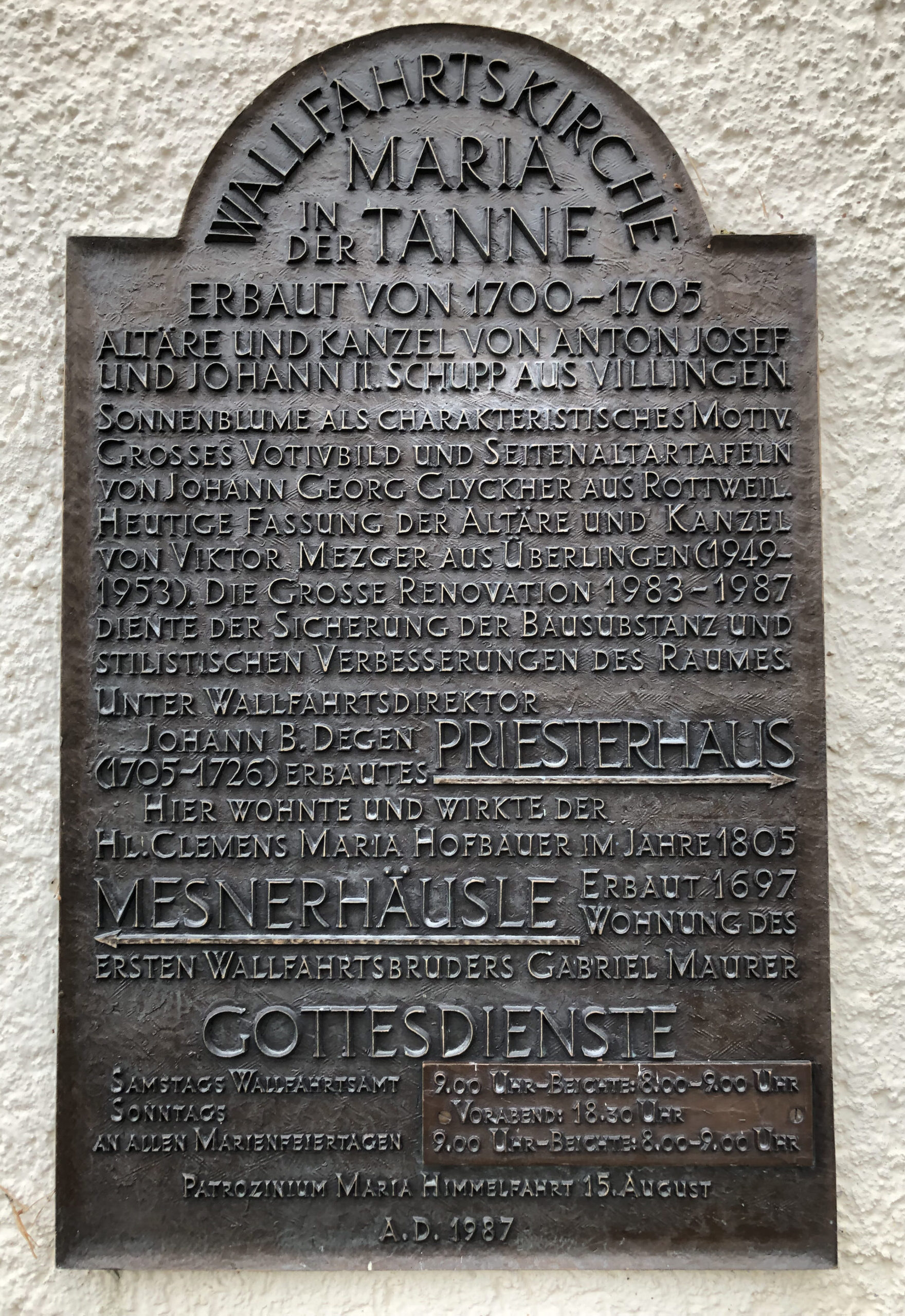
The pilgrimage church has a particularly beautiful interior and is situated against a hill.
ACCESSIBILITY
Triberg is situated on the edge of the Black Forest, not far from the large city of Freiburg im Breisgau, in the state of Baden-Württemberg. The pilgrimage church is located on the old road to Schonach, near the Triberg waterfalls.
The address of the pilgrimage church is:
Rectory “Maria in der Tanne”,
Clemens-Maria-Hofbauer Street 17,
78098 Triberg.
Current information can be found at www.pfarrgemeinde-triberg.de.
Experience
Triberg is a town with around 5,000 inhabitants, and it's not just known for its pilgrimage church. Triberg is also home to the “Schwarzwaldmuseum” (Black Forest Museum), established in 1936. This museum features Black Forest clocks, traditional costumes, wood carvings, craft workshops, mine shafts, musical automatons, and the largest and smallest cuckoo clocks in the world. You can also visit Germany's largest waterfalls here.
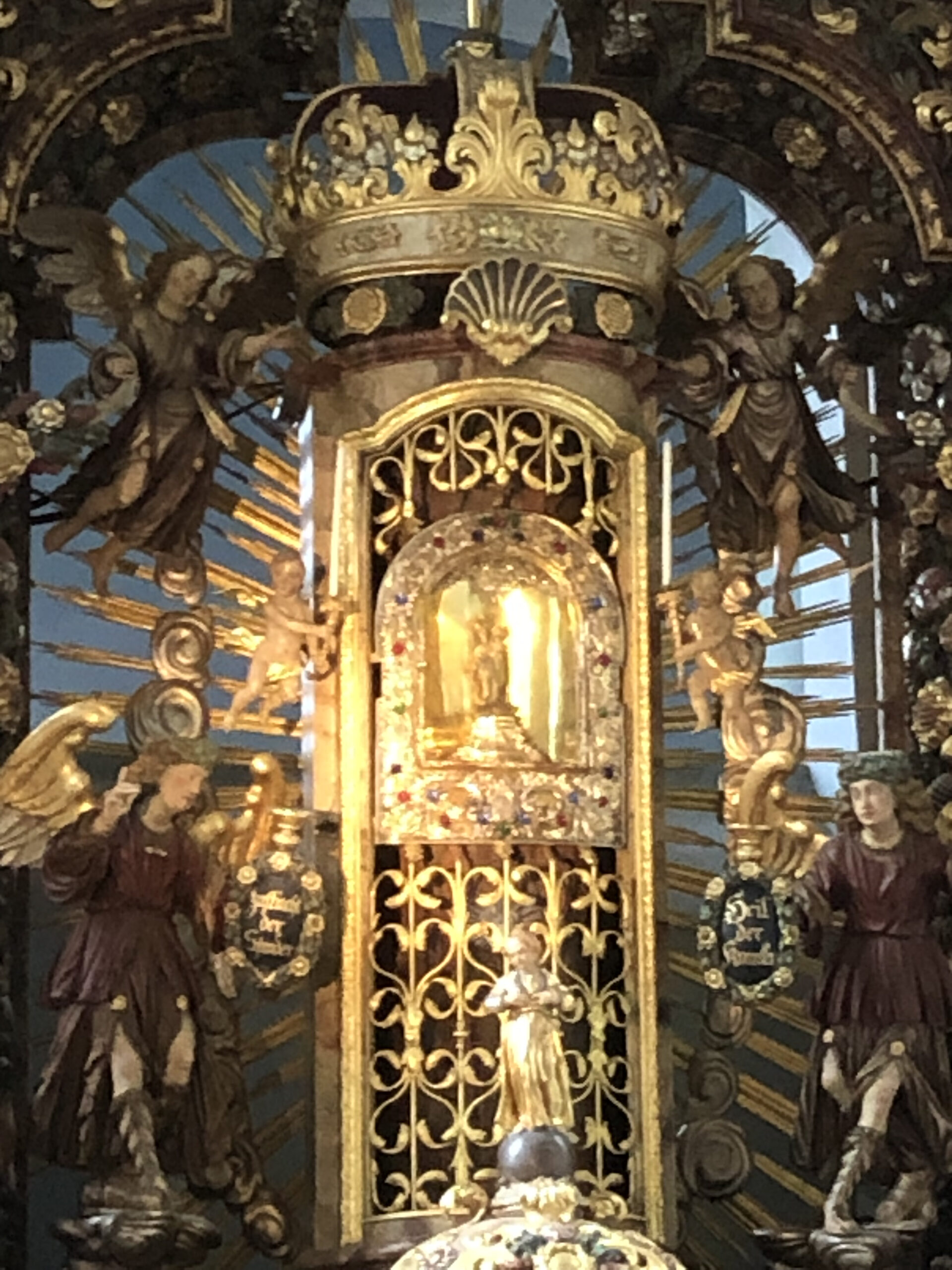
From Triberg, it's an uphill walk and after about 200 metres, the pilgrimage church welcomes the pilgrims. The baroque interior of the church is a true beauty with the special grace image. This image stands in a golden niche in the altar, with behind it the trunk of the pine tree, to which a Mary painting on paper once hung. Miraculous healings have occurred here.
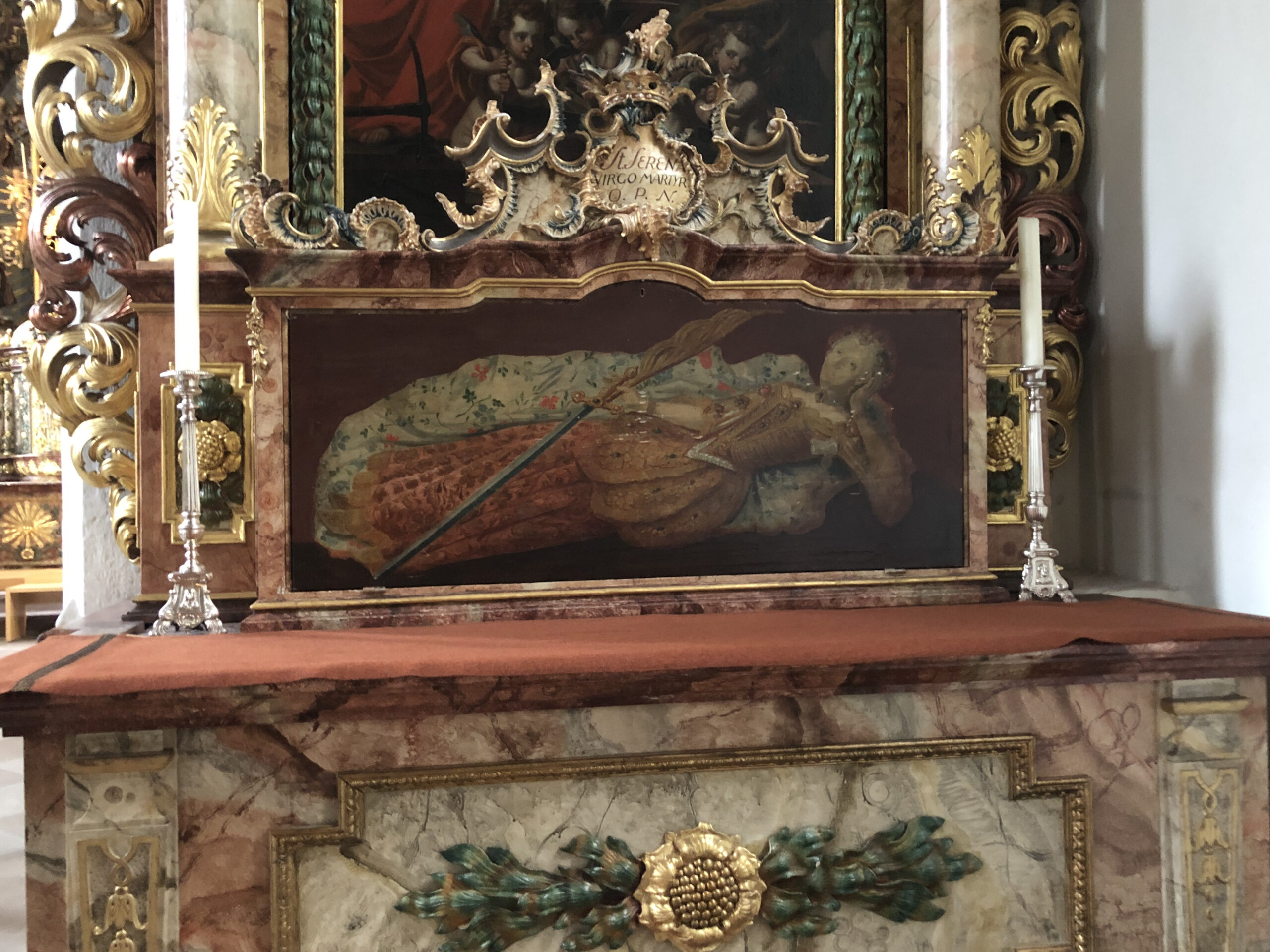
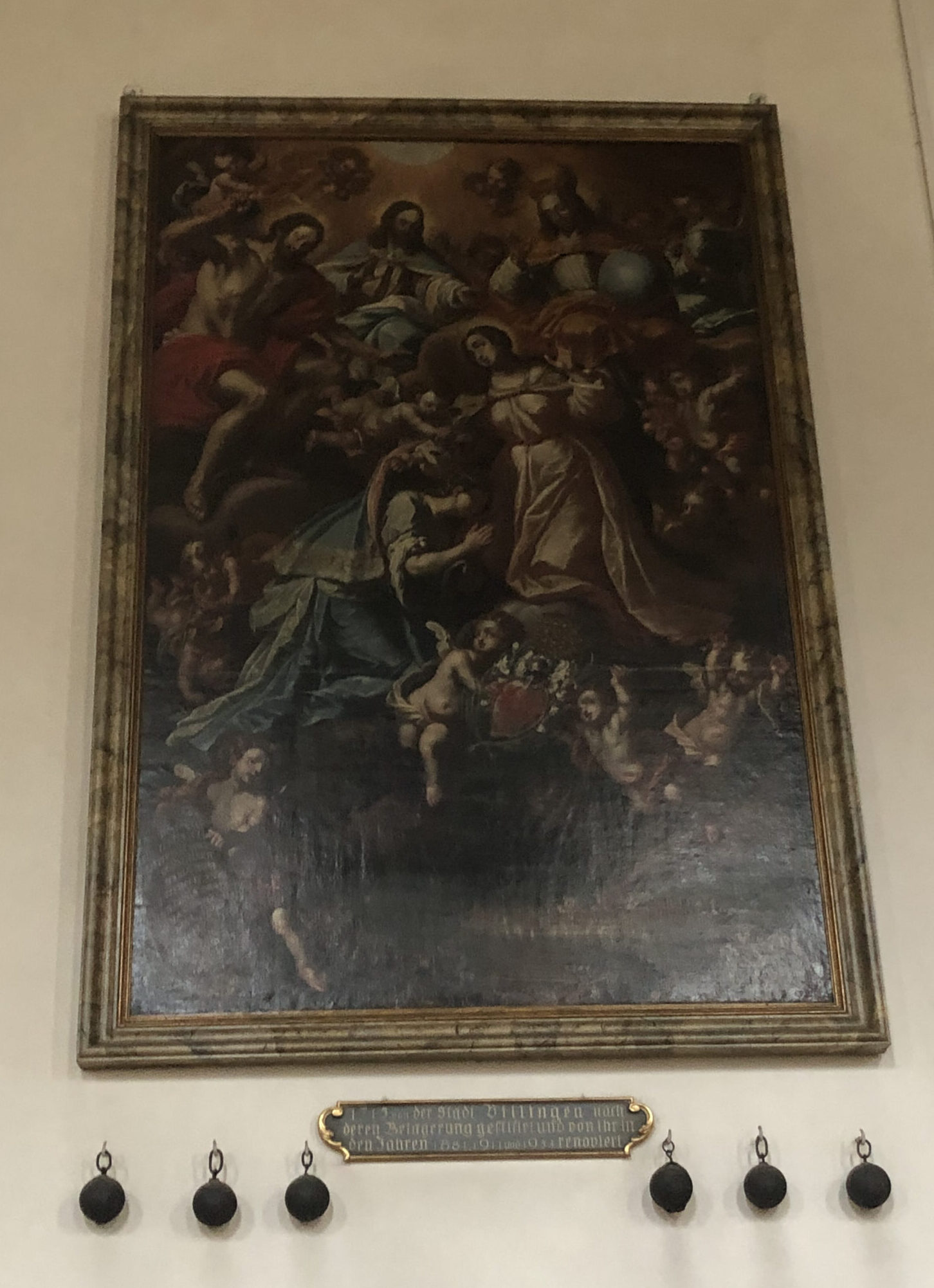
I am told that the reliquary of Saint Serena is opened on feast days. In the church, I also see cannonballs affixed to the wall.
In the church, I also see a leaflet for fundraising, because the pilgrimage church is worth preserving.
Outside the church, on a railing, I see place names and those of Marian apparitions, such as Fátima, Lourdes and Paris. What a gem this pilgrimage church is in the Black Forest.
Posted 3 December 2021
~~~

 Nederlands
  English (UK)
  Deutsch
  Français